Skip to main content
Microeconomics
My Course
Learn
Exam Prep
AI Tutor
Study Guides
Flashcards
Explore
Try the app
My Course
Learn
Exam Prep
AI Tutor
Study Guides
Flashcards
Explore
Try the app
Back
The Demand for Money quiz
You can tap to flip the card.
What does 'money demand' refer to in economics?
You can tap to flip the card.
👆
What does 'money demand' refer to in economics?
Money demand refers to the desire to hold cash rather than invest it, not simply wanting more money.
Track progress
Control buttons has been changed to "navigation" mode.
1/15
Related flashcards
Recommended videos
The Demand for Money definitions
The Demand for Money
15 Terms
02:17
Shifting Money Demand
01:51
Money Demand
Terms in this set (15)
Hide definitions
What does 'money demand' refer to in economics?
Money demand refers to the desire to hold cash rather than invest it, not simply wanting more money.
How does the theory of liquidity relate to money demand?
The theory of liquidity states that interest rates adjust to balance the supply and demand for money.
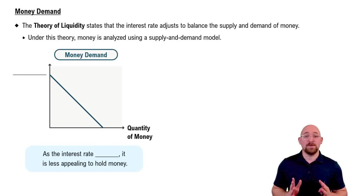
What is represented on the x-axis and y-axis of the money demand graph?
The x-axis shows the quantity of money, and the y-axis shows the interest rate, which is the price of borrowing.
How do rising interest rates affect the demand for holding money?
Rising interest rates decrease the demand for holding money because investing becomes more attractive.
What happens to money demand when interest rates are very low?
When interest rates are low, people are more likely to hold money rather than invest it.
What trade-off do people face regarding money demand?
People must choose between holding money and investing it to earn interest, which creates an opportunity cost.
What does the interest rate represent in the context of money demand?
The interest rate represents the opportunity cost of holding money instead of investing it.
How does a change in interest rate affect the money demand curve?
A change in interest rate causes movement along the money demand curve, not a shift of the curve.
What causes a shift of the money demand curve rather than movement along it?
Factors other than interest rates, such as technological changes or price level changes, cause the money demand curve to shift.
How does easier access to investing (like buying stocks on your phone) affect money demand?
Easier access to investing decreases the demand for holding money, shifting the money demand curve to the left.
What happens to the money demand curve when people want to hold less money due to technological changes?
The money demand curve shifts to the left, indicating a decrease in the quantity demanded for money.
How does an increase in price level (inflation) affect money demand?
An increase in price level causes people to demand more money to cover higher costs, shifting the money demand curve to the right.
What is the effect on money demand when prices rise but interest rates stay the same?
Money demand increases, resulting in a rightward shift of the money demand curve.
What direction does the money demand curve shift when money demand increases?
When money demand increases, the curve shifts to the right.
What direction does the money demand curve shift when money demand decreases?
When money demand decreases, the curve shifts to the left.
 BackBack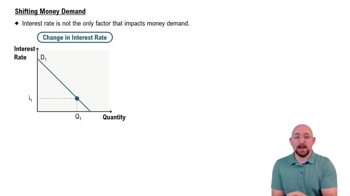
 02:17
02:17