Skip to main content
Microeconomics
My Course
Learn
Exam Prep
AI Tutor
Study Guides
Flashcards
Explore
Try the app
My Course
Learn
Exam Prep
AI Tutor
Study Guides
Flashcards
Explore
Try the app
Back
Taylor Rule definitions
You can tap to flip the card.
Taylor Rule
You can tap to flip the card.
👆
Taylor Rule
A mathematical guideline estimating the central bank's target interest rate using inflation and output gaps.
Track progress
Control buttons has been changed to "navigation" mode.
1/13
Related flashcards
Recommended videos
Taylor Rule quiz
Taylor Rule
15 Terms
Guided course
03:35
Taylor Rule
Guided course
03:35
Taylor Rule
Terms in this set (13)
Hide definitions
Taylor Rule
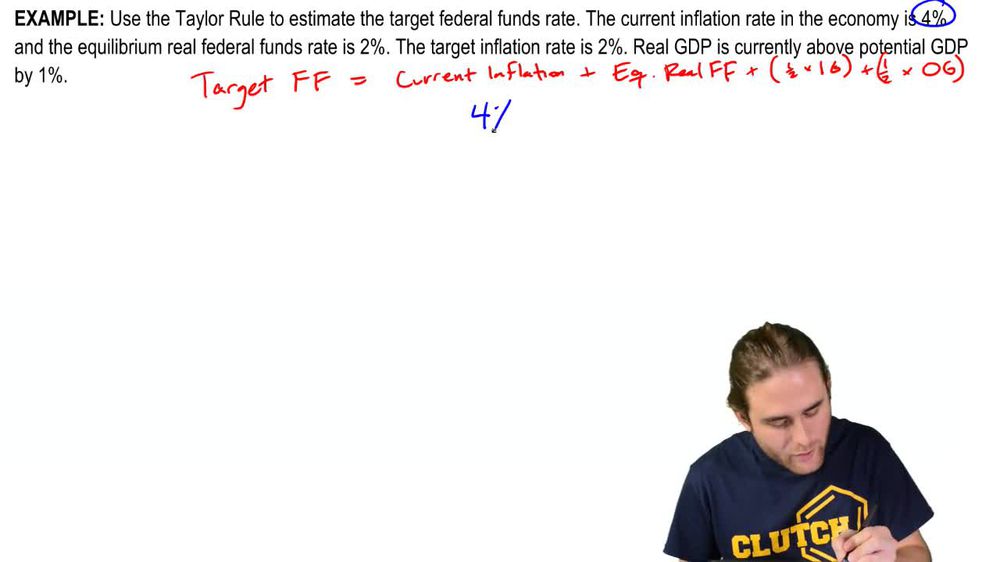
A mathematical guideline estimating the central bank's target interest rate using inflation and output gaps.
Federal Funds Rate
The interest rate charged on overnight loans between banks to meet reserve requirements.
Monetary Policy
Central bank actions influencing money supply and interest rates to stabilize the economy.
Inflation Rate
The percentage change in average prices within an economy over a specific period.
Equilibrium Real Federal Funds Rate
A benchmark interest rate adjusted for inflation, often set at 2% for policy calculations.
Inflation Gap
The difference between current inflation and the central bank's target inflation rate.
Output Gap
The difference between actual GDP and potential GDP, indicating economic slack or overheating.
Potential GDP
The maximum output an economy can achieve without causing inflationary pressures.
Equilibrium Interest Rate
The rate at which money supply and demand balance in the money market.
Reserve Requirements
Regulations mandating banks to hold a minimum amount of funds relative to deposits.
Money Market
A financial market for short-term borrowing and lending, including overnight bank loans.
Target Inflation Rate
The central bank's preferred annual percentage increase in prices, often set at 2%.
Long Run Equilibrium
A state where economic variables, such as interest rates, align with policy targets and potential output.
 BackBack
 03:35
03:35