What is the tax multiplier and how does it affect GDP?
The tax multiplier measures how a change in taxes leads to a change in GDP. A decrease in taxes increases disposable income, boosting consumption and GDP through a chain reaction.
Why is the tax multiplier typically negative?
The tax multiplier is negative because a decrease in taxes increases consumption and GDP, showing an inverse relationship between taxes and GDP.
How does a decrease in taxes impact disposable income?
A decrease in taxes increases disposable income, giving households more money to spend or save.
What is the main difference between the government spending multiplier and the tax multiplier?
The government spending multiplier is usually larger because it involves an initial direct boost in spending, while the tax multiplier is smaller since not all extra disposable income is spent.
How is the tax multiplier calculated?
The tax multiplier is calculated as the change in equilibrium GDP divided by the change in taxes (ΔGDP/ΔTaxes).
Why does the tax multiplier have a smaller magnitude than the government spending multiplier?
Because not all of the extra disposable income from lower taxes is spent; some is saved, leading to a smaller chain reaction in the economy.
What is an automatic stabilizer in fiscal policy?
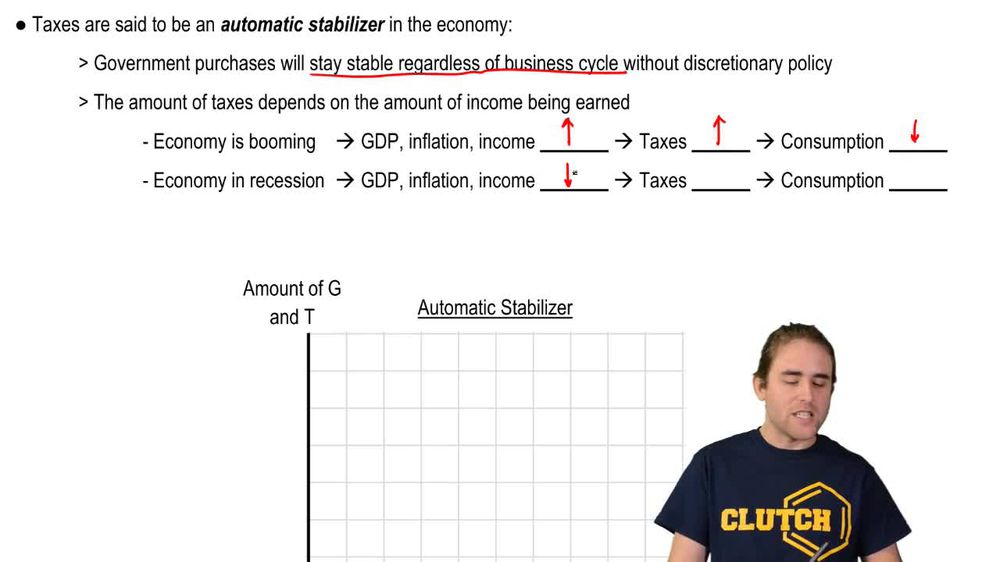
An automatic stabilizer is a feature of fiscal policy that changes automatically with the business cycle, such as taxes increasing during booms and decreasing during recessions.
How do taxes act as an automatic stabilizer during a recession?
During a recession, lower incomes lead to lower taxes, which helps boost consumption and moderate the downturn.
How do taxes act as an automatic stabilizer during an economic boom?
During a boom, higher incomes lead to higher taxes, which reduces consumption and helps prevent the economy from overheating.
Do government purchases act as automatic stabilizers?
No, government purchases generally remain stable unless changed by discretionary policy and do not automatically adjust with the business cycle.
What happens to consumption when taxes decrease?
Consumption increases because households have more disposable income to spend.
What is the chain reaction described by the multiplier effect?
The chain reaction is when increased spending by one person becomes income for another, who then spends part of it, continuing the cycle and amplifying the initial change.
Why does some of the extra disposable income from a tax cut not get spent?
Because households save part of their extra disposable income instead of spending all of it, reducing the overall multiplier effect.
How does the automatic stabilizer affect consumption during a recession?
It helps prevent consumption from falling as much as it otherwise would by reducing taxes and increasing disposable income.
What is the relationship between GDP and taxes in the context of automatic stabilizers?
As GDP rises, taxes collected increase; as GDP falls, taxes collected decrease, helping to stabilize the economy automatically.
 Back
Back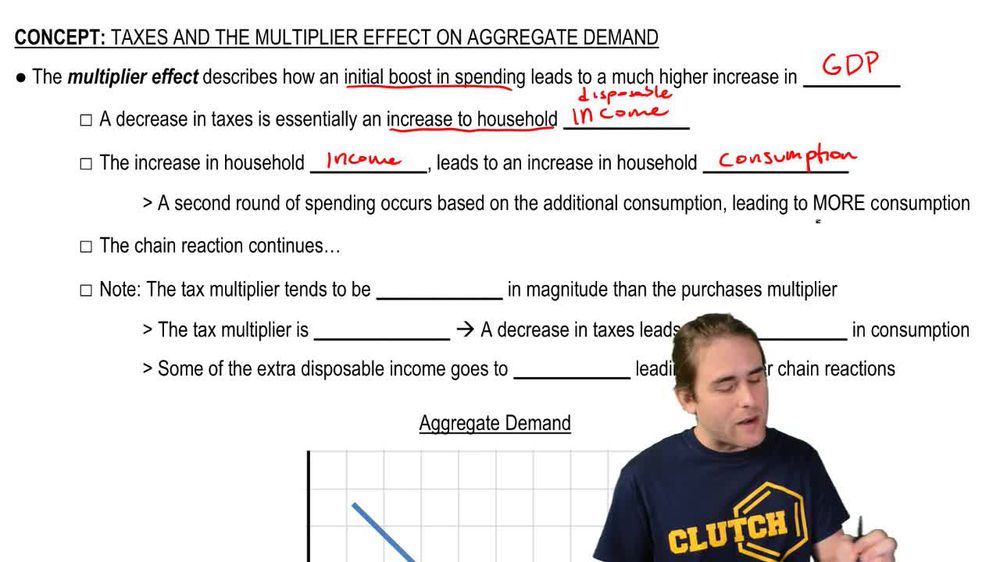
 05:11
05:11