Skip to main content
Microeconomics
My Course
Learn
Exam Prep
AI Tutor
Study Guides
Flashcards
Explore
Try the app
My Course
Learn
Exam Prep
AI Tutor
Study Guides
Flashcards
Explore
Try the app
Back
Scarcity and Choice quiz #4
You can tap to flip the card.
An opportunity cost can make decision making difficult because what?
You can tap to flip the card.
👆
An opportunity cost can make decision making difficult because what?
It requires evaluating what is given up with each choice.
Track progress
Control buttons has been changed to "navigation" mode.
1/40
Related flashcards
Related practice
Recommended videos
Scarcity and Choice quiz #1
Scarcity and Choice
39 Terms
Scarcity and Choice quiz #2
Scarcity and Choice
39 Terms
Scarcity and Choice quiz #3
Scarcity and Choice
39 Terms
Scarcity and Choice
0. Basic Principles of Economics
10 problems
Topic
Marginal Analysis
0. Basic Principles of Economics
9 problems
Topic
0. Basic Principles of Economics
13 topics
14 problems
Chapter
Guided course
02:39
Defining Economic Terms:Scarcity, Trade-offs, and Opportunity Costs
266
views
5
rank
Terms in this set (40)
Hide definitions
An opportunity cost can make decision making difficult because what?
It requires evaluating what is given up with each choice.
Because of differences in opportunity costs, individuals and businesses do what?
Specialize in activities where they have lower opportunity costs.
A _____ is a choice made from available alternatives.
Decision.
Scarcity exists because of what?
Limited resources and unlimited wants.
Opportunity cost is best defined as what?
The value of the next best alternative forgone.
________ is the study of how individuals and societies make choices under the condition of scarcity.
Economics.
Scarcity exists when there are _______ resources available to satisfy all the competing uses.
Insufficient.
A gap between unlimited wants and limited resources creates what?
Scarcity.
Every economic decision has what?
An opportunity cost.
The basic economic problem is what?
Scarcity.
What is a limited resource?
A resource that is not available in sufficient quantity to satisfy all wants.
How would a manufacturer benefit by using fewer scarce resources?
By lowering costs and conserving resources for future use.
_______________ is the value of the best alternative given up when a choice is made.
Opportunity cost.
Because of scarcity, every decision involves a what?
Trade-off.
The opportunity cost of going to college is what?
The income and experience you forgo by not working full-time.
What basic choices are faced by all societies?
What to produce, how to produce, and for whom to produce.
Briefly describe the basic economic problem.
Unlimited wants and limited resources create scarcity, requiring choices.
The opportunity cost of attending college is likely to be highest for a high school graduate who does what?
Has a high-paying job offer.
Scarcity implies that:
Choices must be made among competing uses for resources.
A society's ability to produce needed goods and services is permanently reduced if it does what?
Depletes its scarce resources.
What is the basic economic problem?
Scarcity.
Choosing between spending money on a new suit or a vacation is an example of what?
A trade-off.
Fewer available resources and a lower standard of living are characteristics of what?
Scarcity.
__________ is considered one of the four scarce economic resources.
Land.
Limited quantity item refers to what?
An item that is scarce and not available in unlimited amounts.
Is the act of limiting the types of goods and services produced called what?
Specialization.
Opportunity cost means that something needs to be what?
Given up.
Attending college is a case where the ________________ exceeds the monetary cost.
Opportunity cost.
How does scarcity determine the economic value of an item?
Scarcity increases value because limited supply makes people willing to pay more.
Overpopulation can lead to limited food, immunity, poverty, or competition?
Limited food, poverty, and competition.
As a consequence of the problem of scarcity, what must individuals and societies do?
Make choices and prioritize resource allocation.
When a resource, such as space in the factory, has no alternative use, its opportunity cost is what?
Zero.
In order to compare and evaluate choices, there must be a set of what?
Alternatives.
Without private property rights, people do what?
Have less incentive to conserve and allocate resources efficiently.
Societies embrace various economic systems to deal with the fundamental problem of what?
Scarcity.
What is a consequence of scarcity?
The need to make choices and trade-offs.
Which basic economic question determines how a society will produce goods and services?
How to produce.
What does the video call the things we miss out on as a result of the choices we make?
Opportunity costs.
The phenomenon of scarcity stems from the fact that what?
Resources are limited and wants are unlimited.
A(n) cost is the potential benefit lost by taking an action instead of an alternative action.
Opportunity cost.
 BackBack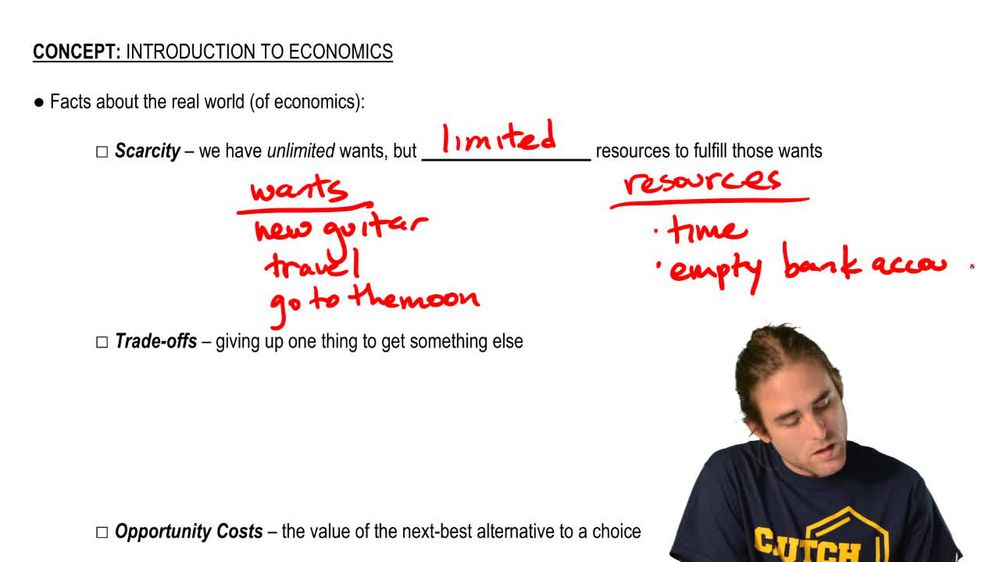
 02:39
02:39