Skip to main content
Microeconomics
My Course
Learn
Exam Prep
AI Tutor
Study Guides
Flashcards
Explore
Try the app
My Course
Learn
Exam Prep
AI Tutor
Study Guides
Flashcards
Explore
Try the app
Back
Sacrifice Ratio quiz
You can tap to flip the card.
What does the sacrifice ratio measure in economics?
You can tap to flip the card.
👆
What does the sacrifice ratio measure in economics?
The sacrifice ratio measures the percentage of GDP lost to reduce inflation by 1%.
Track progress
Control buttons has been changed to "navigation" mode.
1/15
Related flashcards
Recommended videos
Sacrifice Ratio definitions
Sacrifice Ratio
15 Terms
Guided course
08:29
Sacrifice Ratio
Terms in this set (15)
Hide definitions
What does the sacrifice ratio measure in economics?
The sacrifice ratio measures the percentage of GDP lost to reduce inflation by 1%.
How does contractionary monetary policy affect aggregate demand?
Contractionary monetary policy raises interest rates, which lowers aggregate demand.
What is the relationship between nominal interest rate, real interest rate, and expected inflation?
The nominal interest rate equals the real interest rate plus expected inflation.
What happens to the short-run Phillips curve when expected inflation increases?
When expected inflation increases, the short-run Phillips curve shifts to the right.
What is the effect of contractionary monetary policy on unemployment in the short run?
Contractionary monetary policy increases unemployment in the short run.
If GDP falls by 3% to reduce inflation by 1%, what is the sacrifice ratio?
The sacrifice ratio is 3 in this case.
What happens to the short-run Phillips curve when expected inflation decreases in the long run?
The short-run Phillips curve shifts to the left when expected inflation decreases.
Why do banks increase nominal interest rates when expected inflation rises?
Banks increase nominal rates to maintain their desired real return after accounting for higher expected inflation.
What is the immediate effect of contractionary policy on the Phillips curve?
Contractionary policy moves the economy down the short-run Phillips curve, resulting in lower inflation and higher unemployment.
In the long run, what happens to unemployment after expected inflation falls?
Unemployment returns to the natural rate in the long run after expected inflation falls.
What is the trade-off policymakers face when reducing inflation?
Policymakers must accept higher unemployment and lower GDP in the short run to reduce inflation.
How does contractionary monetary policy affect the money supply?
Contractionary monetary policy decreases the money supply.
What happens to investment when interest rates rise due to contractionary policy?
Investment decreases when interest rates rise.
What does the sacrifice ratio tell us about the cost of reducing inflation?
It tells us how much GDP must be sacrificed to lower inflation by 1%.
After contractionary policy and adjustment of expectations, where does the economy settle in the long run?
The economy settles at a lower inflation rate and the natural rate of unemployment in the long run.
 BackBack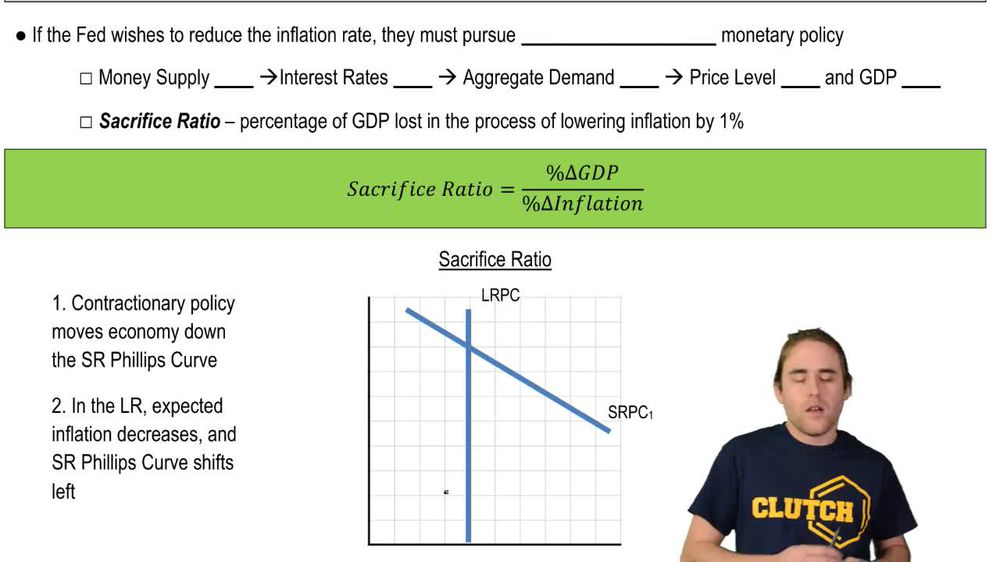
 08:29
08:29