Skip to main content
Microeconomics
My Course
Learn
Exam Prep
AI Tutor
Study Guides
Flashcards
Explore
Try the app
My Course
Learn
Exam Prep
AI Tutor
Study Guides
Flashcards
Explore
Try the app
Back
Risk and Diversification definitions
You can tap to flip the card.
Diversification
You can tap to flip the card.
👆
Diversification
Holding a variety of investments to reduce exposure to risks unique to individual firms, while not eliminating risks affecting the entire market.
Track progress
Control buttons has been changed to "navigation" mode.
1/15
Related flashcards
Recommended videos
Risk and Diversification quiz
Risk and Diversification
15 Terms
Guided course
05:40
Market Risk and Firm-specific Risk
1
views
Guided course
04:01
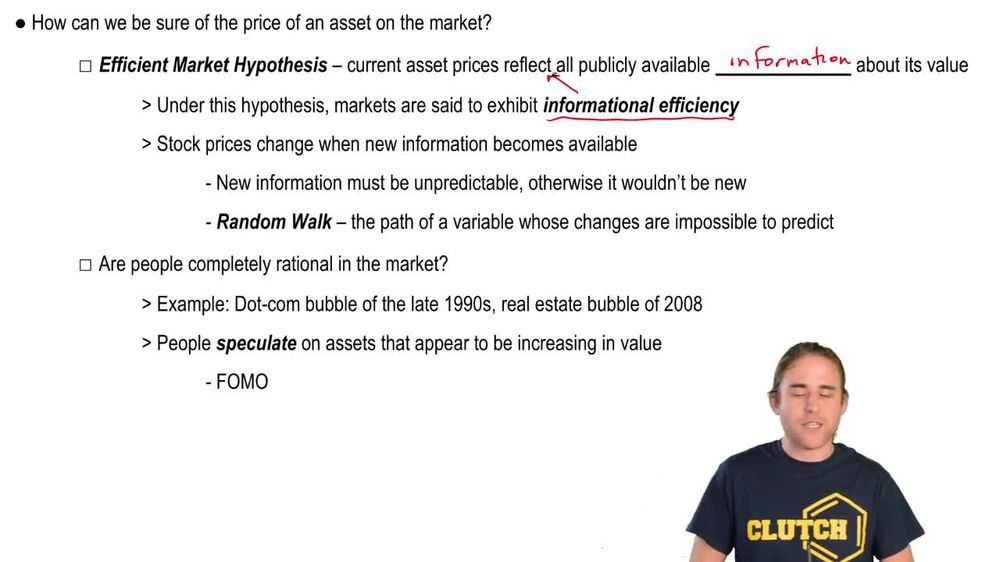
Efficient Markets Theory, Random Walk, and Irrational Behavior
1
views
Terms in this set (15)
Hide definitions
Diversification
Holding a variety of investments to reduce exposure to risks unique to individual firms, while not eliminating risks affecting the entire market.
Firm-specific Risk
Uncertainty impacting only one company, such as changes in its customer base or competition, which can be minimized by spreading investments.
Market Risk
Uncertainty affecting all firms, often caused by events like recessions or wars, which cannot be avoided through spreading investments.
Rate of Return
A measure calculated by dividing the income earned from an investment by its purchase price, reflecting profitability.
Risk-free Rate
The return expected from an investment with virtually no chance of loss, commonly associated with US Treasury bills.
US Treasury Bills
Government-issued securities considered to have minimal risk, often used as a benchmark for risk-free returns.
Dividends
Payments made to shareholders from a company's profits, representing a portion of the income earned from owning stock.
Capital Gains
Profits realized from selling an asset at a higher price than its purchase cost, contributing to investment income.
Interest
Earnings received from lending money or holding bonds, forming part of the income from fixed-income investments.
Efficient Market Hypothesis
A theory stating that asset prices reflect all available information, making future price movements unpredictable.
Informational Efficiency
A condition where asset prices incorporate all publicly available data, ensuring that new information quickly affects values.
Random Walk
A pattern describing unpredictable changes in asset prices, resulting from the arrival of unforeseen information.
Speculation
The act of buying assets with the hope of profiting from price changes, often driven by expectations rather than fundamentals.
Bubble
A situation where asset prices rise rapidly due to excessive demand, often followed by a sharp decline when reality sets in.
Market Equilibrium
A state where asset prices balance supply and demand, influenced by rational and irrational behaviors in financial markets.
 BackBack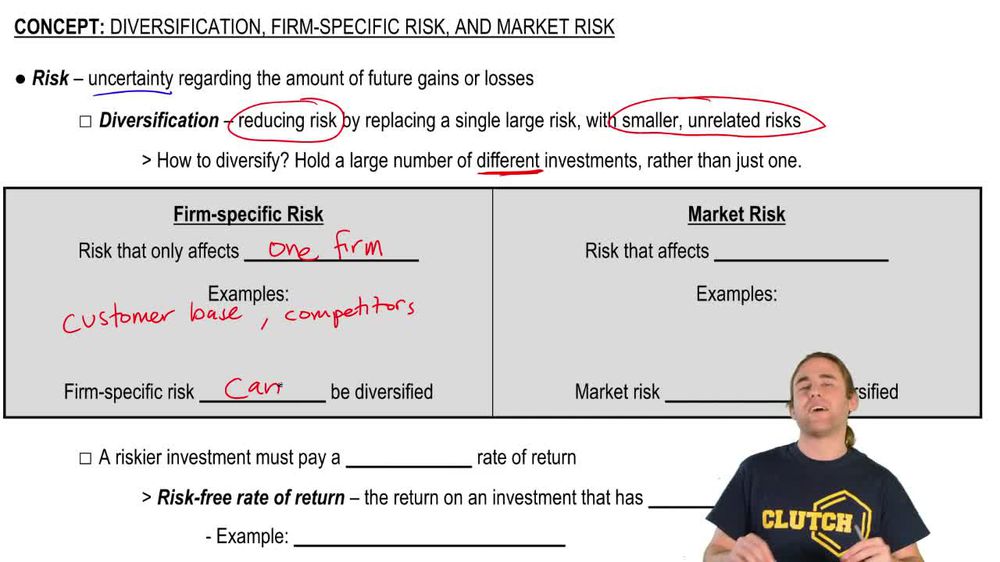
 05:40
05:40