Skip to main content
Microeconomics
My Course
Learn
Exam Prep
AI Tutor
Study Guides
Flashcards
Explore
Try the app
My Course
Learn
Exam Prep
AI Tutor
Study Guides
Flashcards
Explore
Try the app
Back
Revenue in Perfect Competition definitions
You can tap to flip the card.
Total Revenue
You can tap to flip the card.
👆
Total Revenue
Calculated as the product of price and quantity sold, representing all money received by a firm.
Track progress
Control buttons has been changed to "navigation" mode.
1/14
Related flashcards
Related practice
Recommended videos
Revenue in Perfect Competition quiz
Revenue in Perfect Competition
15 Terms
Revenue in Perfect Competition
11. Perfect Competition
10 problems
Topic
Perfect Competition Profit on the Graph
11. Perfect Competition
10 problems
Topic
11. Perfect Competition
11 topics
15 problems
Chapter
Guided course
06:20
Revenue in Perfect Competition
6
views
Guided course
08:15
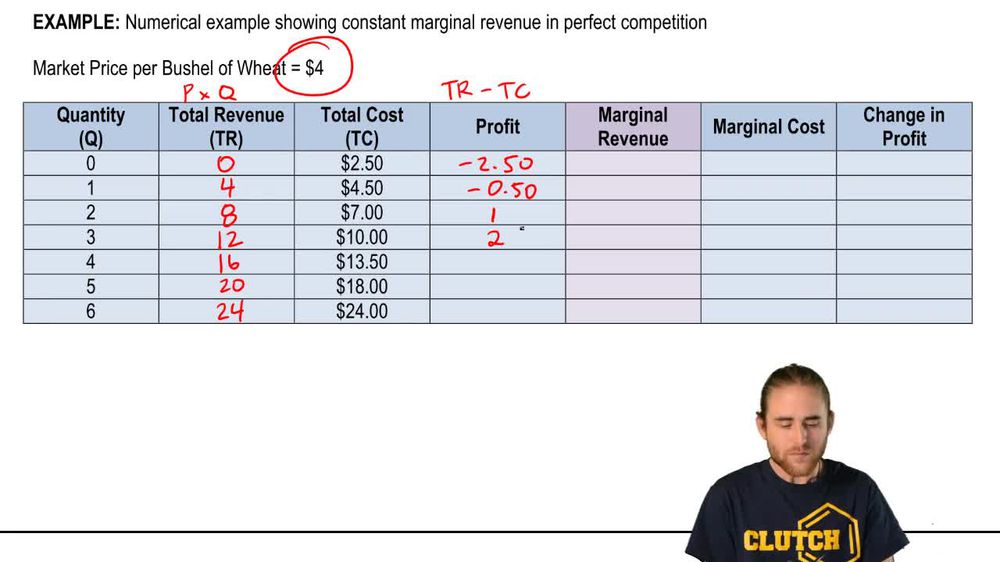
Calculating Profit from a Table
4
views
Terms in this set (14)
Hide definitions
Total Revenue
Calculated as the product of price and quantity sold, representing all money received by a firm.
Average Revenue
Obtained by dividing total revenue by quantity, which simplifies to the price of the product in perfect competition.
Marginal Revenue
Represents the additional money earned from selling one more unit, equal to the price in perfect competition.
Price
The fixed amount set by the market that firms receive for each unit sold in perfect competition.
Quantity
The number of units a firm sells, used to calculate total and average revenue.
Demand Curve
Graphically shows the relationship between price and quantity demanded, coinciding with average revenue in perfect competition.
Perfect Competition
A market structure where firms face a perfectly elastic demand curve and can sell any quantity at the market price.
Marginal Benefit
The extra gain a firm receives from selling one additional unit, reflected in marginal revenue.
Market Structure
The organizational characteristics of a market, influencing how price and revenue relate.
Perfectly Elastic Demand
A situation where firms can sell any quantity at a constant price, resulting in a horizontal demand curve.
Firm
An individual producer in the market, whose revenue depends on price and quantity sold.
Numerical Example
A calculation used to illustrate how revenue concepts operate in practice within perfect competition.
Revenue
The total monetary inflow to a firm from selling its products, central to understanding firm benefits.
Benefits
The positive outcomes for a firm, often measured in terms of revenue received from sales.
 BackBack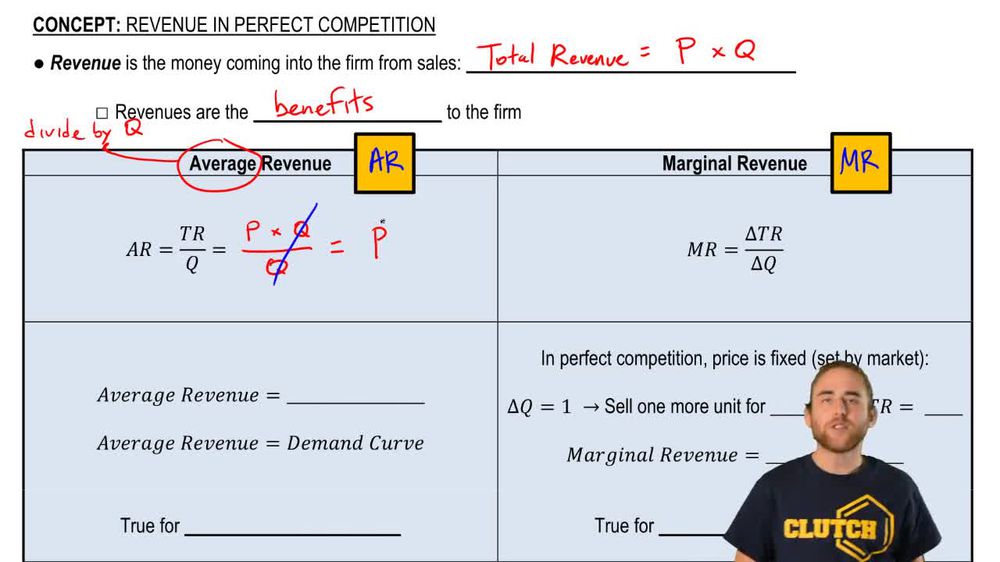
 06:20
06:20