Skip to main content
Microeconomics
My Course
Learn
Exam Prep
AI Tutor
Study Guides
Flashcards
Explore
Try the app
My Course
Learn
Exam Prep
AI Tutor
Study Guides
Flashcards
Explore
Try the app
Back
Revenue in Monopolistic Competition definitions
You can tap to flip the card.
Monopolistic Competition
You can tap to flip the card.
👆
Monopolistic Competition
Market structure with many firms offering differentiated products and facing competition, unlike monopoly.
Track progress
Control buttons has been changed to "navigation" mode.
1/15
Related flashcards
Related practice
Recommended videos
Revenue in Monopolistic Competition quiz
Revenue in Monopolistic Competition
15 Terms
Revenue in Monopolistic Competition
13. Monopolistic Competition
10 problems
Topic
Monopolistic Competition Profit on the Graph
13. Monopolistic Competition
10 problems
Topic
13. Monopolistic Competition
7 topics
15 problems
Chapter
Guided course
03:28
Monopolistic Competition Revenue
4
views
Guided course
07:13
Monopolistic Competition Marginal Revenue
4
views
Terms in this set (15)
Hide definitions
Monopolistic Competition
Market structure with many firms offering differentiated products and facing competition, unlike monopoly.
Demand Curve
Graphical representation showing how quantity demanded changes as price changes, typically downward sloping.
Price Effect
Impact on revenue per unit when price changes, resulting in lower revenue for each unit sold at a reduced price.
Output Effect
Increase in revenue from selling more units when price decreases, counteracting the price effect.
Marginal Revenue
Additional revenue gained from selling one more unit, always less than price in monopolistic competition.
Total Revenue
Overall income from sales, calculated by multiplying price by quantity sold.
Average Revenue
Revenue per unit sold, equal to price and represented by the demand curve in monopolistic competition.
Profit
Financial gain calculated by subtracting total costs from total revenue, determined similarly in monopoly and monopolistic competition.
Marginal Cost
Cost incurred from producing one additional unit, used in profit maximization decisions.
Negative Marginal Revenue
Situation where selling an extra unit reduces total revenue, indicating overproduction.
Differentiation
Distinctive features or attributes that set products apart in monopolistic competition.
Perfect Competition
Market structure where marginal revenue equals price, contrasting with monopolistic competition.
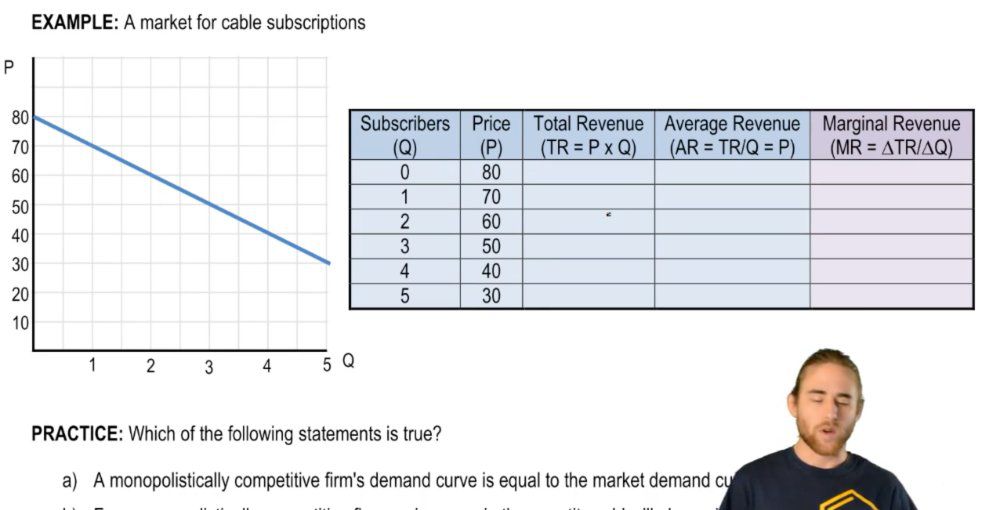
Cable Subscriptions
Example used to illustrate revenue calculations in a monopolistically competitive market.
Revenue Dynamics
Interactions between price, quantity, and effects on total, average, and marginal revenue in market decisions.
Subscriber Numbers
Quantity variable in the example, showing how changes in price affect total and marginal revenue.
 BackBack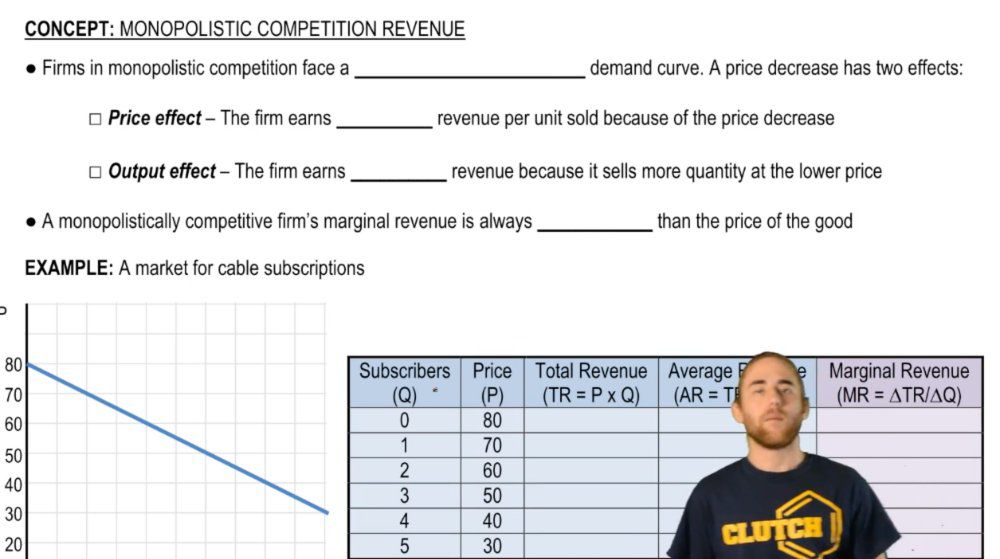
 03:28
03:28