Skip to main content
Microeconomics
My Course
Learn
Exam Prep
AI Tutor
Study Guides
Flashcards
Explore
Try the app
My Course
Learn
Exam Prep
AI Tutor
Study Guides
Flashcards
Explore
Try the app
Back
Revenue, Cost, and Profit definitions
You can tap to flip the card.
Revenue
You can tap to flip the card.
👆
Revenue
Amount received from sales, representing the inflow of money to a firm, calculated as price times quantity sold.
Track progress
Control buttons has been changed to "navigation" mode.
1/17
Related flashcards
Related practice
Recommended videos
Revenue, Cost, and Profit quiz #1
Revenue, Cost, and Profit
14 Terms
Revenue, Cost, and Profit
10. The Costs of Production
10 problems
Topic
The Production Function and Diminishing Returns
10. The Costs of Production
10 problems
Topic
10. The Costs of Production
9 topics
15 problems
Chapter
Guided course
05:51
Explicit and Implicit Cost
5
views
Guided course
07:54
Fixed Costs and Variable Costs; Short Run and Long Run
4
views
Guided course
01:59
Accounting Profit and Economic Profit
4
views
Terms in this set (17)
Hide definitions
Revenue
Amount received from sales, representing the inflow of money to a firm, calculated as price times quantity sold.
Total Revenue
Sum of all money earned from sales, found by multiplying the selling price by the number of units sold.
Cost
Value of inputs used in production, representing the outflow of resources necessary to create output.
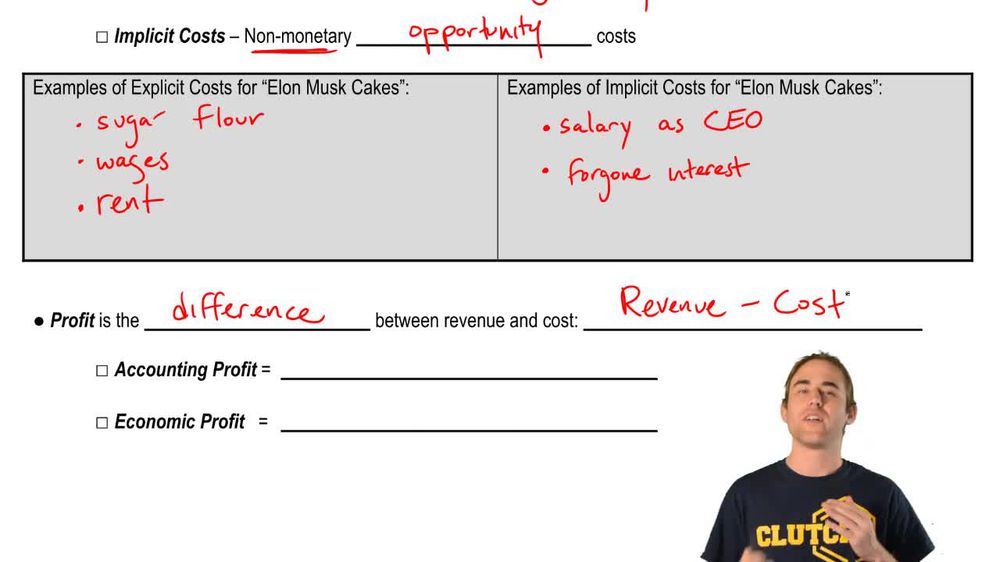
Explicit Cost
Direct monetary expenditure, such as wages or rent, easily observed as money leaving the firm.
Implicit Cost
Non-monetary opportunity cost, like foregone salary or interest, reflecting benefits sacrificed without cash payment.
Opportunity Cost
Value of the next best alternative forgone when a decision is made, including both monetary and non-monetary sacrifices.
Profit
Difference between revenue and cost, representing what remains after all expenses are subtracted from sales income.
Accounting Profit
Amount left after subtracting explicit costs from revenue, focusing only on direct monetary expenses.
Economic Profit
Amount left after subtracting both explicit and implicit costs from revenue, reflecting true opportunity costs.
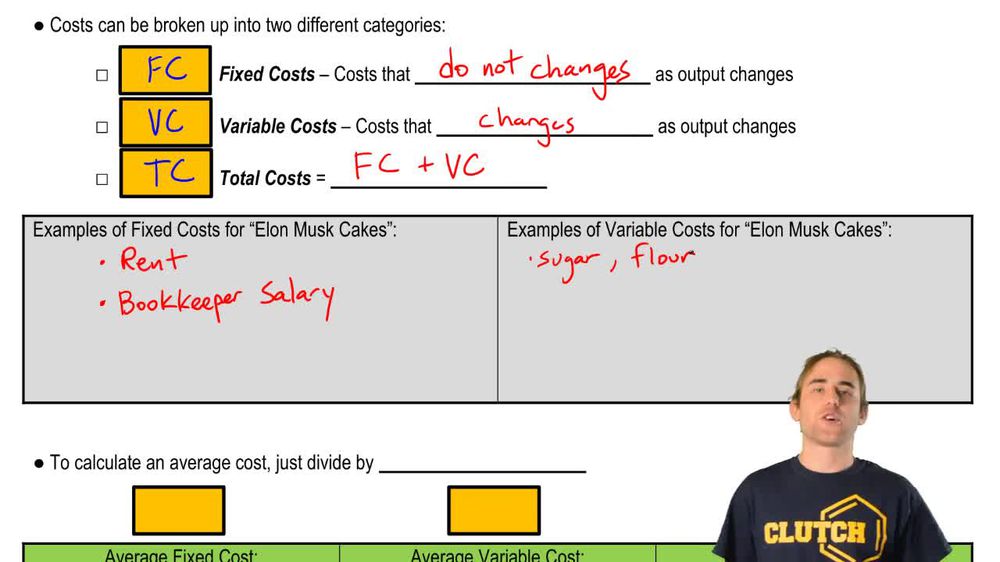
Fixed Cost
Expense that remains unchanged regardless of output level, such as rent or salaried employees.
Variable Cost
Expense that changes with output, including items like raw materials and day laborers.
Total Cost
Sum of fixed and variable costs, representing all expenses incurred in production.
Average Fixed Cost
Fixed cost per unit of output, calculated by dividing total fixed cost by the quantity produced.
Average Variable Cost
Variable cost per unit of output, found by dividing total variable cost by the number of units produced.
Average Total Cost
Total cost per unit, determined by dividing total cost by output or by adding average fixed and average variable costs.
Short Run
Time period in which at least one cost is fixed, limiting a firm's ability to adjust all inputs.
Long Run
Time period when all costs become variable, allowing full adjustment of business operations and inputs.
 BackBack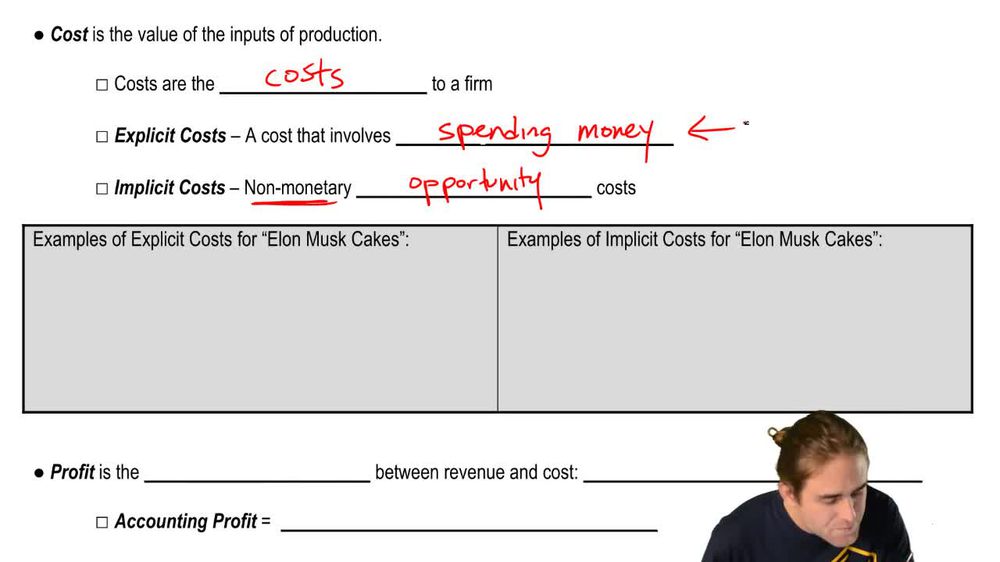
 05:51
05:51