Back

Quantitative Analysis of Price Ceilings and Price Floors: Finding Points definitions

Control buttons has been changed to "navigation" mode.
1/15
  • Price Ceiling

    A maximum allowable price set below equilibrium, causing increased demand and decreased supply in the market.
  • Price Floor

    A minimum allowable price set above equilibrium, resulting in altered market supply and demand.
  • Equilibrium Price

    The market price where quantity demanded equals quantity supplied, ensuring no shortage or surplus.
  • Equilibrium Quantity

    The market quantity where demand and supply are balanced, with no excess or deficit.
  • Quantity Demanded

    The total units consumers are willing to purchase at a specific price, influenced by price controls.
  • Quantity Supplied

    The total units producers are willing to offer at a specific price, affected by price regulations.
  • Shortage

    A market condition where demand exceeds supply, often caused by an effective price ceiling.
  • Surplus

    A market condition where supply exceeds demand, typically resulting from an effective price floor.
  • Demand Curve

    A graphical representation showing the relationship between price and quantity consumers desire.
  • Supply Curve

    A graphical representation illustrating the relationship between price and quantity producers offer.
  • Effective Price Ceiling

    A price restriction set below equilibrium, actively impacting market outcomes and creating shortages.
  • Effective Price Floor

    A price restriction set above equilibrium, actively influencing market outcomes and causing surpluses.
  • Rental Market

    A market context used to illustrate price controls, involving housing units and their prices.
  • Algebraic Equation

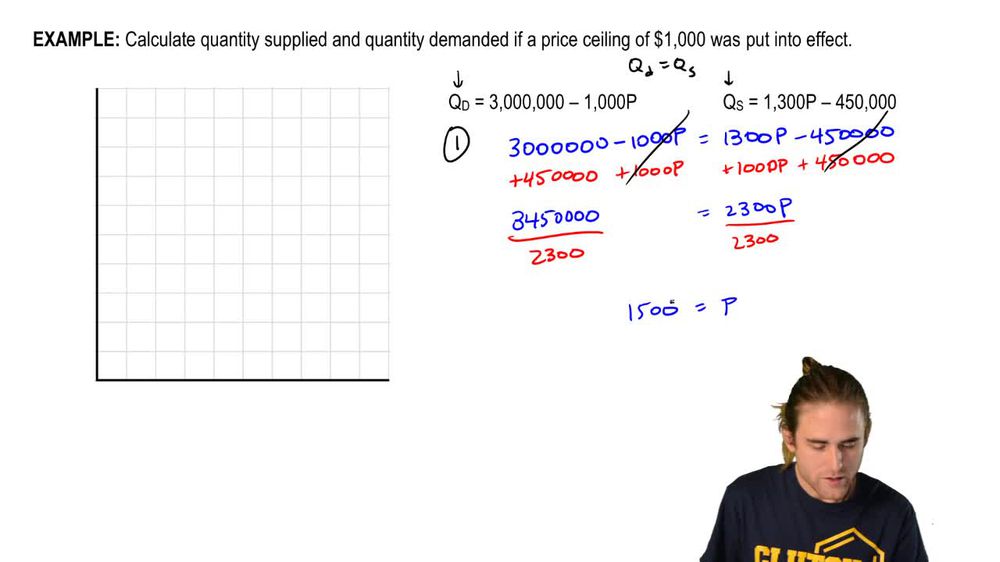
    A mathematical expression used to calculate market quantities under price controls.
  • Graph

    A visual tool for analyzing market equilibrium and effects of price ceilings or floors.