Skip to main content
Microeconomics
My Course
Learn
Exam Prep
AI Tutor
Study Guides
Flashcards
Explore
Try the app
My Course
Learn
Exam Prep
AI Tutor
Study Guides
Flashcards
Explore
Try the app
Back
Monopolistic Competition Profit on the Graph definitions
You can tap to flip the card.
Monopolistic Competition
You can tap to flip the card.
👆
Monopolistic Competition
A market structure with many firms, differentiated products, and separate marginal revenue and demand curves.
Track progress
Control buttons has been changed to "navigation" mode.
1/14
Related flashcards
Related practice
Recommended videos
Monopolistic Competition Profit on the Graph quiz #1
Monopolistic Competition Profit on the Graph
10 Terms
Monopolistic Competition Profit on the Graph
13. Monopolistic Competition
10 problems
Topic
Monopolistic Competition in the Long Run
13. Monopolistic Competition
10 problems
Topic
13. Monopolistic Competition
7 topics
15 problems
Chapter
Guided course
07:07
Monopolistic Competition Profit on the Graph
4
views
Terms in this set (14)
Hide definitions
Monopolistic Competition
A market structure with many firms, differentiated products, and separate marginal revenue and demand curves.
Profit Maximizing Quantity
The output level where marginal revenue and marginal cost intersect, ensuring maximum profit or minimum loss.
Marginal Revenue
The additional income from selling one more unit, always below the demand curve in this market structure.
Marginal Cost
The extra expense incurred from producing one additional unit, used to determine optimal output.
Demand Curve
A graphical representation showing the relationship between price and quantity demanded at each price point.
Average Total Cost
The per-unit expense of production, found on its own curve and used to calculate profit or loss.
Profit
The area between price and average total cost at the optimal output, calculated for all units produced.
Loss
Occurs when average total cost exceeds price at the optimal output, represented by the area between curves.
Loss Minimizing Quantity
The output level where the difference between average total cost and price is smallest, reducing losses.
Price
The value at which goods are sold, determined from the demand curve at the optimal output.
Graphical Representation
A visual tool displaying curves for demand, marginal revenue, and average total cost to analyze profit and loss.
Perfect Competition
A market structure where profit and loss calculations use the same formula, but curves overlap differently.
Rectangle Area
The space between price and average total cost at the optimal output, used to measure profit or loss.
Intersection
The point where marginal revenue and marginal cost curves meet, indicating optimal output.
 BackBack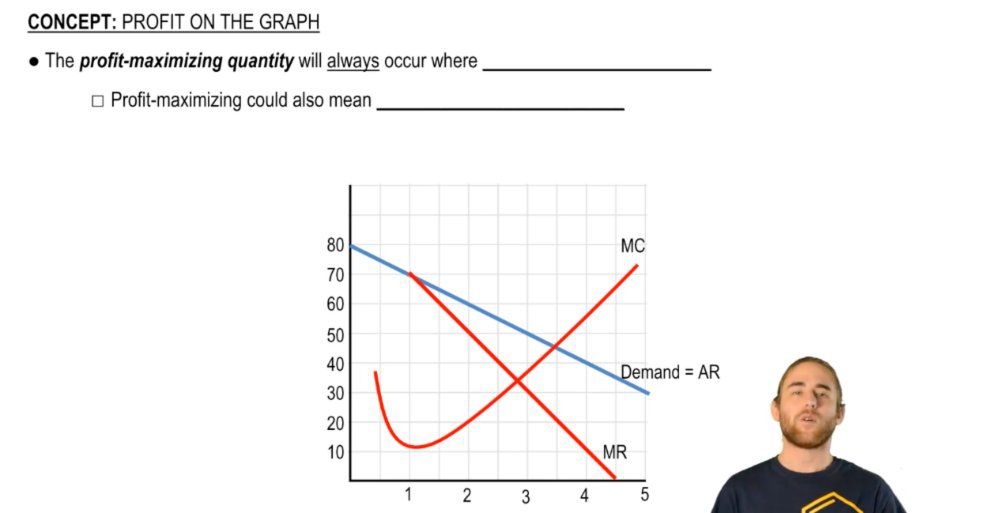
 07:07
07:07