Productivity is the amount of goods and services produced from each unit of labor. It measures how efficiently labor is used to generate output.
Name the three main factors that determine productivity.
The three main factors are physical capital per worker, human capital, and the level of technology.
What is physical capital, and how does it affect productivity?
Physical capital includes tools, machinery, and structures that help workers produce goods and services. More physical capital per worker increases productivity.
How can physical capital be used to create more physical capital?
Physical capital, like machines, can be used in factories to produce more machines or tools, thus increasing the overall stock of capital and productivity.
Define human capital and explain its role in productivity.
Human capital is the knowledge and skills of the workforce. Higher human capital means workers are better trained and educated, leading to higher productivity.
How is human capital increased in an economy?
Human capital is increased by investing resources in education and training, which improves workers' skills and knowledge over time.
What is the per worker production function?
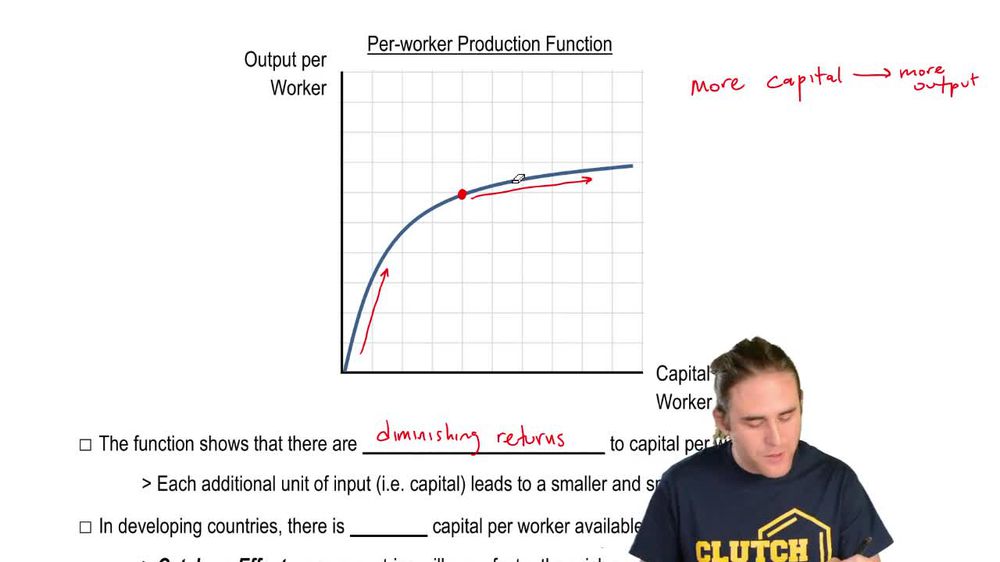
The per worker production function shows the relationship between physical capital per worker and output per worker, illustrating how output changes as capital increases.
What does the per worker production function demonstrate about returns to capital?
It demonstrates diminishing returns to capital, meaning that each additional unit of capital increases output by a smaller amount than the previous unit.
Explain the concept of diminishing returns to capital.
Diminishing returns to capital means that as more capital is added, the increase in output from each additional unit of capital becomes smaller.
What is the catch-up effect in economic growth?
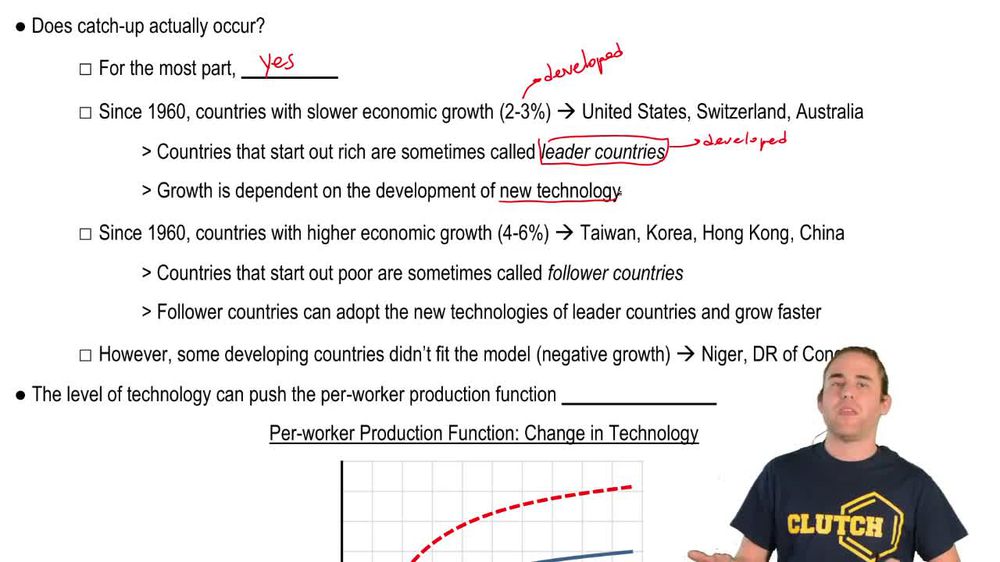
The catch-up effect is when poorer (developing) countries grow faster than richer (developed) countries because they can gain more from each additional unit of capital.
Why do developing countries often experience faster economic growth than developed countries?
Developing countries have less capital per worker, so investments in capital yield larger increases in output compared to developed countries.
What are 'leader countries' and 'follower countries' in the context of economic growth?
Leader countries are developed countries that innovate new technologies, while follower countries are developing countries that adopt these technologies to grow faster.
How does technological advancement affect the per worker production function?
Technological advancement shifts the per worker production function outward, making each unit of capital more productive and increasing output at every level of capital.
Why is technological progress important for sustaining economic growth in developed countries?
Because of diminishing returns to capital, developed countries rely on technological progress to continue increasing productivity and sustaining economic growth.
Give an example of how developing countries can leapfrog technologies to boost productivity.
Some African countries skipped building landline infrastructure and adopted cell phones directly, allowing them to quickly improve communication and productivity.
 Back
Back
 06:37
06:37