Back

Price Ceilings, Price Floors, and Black Markets quiz #1

Control buttons has been changed to "navigation" mode.
1/36
  • What is the difference between a price floor and a price ceiling?

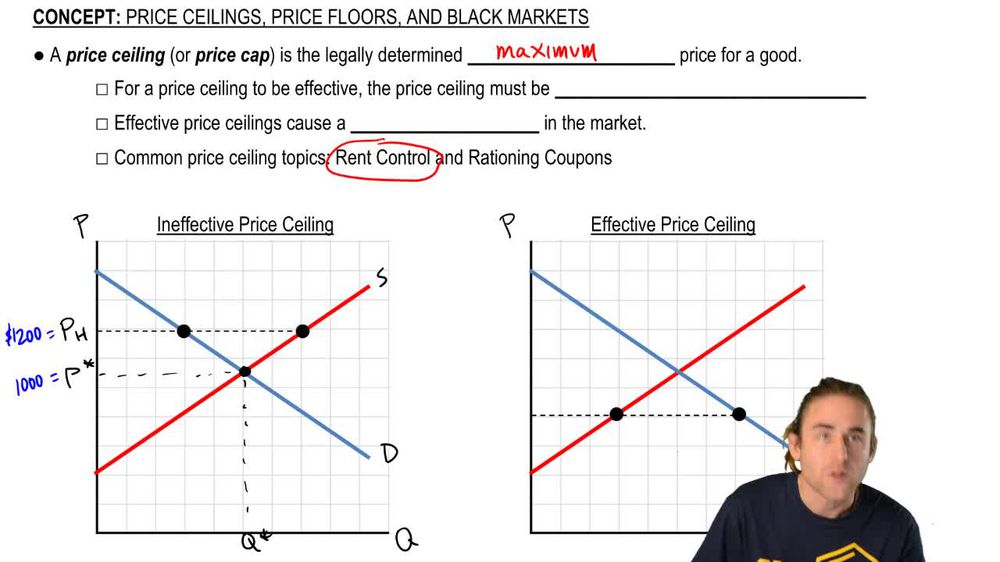
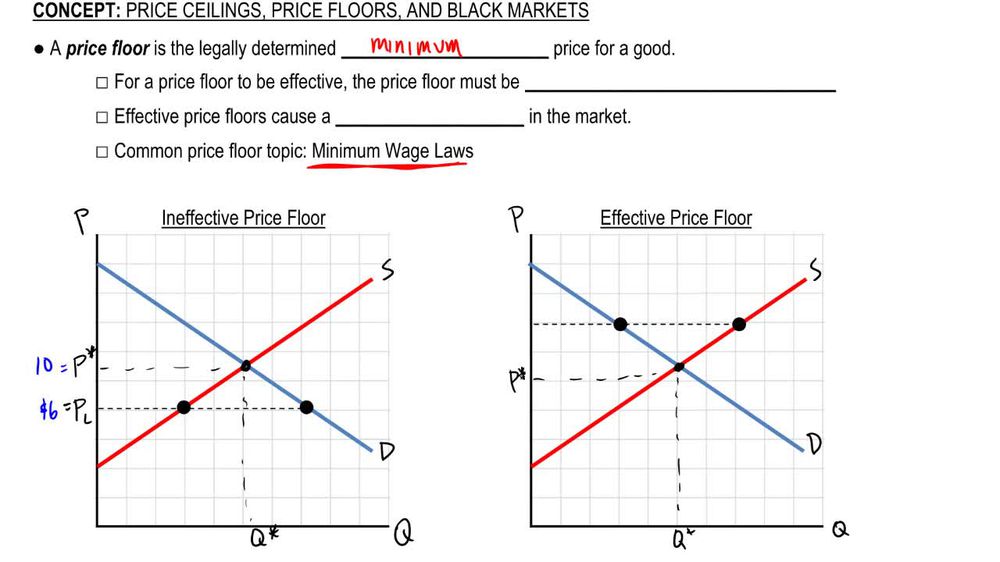
    A price ceiling is a government-imposed maximum price, while a price floor is a government-imposed minimum price.
  • How do regulations on prices affect business practices?

    Price regulations can lead to shortages or surpluses, affecting production, hiring, and market strategies.
  • What are the results of the imposition of rent controls?

    Rent controls, a type of price ceiling, often lead to shortages of rental units and reduced incentives for landlords to maintain properties.
  • Which point on a supply and demand graph shows minimum wage as the price floor?

    The point above the equilibrium price where the price floor is set represents minimum wage.
  • On which kinds of goods do governments generally place price ceilings?

    Governments typically place price ceilings on essential goods like housing and basic food items.
  • Can prices be set too low by government intervention?

    Yes, if a price ceiling is set below equilibrium, it can cause shortages.
  • What happens when a price ceiling is set below equilibrium?

    Price ceilings set below equilibrium cause shortages; those above equilibrium have no effect.
  • What are some unintended effects of rent control?

    Unintended effects include housing shortages, reduced maintenance, and black markets.
  • What are the effects of a government setting maximum prices below equilibrium?

    Setting maximum prices below equilibrium leads to shortages and possible black markets.
  • Who is likely to be in favor of a price ceiling on a good?

    Consumers who want lower prices are likely to favor price ceilings.
  • Who sets the price ceiling for a product's pricing?

    The government sets the price ceiling.
  • What is a potential problem with a high-low pricing strategy in regulated markets?

    It may conflict with price controls, leading to legal issues or market distortions.
  • Which types of goods and services do price ceilings typically affect?

    Price ceilings typically affect essential goods and services.
  • What is true about a binding price ceiling?

    A binding price ceiling is set below equilibrium and causes a shortage.
  • What would be true in a city with rent-controlled apartments?

    There would likely be a shortage of available apartments.
  • What is an example of price gouging?

    Charging excessively high prices for goods during emergencies, above legal limits.
  • Consider the graph. What is the deadweight loss associated with the price floor?

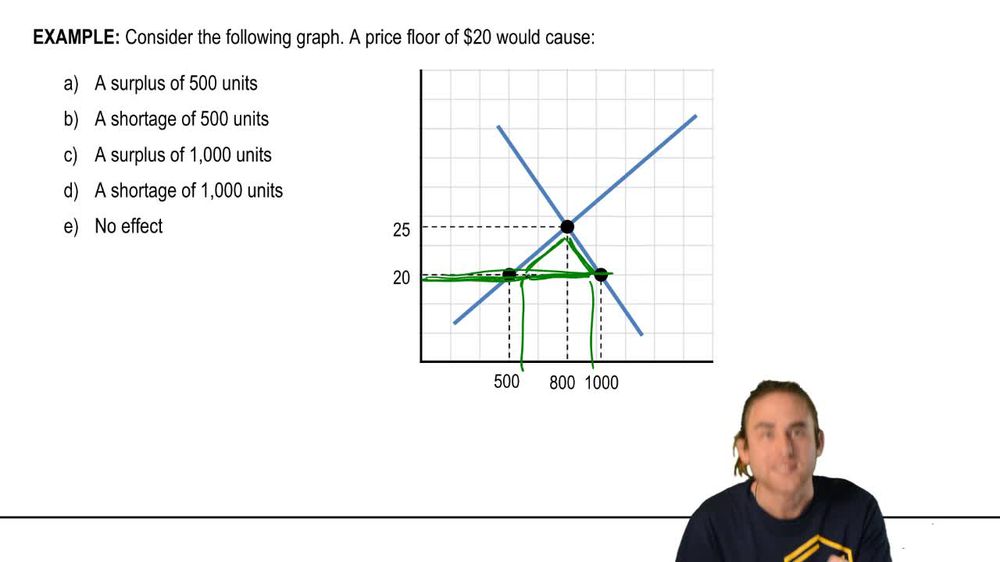
    Deadweight loss is the lost economic efficiency due to the surplus created by the price floor.
  • What is the deadweight loss associated with the price floor?

    It is the reduction in total surplus caused by the surplus of goods or labor.
  • What might cause the real value of money to rise in an economy?

    A decrease in the price level or inflation rate.
  • What is a consequence of a binding price ceiling?

    A binding price ceiling leads to shortages and possible black markets.
  • What is the consequence of a nonbinding price floor?

    It has no effect on the market; transactions continue at equilibrium.
  • How can the risk of price escalation be addressed?

    Government intervention through price ceilings or floors.
  • Which transaction fails to produce gains from trade for both buyers and sellers?

    Transactions prevented by binding price controls fail to produce gains from trade.
  • Why are binding price floor laws passed?

    To ensure minimum income for producers or workers, such as minimum wage laws.
  • Under what condition might a government impose a price ceiling?

    If prices are considered too high for essential goods, causing affordability issues.
  • What quantity will the sellers be able to sell after the imposition of the price floor?

    Sellers can only sell up to the quantity demanded at the price floor, which is less than the quantity supplied.
  • How has the international community sought to reduce the negative effects of price floors?

    By implementing subsidies or purchasing surpluses to support affected markets.
  • Why does a rationing system often result in the formation of black markets?

    Because shortages create unmet demand, leading people to trade illegally.
  • Who among the following benefits the most from rent control?

    Tenants who secure apartments at the controlled rent benefit most.
  • What does not result from a price ceiling set below the equilibrium price?

    A surplus would not result; instead, a shortage occurs.
  • Which tax has a ceiling on the amount of annual earnings subject to tax?

    Social Security payroll tax has a ceiling on taxable earnings.
  • What motivates producers and consumers in the black market?

    Unmet demand and supply due to price controls motivate black market activity.
  • Who sets the upper limit for a product's pricing?

    The government sets the upper limit through price ceilings.
  • What is an example of a cost-oriented price setting approach?

    Setting prices based on production costs plus a markup.
  • In which type of economy would prices be set by the government?

    In a command or centrally planned economy.
  • In reference pricing, what is used as a benchmark?

    A standard or competitor's price is used as a benchmark.