Skip to main content
Microeconomics
My Course
Learn
Exam Prep
AI Tutor
Study Guides
Flashcards
Explore
Try the app
My Course
Learn
Exam Prep
AI Tutor
Study Guides
Flashcards
Explore
Try the app
Back
PPF - Increasing Marginal Opportunity Costs and Allocative Efficiency definitions
You can tap to flip the card.
Production Possibility Frontier
You can tap to flip the card.
👆
Production Possibility Frontier
A curve showing all combinations of two goods that can be produced using available resources efficiently.
Track progress
Control buttons has been changed to "navigation" mode.
1/15
Related flashcards
Related practice
Recommended videos
PPF - Increasing Marginal Opportunity Costs and Allocative Efficiency quiz #1
PPF - Increasing Marginal Opportunity Costs and Allocative Efficiency
11 Terms
PPF - Increasing Marginal Opportunity Costs and Allocative Efficiency
2. Introductory Economic Models
10 problems
Topic
PPF - Outward Shifts
2. Introductory Economic Models
9 problems
Topic
2. Introductory Economic Models
6 topics
15 problems
Chapter
Guided course
08:42
Allocative Efficiency with Marginal Analysis
17
views
1
rank
Guided course
04:38
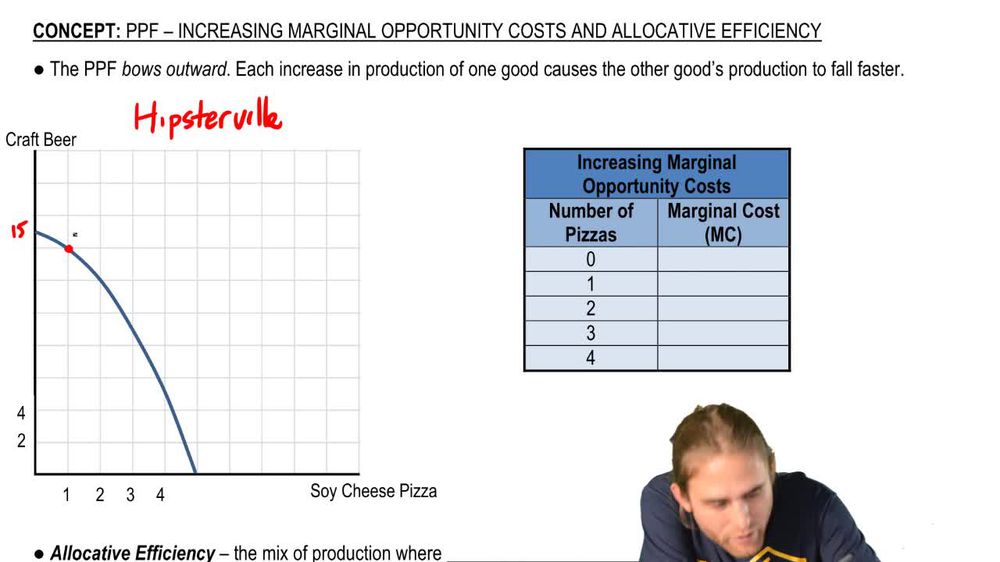
Increasing Marginal Opportunity Costs
21
views
3
rank
Terms in this set (15)
Hide definitions
Production Possibility Frontier
A curve showing all combinations of two goods that can be produced using available resources efficiently.
Marginal Opportunity Cost
The amount of one good that must be given up to produce an additional unit of another good.
Allocative Efficiency
A point where consumer preferences are met, as marginal benefit equals marginal cost for the mix of goods.
Productive Efficiency
A situation where resources are used so that it’s impossible to produce more of one good without reducing another.
Marginal Cost
The increase in sacrifice of one good for each additional unit of another, rising as more is produced.
Marginal Benefit
The value consumers place on an additional unit of a good, which decreases as more units are obtained.
Arc Method
A technique for calculating the average slope between two points on a curve, used for non-linear graphs.
Bowed-Out Curve
A graphical shape representing increasing marginal opportunity costs, not a straight line between endpoints.
Consumer Preferences
The subjective values and desires that determine the optimal mix of goods for allocative efficiency.
Efficient Quantity
The specific amount of goods produced where marginal benefit and marginal cost intersect.
Willingness to Pay
The maximum value consumers assign to a good, highest for initial units and lower for subsequent ones.
Slope
A measure of the rate at which one good must be sacrificed to produce more of another, varying on a curved PPF.
Midpoint
The average value between two production levels, used for plotting marginal cost and benefit on a curve.
Intersection
The point on a graph where two curves, such as marginal cost and marginal benefit, meet to indicate efficiency.
Resource Allocation
The distribution of inputs between goods to achieve either productive or allocative efficiency.
 BackBack
 08:42
08:42