Skip to main content
Microeconomics
My Course
Learn
Exam Prep
AI Tutor
Study Guides
Flashcards
Explore
Try the app
My Course
Learn
Exam Prep
AI Tutor
Study Guides
Flashcards
Explore
Try the app
Back
Polices to Reduce Poverty definitions
You can tap to flip the card.
Minimum Wage
You can tap to flip the card.
👆
Minimum Wage
A mandated lowest hourly pay employers must offer, acting as a price floor to boost earnings for low-income workers.
Track progress
Control buttons has been changed to "navigation" mode.
1/15
Related flashcards
Related practice
Recommended videos
Polices to Reduce Poverty quiz #1
Polices to Reduce Poverty
10 Terms
Polices to Reduce Poverty
16. Income Inequality and Poverty
9 problems
Topic
Lorenz Curve and Gini Coefficient
16. Income Inequality and Poverty
10 problems
Topic
16. Income Inequality and Poverty
5 topics
14 problems
Chapter
Guided course
06:15
Policies to Reduce Poverty
3
views
Terms in this set (15)
Hide definitions
Minimum Wage
A mandated lowest hourly pay employers must offer, acting as a price floor to boost earnings for low-income workers.
Price Floor
A government-imposed minimum allowable price, preventing prices from falling below a set level, such as in labor markets.
Welfare
A government program providing cash payments to supplement income for those in financial need, often with eligibility limits.
Negative Income Tax
A system where low-income individuals receive payments from the government instead of paying taxes, creating a subsidy effect.
Earned Income Tax Credit
A U.S. program offering tax refunds to low-income workers, functioning similarly to a negative income tax.
In-kind Transfers
Non-cash benefits provided by the government, such as food vouchers or free healthcare, to support those in poverty.
Food Stamps
Government-issued vouchers redeemable for food, ensuring access to nutrition for low-income households.
Medicaid
A U.S. government program offering free or subsidized healthcare services to individuals with limited income.
Subsidy
Financial assistance from the government to reduce costs for individuals or families, often tied to income levels.
Anti-poverty Programs
Government initiatives designed to alleviate poverty through income support, subsidies, or non-cash benefits.
Disincentive
A factor that reduces motivation to work, often arising when government benefits outweigh potential earnings.
Standard of Living
The level of material comfort and well-being experienced by individuals, influenced by income and access to services.
Obamacare
A U.S. healthcare reform that expanded subsidies for low-income families but sometimes reduced benefits as earnings increased.
Threshold
A specific income level at which individuals transition from receiving government subsidies to paying taxes.
Cash Payments
Direct monetary assistance provided by the government to individuals in need, often through welfare programs.
 BackBack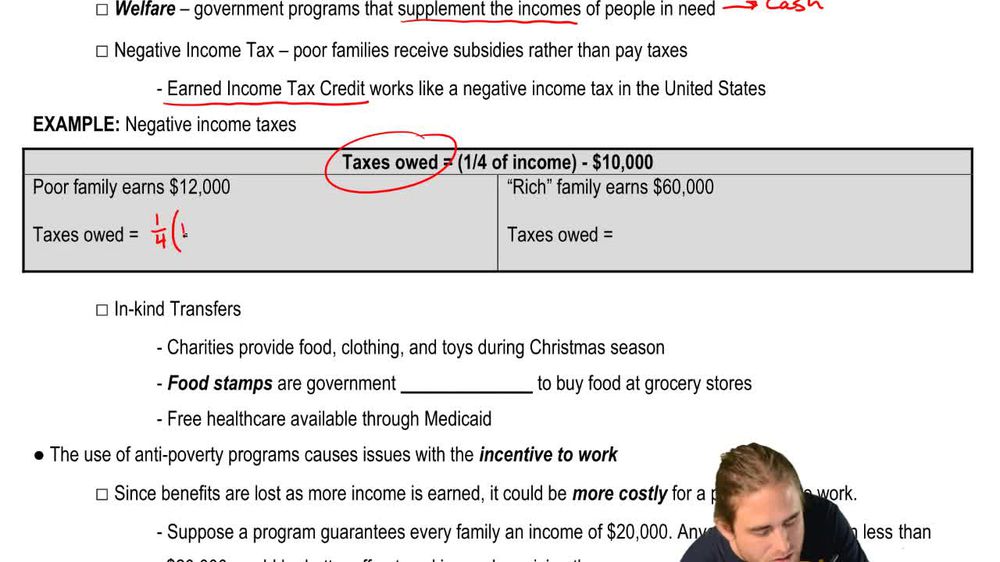
 06:15
06:15