What is a supply shock in the context of aggregate supply?
A supply shock is an unexpected event that affects a firm's production costs and shifts the aggregate supply curve, usually due to changes in input prices.
How does an increase in input prices, like gasoline, affect the short-run aggregate supply (SRAS) curve?
An increase in input prices shifts the SRAS curve to the left, indicating reduced supply in the economy.
What happens to GDP and price levels when the SRAS curve shifts left due to a supply shock?
GDP decreases and price levels increase, leading to lower output and higher inflation.
How does a supply shock impact unemployment in the short run?
A supply shock increases unemployment because less GDP means fewer workers are needed to produce output.
What is the effect of a supply shock on inflation?
A supply shock causes inflation to rise due to higher production costs and reduced supply.
How does the short-run Phillips curve respond to a supply shock?
The short-run Phillips curve shifts to the right, showing higher inflation and higher unemployment at every level.
Why is a supply shock considered 'doubly bad' for the economy?
It leads to both higher inflation and higher unemployment, making economic conditions worse.
What trade-off do policymakers face during a supply shock?
Policymakers must choose between reducing inflation or unemployment, as improving one worsens the other.
What does a rightward shift in the short-run Phillips curve indicate?
It indicates that at every level, both inflation and unemployment are higher than before.
How does a decrease in aggregate supply affect economic output?
A decrease in aggregate supply reduces economic output, resulting in lower GDP.
What happens to the price level when aggregate supply decreases?
The price level increases, leading to higher inflation.
How does a supply shock complicate achieving market equilibrium?
It makes it harder to balance inflation and unemployment, as both worsen simultaneously.
What is the relationship between unemployment and GDP during a supply shock?
As GDP decreases, unemployment increases because fewer workers are needed.
What is the main challenge for policymakers during a supply shock?
They must address both rising inflation and unemployment, which are difficult to solve together.
How does the Phillips curve illustrate the trade-off between inflation and unemployment?
The Phillips curve shows that efforts to reduce unemployment often increase inflation, and vice versa.
 Back
Back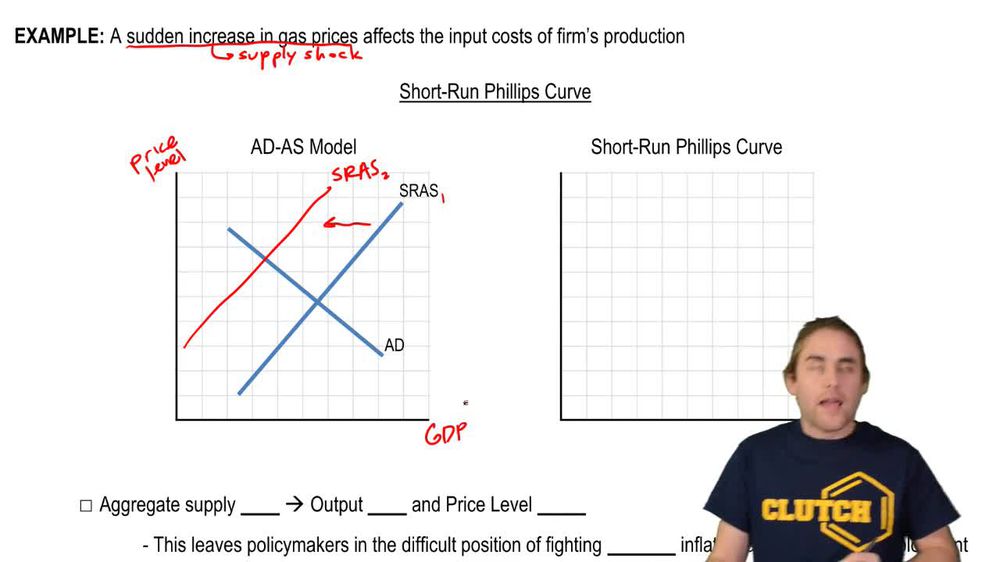
 05:19
05:19