Skip to main content
Microeconomics
My Course
Learn
Exam Prep
AI Tutor
Study Guides
Flashcards
Explore
Try the app
My Course
Learn
Exam Prep
AI Tutor
Study Guides
Flashcards
Explore
Try the app
Back
Percentage Change and Price Elasticity of Demand definitions
You can tap to flip the card.
Elasticity
You can tap to flip the card.
👆
Elasticity
A measure of sensitivity between two variables, allowing comparison across products by removing units.
Track progress
Control buttons has been changed to "navigation" mode.
1/15
Related flashcards
Related practice
Recommended videos
Percentage Change and Price Elasticity of Demand quiz #1
Percentage Change and Price Elasticity of Demand
17 Terms
Percentage Change and Price Elasticity of Demand
4. Elasticity
10 problems
Topic
Elasticity and the Midpoint Method
4. Elasticity
10 problems
Topic
4. Elasticity
11 topics
15 problems
Chapter
Guided course
09:14
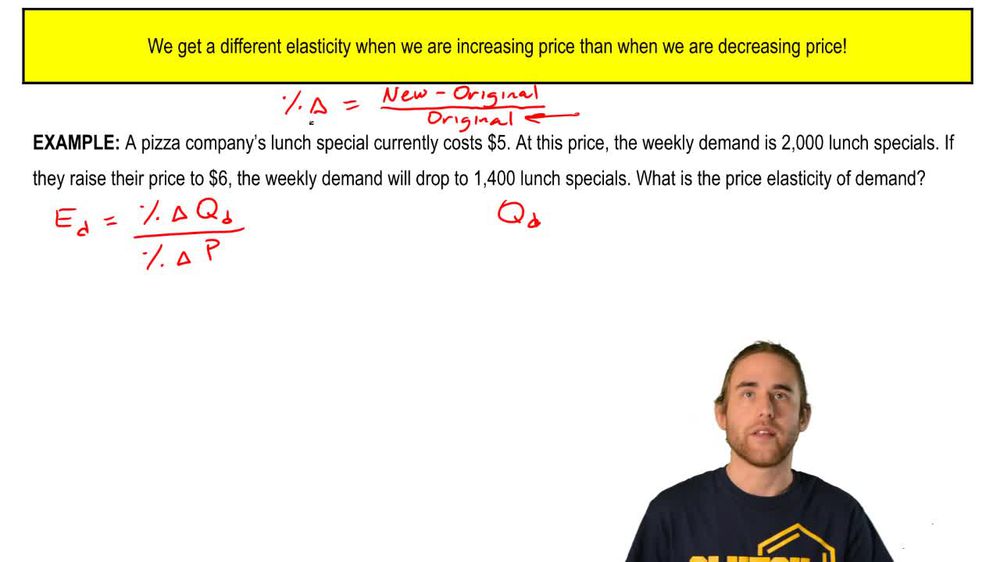
Percentage Change and Price Elasticity of Demand
4
views
Guided course
04:34
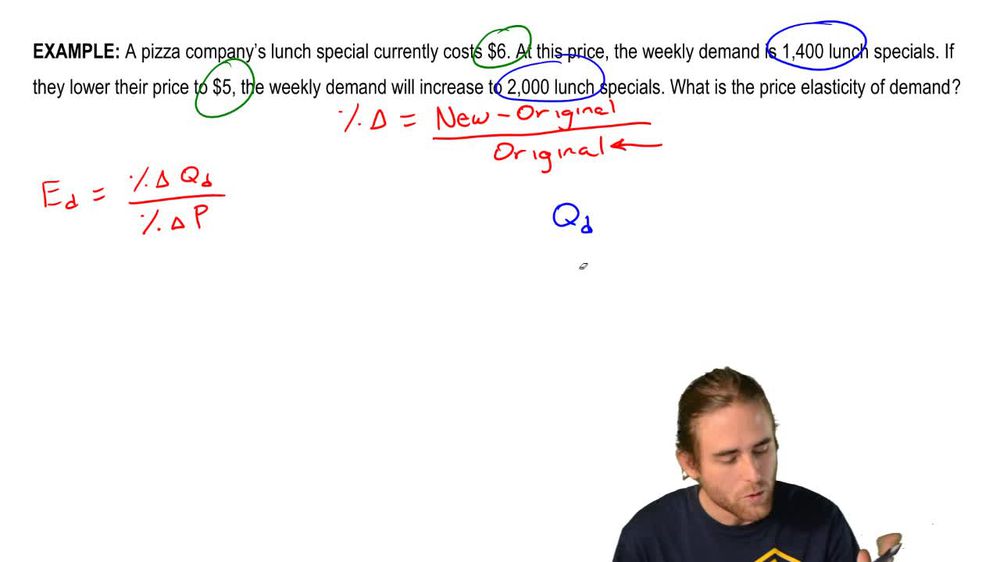
Different Answers when Increasing or Decreasing Prices! (Part 1)
11
views
Guided course
05:31
Different Answers when Increasing or Decreasing Prices! (Part 2)
9
views
Terms in this set (15)
Hide definitions
Elasticity
A measure of sensitivity between two variables, allowing comparison across products by removing units.
Percentage Change
A calculation using the difference between new and original values divided by the original, expressed as a proportion.
Quantity Demanded
The amount of a product consumers are willing to purchase at a specific price during a given period.
Price
The monetary value assigned to a product, influencing consumer purchasing decisions and demand.
Price Elasticity of Demand
A ratio showing how much quantity demanded responds to a change in price, using percentage changes.
Absolute Value
A mathematical approach that considers only the positive magnitude, ignoring negative signs in elasticity calculations.
Elastic Demand
A situation where the percentage change in quantity demanded exceeds the percentage change in price.
Inelastic Demand
A scenario where the percentage change in quantity demanded is less than the percentage change in price.
Unit Elastic
A condition where the percentage change in quantity demanded equals the percentage change in price.
Denominator
The value used as the base in percentage change calculations, affecting elasticity results.
Numerator
The value representing the difference between new and original amounts in percentage change calculations.
Delta
A Greek symbol used to denote change in a variable, commonly seen in economic formulas.
Average
A method of combining original and new values to create a consistent base for elasticity calculations.
Law of Demand
A principle stating that as price rises, quantity demanded falls, and vice versa, reflecting an inverse relationship.
Sensitivity
The degree to which one variable responds to changes in another, central to elasticity analysis.
 BackBack
 09:14
09:14