Skip to main content
Microeconomics
My Course
Learn
Exam Prep
AI Tutor
Study Guides
Flashcards
Explore
Try the app
My Course
Learn
Exam Prep
AI Tutor
Study Guides
Flashcards
Explore
Try the app
Back
People Respond to Incentives quiz #1
You can tap to flip the card.
Which is an example of a negative incentive for producers?
You can tap to flip the card.
👆
Which is an example of a negative incentive for producers?
A tax increase on production, which discourages producers from making more goods.
Track progress
Control buttons has been changed to "navigation" mode.
1/38
Related flashcards
Related practice
Recommended videos
People Respond to Incentives quiz #2
People Respond to Incentives
13 Terms
People Respond to Incentives definitions
People Respond to Incentives
14 Terms
People Respond to Incentives
0. Basic Principles of Economics
10 problems
Topic
Scarcity and Choice
0. Basic Principles of Economics
10 problems
Topic
0. Basic Principles of Economics
13 topics
14 problems
Chapter
Guided course
01:40
Economic Incentives
109
views
Terms in this set (38)
Hide definitions
Which is an example of a negative incentive for producers?
A tax increase on production, which discourages producers from making more goods.
Which statement best describes incentives?
Incentives are factors that motivate people to act in ways that make themselves better off.
Which best describes the effect negative incentives have on a certain course of action?
Negative incentives discourage people from pursuing a particular action.
What type of incentives appeal to someone’s concern about a cause?
Moral incentives appeal to someone’s concern about a cause.
Which phrase describes the income effect?
The income effect describes how changes in income influence the quantity of goods people buy.
What is the core economic concept of 'incentives'?
People respond to incentives by changing their behavior to make themselves better off.
Microsoft charges a price of \$599 for a copy of Windows 7. Is this pricing decision rational?
Yes, if Microsoft believes that enough consumers will buy at that price to maximize profit.
How does the market system use incentives to influence people's behavior?
The market system encourages people to exploit opportunities to improve their well-being.
What is an example of a positive incentive?
A bonus paid to employees for meeting sales targets.
What is the indirect incentive in the unemployment insurance program?
It may encourage some people to remain unemployed longer to continue receiving benefits.
What is the most basic form of incentive compensation?
A wage or salary paid for work performed.
How do you summarize the behavior of many individual buyers?
Individual buyers respond to price changes and incentives to maximize their benefit.
If people act with rational expectations, what does this imply?
They use all available information to make decisions that maximize their well-being.
What common mistake do consumers make when making decisions?
Failing to consider all available incentives and alternatives.
What is true about incentives?
Incentives can be positive or negative and influence people's choices.
What does the field of behavioral economics study?
Behavioral economics studies how psychological factors affect economic decision-making.
How can too little risk affect your investing experience?
Taking too little risk may result in lower potential returns on investments.
Which of these groups responds to the incentive of higher profits?
Producers and businesses respond to higher profits by increasing production.
Why is it so important to get incentives right when creating a policy?
Proper incentives ensure that people respond in ways that achieve the policy’s goals.
How do you think monetary and non-monetary incentives impact your decisions?
Both types of incentives influence choices by offering rewards or benefits for certain actions.
How does the concept of the 'invisible hand' support this idea?
The invisible hand suggests that individuals pursuing their own incentives can benefit society as a whole.
Which two sentences describe incentives?
Incentives motivate people to act. People respond to incentives to make themselves better off.
Which factor plays the biggest role in motivating economic decisions in a market economy?
Incentives play the biggest role in motivating economic decisions.
Microsoft charges a price of \$599 for a copy of Windows 7. Is this pricing decision rational?
Yes, if the price maximizes Microsoft’s profit given consumer demand.
How do people respond to incentives to make themselves better off?
Choosing to buy oranges instead of apples when apple prices rise.
What is an example of an incentive?
Offering a discount to customers who buy in bulk.
What type of power do monetary incentives represent?
Monetary incentives represent economic power.
Why do economic decisions vary from person to person even under the same circumstances?
People have different preferences, information, and responses to incentives.
What is the term for self-interested actions that take the reactions of others into account?
Strategic behavior.
What is likely true of countries that average one computer per person?
They likely have high levels of technology adoption and economic development.
Which is useful for making rational choices?
Considering all available incentives and alternatives.
Microsoft charges a price of \$599 for a copy of Windows 7. Is this pricing decision rational?
Yes, if it aligns with maximizing profit based on consumer willingness to pay.
Microsoft charges a price of \$599 for a copy of Windows 7. Is this pricing decision rational?
Yes, if the price reflects consumer demand and maximizes profit.
Microsoft charges a price of \$599 for a copy of Windows 7. Is this pricing decision rational?
Yes, if Microsoft expects enough sales at that price to make it profitable.
In the market, actions known as incentives affect
The choices and behaviors of buyers and sellers.
Investors respond to the incentive of
Potential financial returns or profits.
It is estimated that less education equals higher ______.
Unemployment.
Because people respond to incentives
Their choices and behaviors change when incentives change.
 BackBack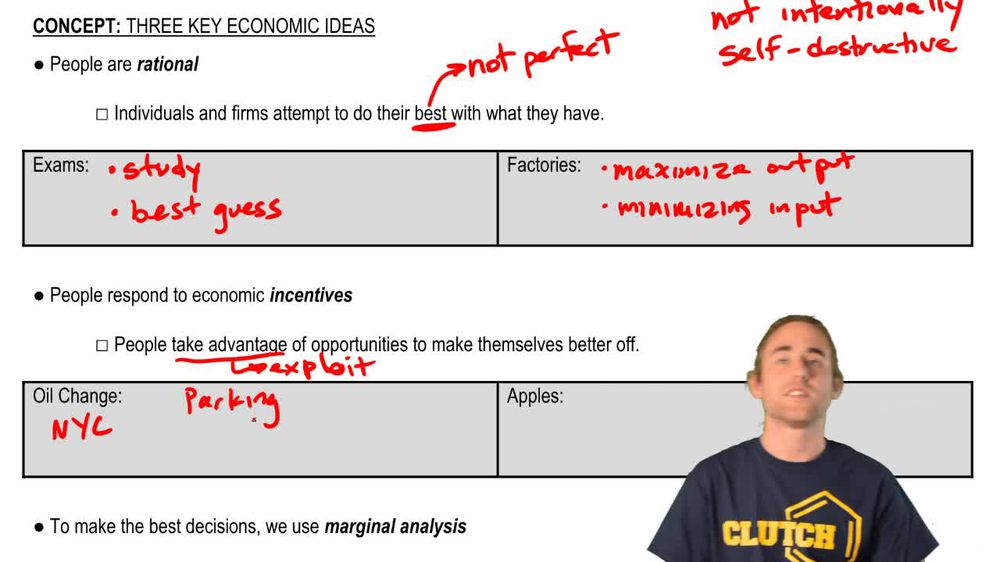
 01:40
01:40