Skip to main content
Microeconomics
My Course
Learn
Exam Prep
AI Tutor
Study Guides
Flashcards
Explore
Try the app
My Course
Learn
Exam Prep
AI Tutor
Study Guides
Flashcards
Explore
Try the app
Back
Other Factors of Production: Land and Capital definitions
You can tap to flip the card.
Land
You can tap to flip the card.
👆
Land
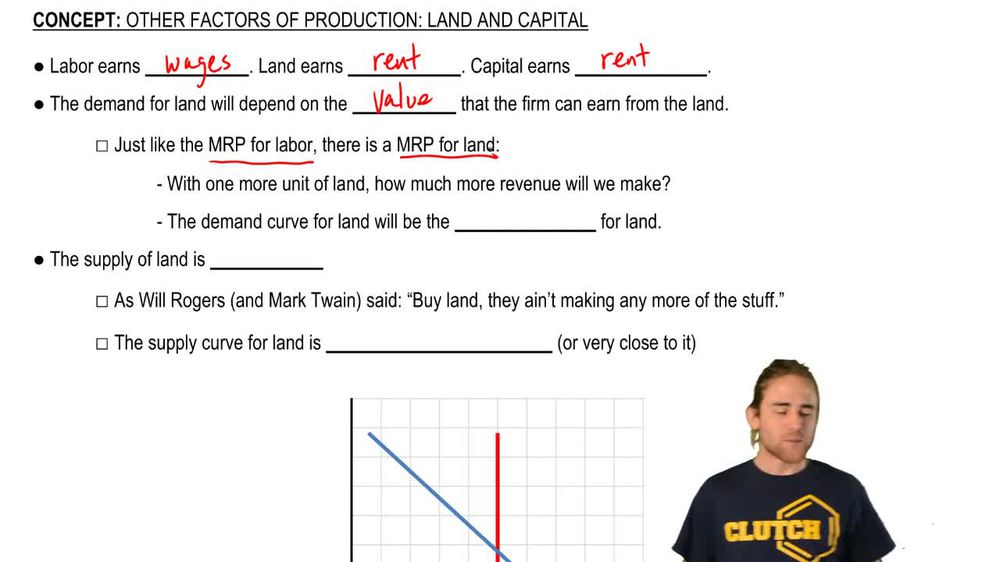
Includes physical terrain and natural resources such as forests and oil deposits, forming a fixed factor in production.
Track progress
Control buttons has been changed to "navigation" mode.
1/15
Related flashcards
Related practice
Recommended videos
Other Factors of Production: Land and Capital quiz #1
Other Factors of Production: Land and Capital
10 Terms
Other Factors of Production: Land and Capital
15. Markets for the Factors of Production
10 problems
Topic
Unions
15. Markets for the Factors of Production
10 problems
Topic
15. Markets for the Factors of Production
10 topics
13 problems
Chapter
Guided course
02:08
Other Factors of Production: Capital
2
views
Guided course
03:31
Other Factors of Production: Land
1
views
Terms in this set (15)
Hide definitions
Land
Includes physical terrain and natural resources such as forests and oil deposits, forming a fixed factor in production.
Capital
Consists of physical assets like factories and equipment used in production, distinct from human skills.
Rent
Payment earned by land or capital for its use in production, determined by market equilibrium.
Marginal Revenue Product
Additional revenue generated from employing one more unit of a factor, guiding demand decisions.
Supply Curve
Graphical representation showing how the quantity of a factor available changes with its price.
Demand Curve
Graph depicting how much of a factor firms want at various prices, based on its value in production.
Equilibrium Rental Rate
Market price where the quantity of a factor demanded equals the quantity supplied.
Perfectly Inelastic Supply
Situation where the quantity of a factor remains unchanged regardless of price, shown as a vertical line.
Upward Sloping Supply
Condition where higher prices lead to greater availability of a factor, illustrated by a rising curve.
Production Function
Relationship outlining how inputs like land and capital are transformed into output.
Natural Resources
Raw materials found in or on land, such as forests and oil, included in the land category.
Quantity
Amount of a factor available or used in production, often fixed for land and variable for capital.
Factory
Physical location where goods are produced, considered a form of capital.
Equipment
Machinery and tools used in production, classified as capital assets.
Rental Price
Cost paid for using land or capital, influencing supply and demand in factor markets.
 BackBack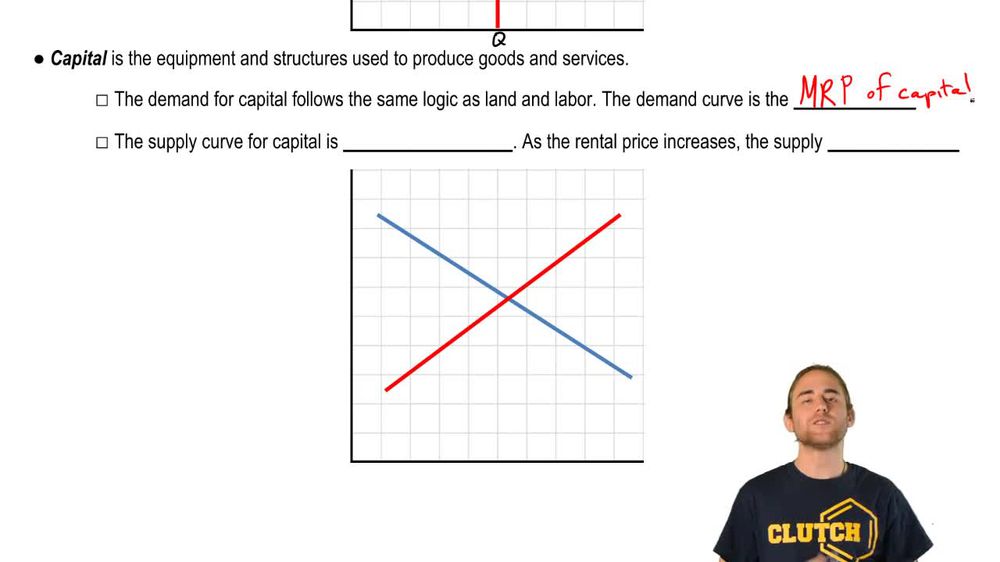
 02:08
02:08