Skip to main content
Microeconomics
My Course
Learn
Exam Prep
AI Tutor
Study Guides
Flashcards
Explore
Try the app
My Course
Learn
Exam Prep
AI Tutor
Study Guides
Flashcards
Explore
Try the app
Back
Nominal Income and Real Income quiz
You can tap to flip the card.
What is nominal income?
You can tap to flip the card.
👆
What is nominal income?
Nominal income is the amount of money you earn as measured in dollars, without adjusting for inflation.
Track progress
Control buttons has been changed to "navigation" mode.
1/15
Related flashcards
Recommended videos
Nominal Income and Real Income definitions
Nominal Income and Real Income
14 Terms
06:07
Nominal Income and Real Income
1
views
Terms in this set (15)
Hide definitions
What is nominal income?
Nominal income is the amount of money you earn as measured in dollars, without adjusting for inflation.
How does inflation affect purchasing power?
Inflation reduces purchasing power by increasing prices, so the same amount of money buys fewer goods and services.
What is real income?
Real income is nominal income adjusted for inflation, reflecting the actual purchasing power of your earnings.
How do you calculate real income?
Real income is calculated by dividing nominal income by the price index (CPI) for the year being analyzed.
If nominal income stays the same but prices rise, what happens to real income?
Real income decreases because your money can buy less due to higher prices.
Why do people seek raises during periods of inflation?
People seek raises to maintain or increase their purchasing power as inflation erodes the value of their income.
What does the Consumer Price Index (CPI) measure?
The CPI measures the average change in prices paid by consumers for goods and services, serving as an indicator of inflation.
What is the formula for the percentage change in real income?
The percentage change in real income is approximately equal to the percentage change in nominal income minus the percentage change in the price level.
If your nominal income increases by 20% and the price level increases by 10%, what is the approximate percentage change in your real income?
The approximate percentage change in real income is 10% (20% - 10%).
In the example, what was the real income in year two if nominal income was \$50,000 and the price index was 1.05?
The real income was \$47,619, meaning \$50,000 in year two buys what \$47,619 did in year one.
Why is the base year important when calculating real income?
The base year provides a reference point (CPI = 100) for comparing changes in purchasing power over time.
How does a rise in nominal income that outpaces inflation affect real income?
If nominal income rises faster than inflation, real income increases, allowing you to buy more goods and services.
What does it mean if your real income stays the same over time?
It means your nominal income has increased at the same rate as inflation, so your purchasing power is unchanged.
How can the percentage change formula help when detailed data is unavailable?
It provides a quick estimate of how much inflation has impacted your real income without needing all the details.
What is the economic significance of understanding real income?
Understanding real income helps evaluate the impact of inflation on economic welfare, consumer surplus, and income elasticity of demand.
 BackBack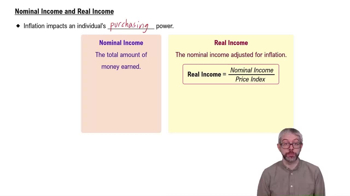
 06:07
06:07