Skip to main content
Microeconomics
My Course
Learn
Exam Prep
AI Tutor
Study Guides
Flashcards
Explore
Try the app
My Course
Learn
Exam Prep
AI Tutor
Study Guides
Flashcards
Explore
Try the app
Back
Nominal GDP and Real GDP quiz
You can tap to flip the card.
What is the main difference between nominal GDP and real GDP?
You can tap to flip the card.
👆
What is the main difference between nominal GDP and real GDP?
Nominal GDP uses current prices to value final goods and services, while real GDP uses base year prices to isolate changes in production.
Track progress
Control buttons has been changed to "navigation" mode.
1/15
Related flashcards
Recommended videos
Nominal GDP and Real GDP definitions
Nominal GDP and Real GDP
14 Terms
Guided course
03:04
Inflation and the GDP Deflator
Guided course
09:15
Nominal GDP and Real GDP
Terms in this set (15)
Hide definitions
What is the main difference between nominal GDP and real GDP?
Nominal GDP uses current prices to value final goods and services, while real GDP uses base year prices to isolate changes in production.
How do you calculate nominal GDP for a given year?
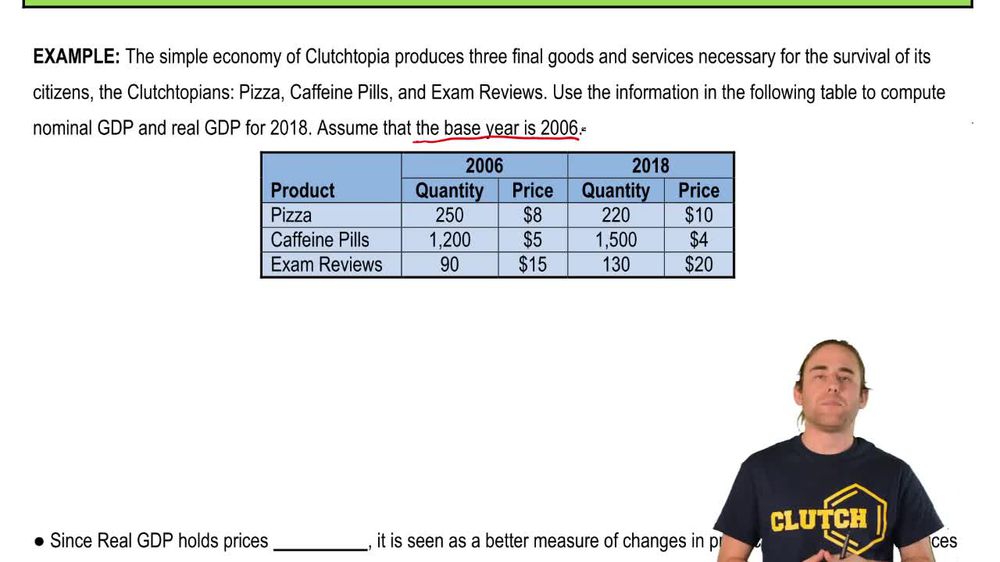
Nominal GDP is calculated by multiplying the quantity of each good produced by its current year price and summing the results for all goods.
How do you calculate real GDP for a given year?
Real GDP is calculated by multiplying the quantity of each good produced by its base year price and summing the results for all goods.
Why is real GDP generally considered a better measure of economic growth than nominal GDP?
Real GDP holds prices constant, allowing for better comparison of production changes over time without the effects of inflation.
What is the formula for the GDP deflator?
The GDP deflator is calculated as (Nominal GDP / Real GDP) × 100.
What does the GDP deflator measure?
The GDP deflator measures the overall change in price levels (inflation) in an economy by comparing nominal and real GDP.
How do you calculate the inflation rate using the GDP deflator?
The inflation rate is the percentage change in the GDP deflator from one year to the next, calculated as (New deflator - Old deflator) / Old deflator.
Why are nominal GDP and real GDP equal in the base year?
They are equal because both use the base year prices, making the numerator and denominator the same in the GDP deflator formula.
What is the value of the GDP deflator in the base year, and why?
The GDP deflator in the base year is always 100 because nominal GDP equals real GDP in that year.
What is inflation in the context of GDP measurement?
Inflation is the general rise in price levels in an economy from one year to the next, which can be monitored using nominal and real GDP.
What is the main drawback of using real GDP with constant base year prices?
The main drawback is that relative prices of goods can change over time, which may distort the value of production if only base year prices are used.
What is the purpose of chain-weighted prices in GDP calculation?
Chain-weighted prices adjust for changes in relative prices over time, providing a more accurate measure than using only base year or current prices.
What are the four components of GDP in the expenditures approach?
The four components are consumption, investment, government purchases, and net exports.
In a simple economy, how would you find the total value of GDP for multiple goods?
You multiply the quantity of each good by its price (current for nominal, base year for real) and sum the values for all goods.
What simple formula should you remember for calculating percentage change, such as the inflation rate?
Use (new value - old value) / old value to find the percentage change.
 BackBack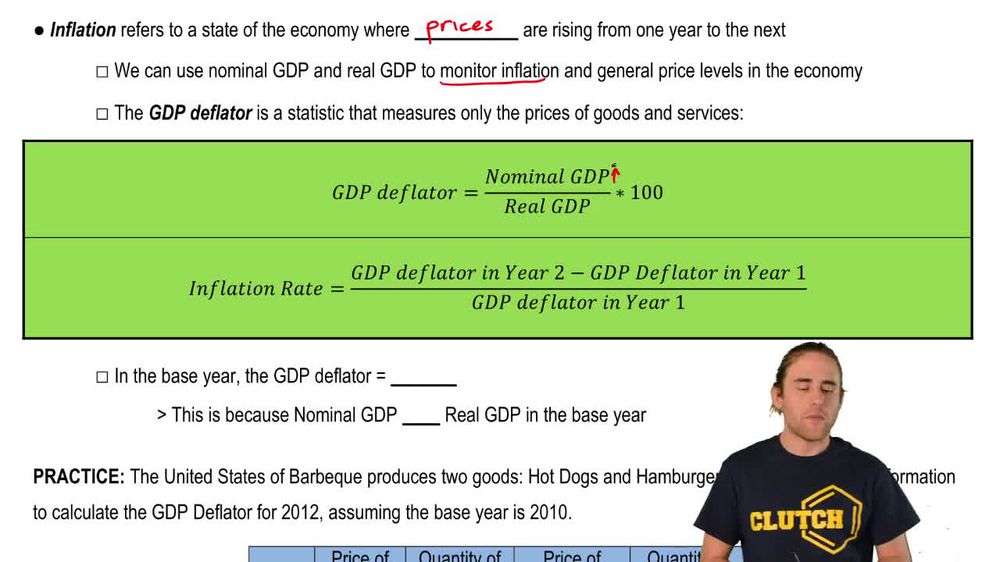
 03:04
03:04