Skip to main content
Microeconomics
My Course
Learn
Exam Prep
AI Tutor
Study Guides
Flashcards
Explore
Try the app
My Course
Learn
Exam Prep
AI Tutor
Study Guides
Flashcards
Explore
Try the app
Back
Net Exports Equal Net Foreign Investment definitions
You can tap to flip the card.
Net Exports
You can tap to flip the card.
👆
Net Exports
Reflects the difference between a country's exports and imports, indicating whether it sells more goods abroad than it buys.
Track progress
Control buttons has been changed to "navigation" mode.
1/15
Related flashcards
Recommended videos
Net Exports Equal Net Foreign Investment quiz
Net Exports Equal Net Foreign Investment
15 Terms
Guided course
07:24
Net Exports Equal Net Foreign Investment
Terms in this set (15)
Hide definitions
Net Exports
Reflects the difference between a country's exports and imports, indicating whether it sells more goods abroad than it buys.
Net Foreign Investment
Measures the difference between foreign assets acquired by domestic citizens and domestic assets acquired by foreigners.
Trade Balance
Shows whether a country exports more than it imports or vice versa, impacting its economic relationships.
Foreign Direct Investment
Involves ownership of physical capital, such as factories or land, by a domestic entity in a foreign country or vice versa.
Foreign Portfolio Investment
Consists of financial assets like stocks or bonds purchased by domestic citizens in foreign countries or by foreigners domestically.
Physical Capital
Includes tangible assets such as buildings or factories used in production, often involved in direct investment.
Financial Asset
Represents claims to future income, such as stocks or bonds, and is central to portfolio investment.
Export
A good or service sold by domestic producers to buyers in other countries, increasing net exports.
Import
A good or service purchased from foreign producers, decreasing net exports.
Capital Flow
Movement of money and assets across borders, balancing trade differences through investment.
Asset
Anything of value owned, including currency, land, factories, stocks, or bonds, exchanged in international transactions.
Bond
A financial instrument representing a loan, often purchased as part of foreign portfolio investment.
Currency
Medium of exchange, such as yen or dollars, acquired in international trade and investment.
Market Equilibrium
A state where net exports and net foreign investment are balanced, ensuring stable international economic relations.
International Economics
Field studying the flow of goods, services, and capital between countries, crucial for understanding trade and investment.
 BackBack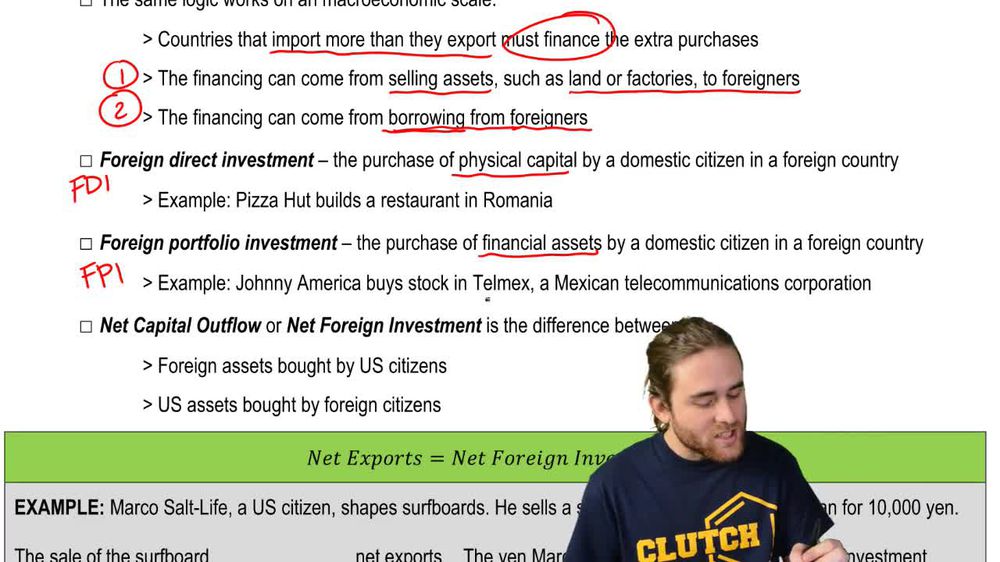
 07:24
07:24