Skip to main content
Microeconomics
My Course
Learn
Exam Prep
AI Tutor
Study Guides
Flashcards
Explore
Try the app
My Course
Learn
Exam Prep
AI Tutor
Study Guides
Flashcards
Explore
Try the app
Back
Monopolistic Competition in the Long Run quiz
You can tap to flip the card.
In the long run, what happens to economic profit in monopolistic competition?
You can tap to flip the card.
👆
In the long run, what happens to economic profit in monopolistic competition?
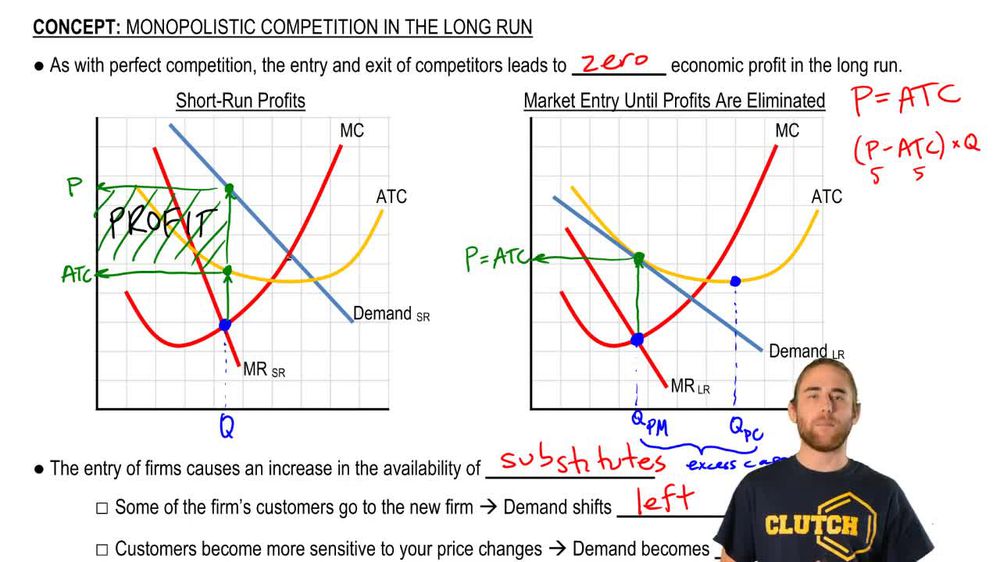
Economic profit becomes zero as price equals average total cost due to the entry and exit of firms.
Track progress
Control buttons has been changed to "navigation" mode.
1/15
Related flashcards
Related practice
Recommended videos
Monopolistic Competition in the Long Run definitions
Monopolistic Competition in the Long Run
15 Terms
Monopolistic Competition in the Long Run
13. Monopolistic Competition
10 problems
Topic
Efficiency in Monopolistic Competition
13. Monopolistic Competition
10 problems
Topic
13. Monopolistic Competition
7 topics
15 problems
Chapter
Guided course
09:47
Monopolistic Competition in the Long Run
5
views
Guided course
01:33
How Companies Stay Profitable
2
views
Terms in this set (15)
Hide definitions
In the long run, what happens to economic profit in monopolistic competition?
Economic profit becomes zero as price equals average total cost due to the entry and exit of firms.
Why does the demand curve for a firm in monopolistic competition become more elastic in the long run?
The entry of new firms increases the availability of substitutes, making consumers more sensitive to price changes.
What causes the demand curve to shift to the left for a monopolistically competitive firm in the long run?
The entry of new firms draws away some customers, reducing demand for the original firm's product.
At what point does a monopolistically competitive firm maximize profit?
A firm maximizes profit where marginal revenue equals marginal cost.
In monopolistic competition, does the firm produce at the minimum of average total cost in the long run?
No, the firm does not produce at the minimum average total cost, leading to excess capacity.
What is excess capacity in the context of monopolistic competition?
Excess capacity is when a firm produces less than the quantity that would minimize average total cost.
How does the long-run equilibrium in monopolistic competition differ from perfect competition?
In monopolistic competition, price equals average total cost but not at its minimum, unlike perfect competition where it is at the minimum.
What happens to a firm's profit if it does not differentiate its product in monopolistic competition?
Other firms will replicate its product, eroding profits until there is no economic profit.
Why do firms in monopolistic competition need to continuously differentiate their products?
Continuous differentiation helps maintain profitability and prevents competitors from capturing their market share.
Give an example of product differentiation by a real-world firm.
Starbucks expanded its product line to include tea, coffee mugs, and a loyalty program to differentiate itself.
What is the relationship between price and average total cost in the long-run equilibrium of monopolistic competition?
Price equals average total cost, resulting in zero economic profit.
What role does the entry and exit of firms play in monopolistic competition?
Entry and exit of firms drive economic profit to zero in the long run by adjusting market supply and demand.
How does the demand curve's elasticity affect a monopolistically competitive firm's pricing power in the long run?
Greater elasticity reduces the firm's pricing power, as consumers are more responsive to price changes.
What is the profit equation used to determine economic profit in monopolistic competition?
Profit equals (Price minus Average Total Cost) times Quantity.
Why is the long-run equilibrium in monopolistic competition considered inefficient?
Because firms do not produce at minimum average total cost, resulting in excess capacity and inefficiency.
 BackBack
 09:47
09:47