Skip to main content
Microeconomics
My Course
Learn
Exam Prep
AI Tutor
Study Guides
Flashcards
Explore
Try the app
My Course
Learn
Exam Prep
AI Tutor
Study Guides
Flashcards
Explore
Try the app
Back
Monetary Policy and Aggregate Demand quiz
You can tap to flip the card.
How does a lower interest rate affect consumption in the economy?
You can tap to flip the card.
👆
How does a lower interest rate affect consumption in the economy?
A lower interest rate increases consumption because borrowing is cheaper and saving is less attractive.
Track progress
Control buttons has been changed to "navigation" mode.
1/15
Related flashcards
Recommended videos
Monetary Policy and Aggregate Demand definitions
Monetary Policy and Aggregate Demand
15 Terms
Guided course
06:24
Price Levels and the Money Market
Guided course
04:53
Monetary Policy and Aggregate Demand
Guided course
06:42
Interest Rates and Aggregate Demand
Terms in this set (15)
Hide definitions
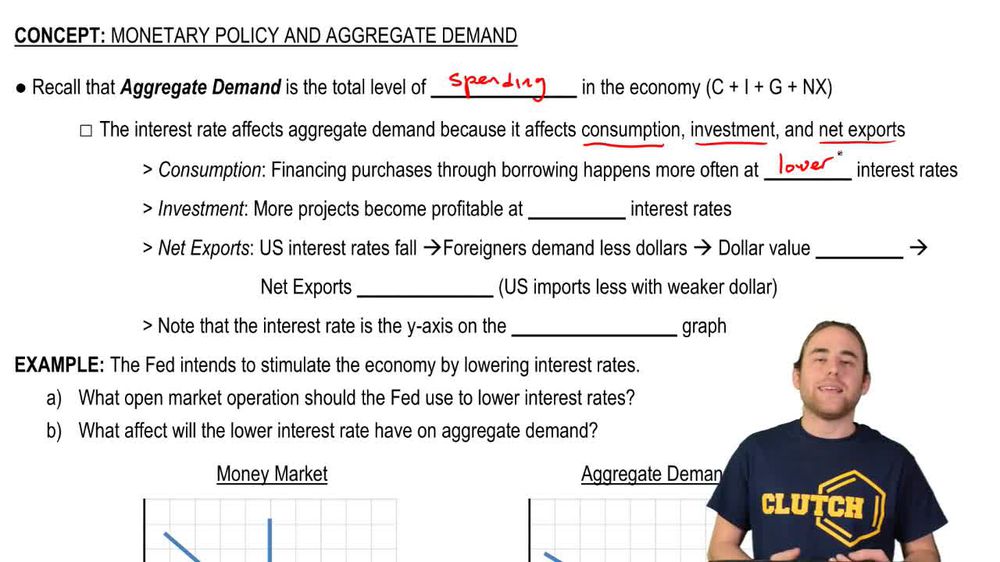
How does a lower interest rate affect consumption in the economy?
A lower interest rate increases consumption because borrowing is cheaper and saving is less attractive.
What is the effect of lower interest rates on investment spending?
Lower interest rates increase investment spending because it reduces the cost of borrowing for businesses.
How do lower interest rates impact net exports?
Lower interest rates weaken the domestic currency, making imports more expensive and exports more competitive, thus increasing net exports.
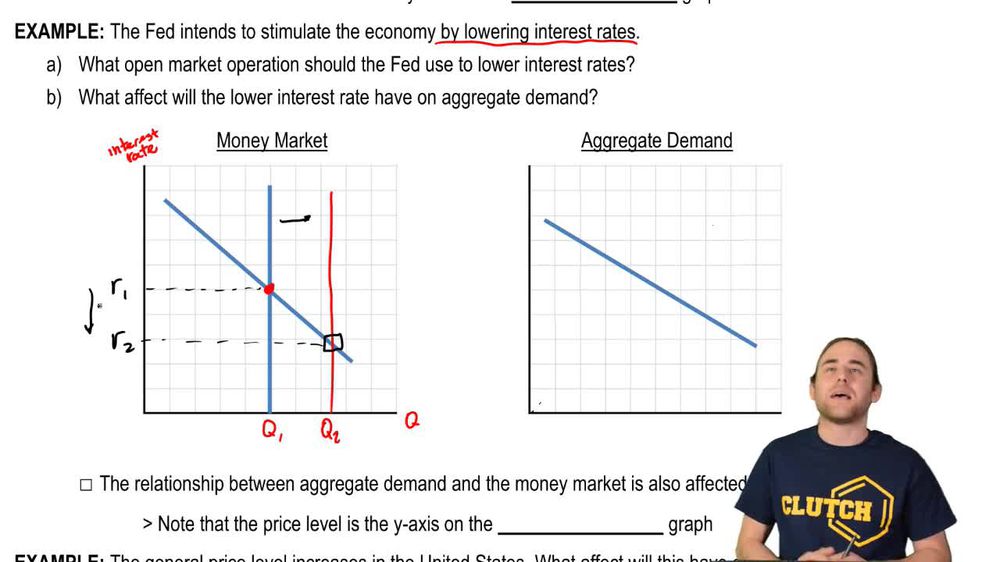
Which open market operation does the Federal Reserve use to lower interest rates?
The Federal Reserve purchases securities from the public to increase the money supply and lower interest rates.
What happens to the money supply when the Fed purchases securities?
The money supply increases because the Fed injects money into the economy by buying securities.
How does an increase in the money supply affect the equilibrium interest rate?
An increase in the money supply lowers the equilibrium interest rate in the money market.
What is the result of a lower interest rate on the aggregate demand curve?
A lower interest rate shifts the aggregate demand curve to the right, indicating increased total spending.
Which components of aggregate demand are directly affected by changes in the interest rate?
Consumption, investment, and net exports are directly affected by changes in the interest rate.
What happens to aggregate demand during a recession if the Fed lowers interest rates?
Aggregate demand increases, helping to stimulate economic activity and counteract the recession.
On the aggregate demand curve, what does a change in the price level cause?
A change in the price level causes a movement along the aggregate demand curve, not a shift of the curve.
How does an increase in the general price level affect money demand?
An increase in the price level raises money demand because people need more cash to buy goods and services.
What happens to the equilibrium interest rate if money demand increases but money supply stays the same?
The equilibrium interest rate rises because the higher demand for money increases its price.
When does the aggregate demand curve shift rather than move along the curve?
The aggregate demand curve shifts when an underlying factor, such as the interest rate, changes, not when the price level changes.
What is the y-axis variable on the money market graph?
The y-axis on the money market graph represents the interest rate, which is the price of money.
How does the Fed's open market purchase of securities help during a recession?
It increases the money supply, lowers interest rates, and stimulates spending in the economy, helping to counteract the recession.
 BackBack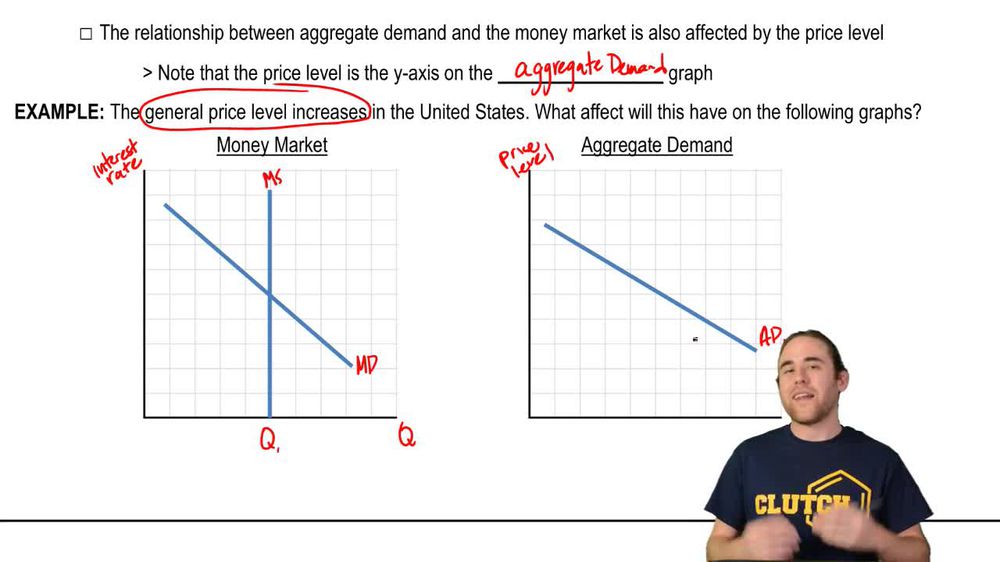
 06:24
06:24