Skip to main content
Microeconomics
My Course
Learn
Exam Prep
AI Tutor
Study Guides
Flashcards
Explore
Try the app
My Course
Learn
Exam Prep
AI Tutor
Study Guides
Flashcards
Explore
Try the app
Back
Market Supply Curve in the Short Run and Long Run definitions
You can tap to flip the card.
Market Supply Curve
You can tap to flip the card.
👆
Market Supply Curve
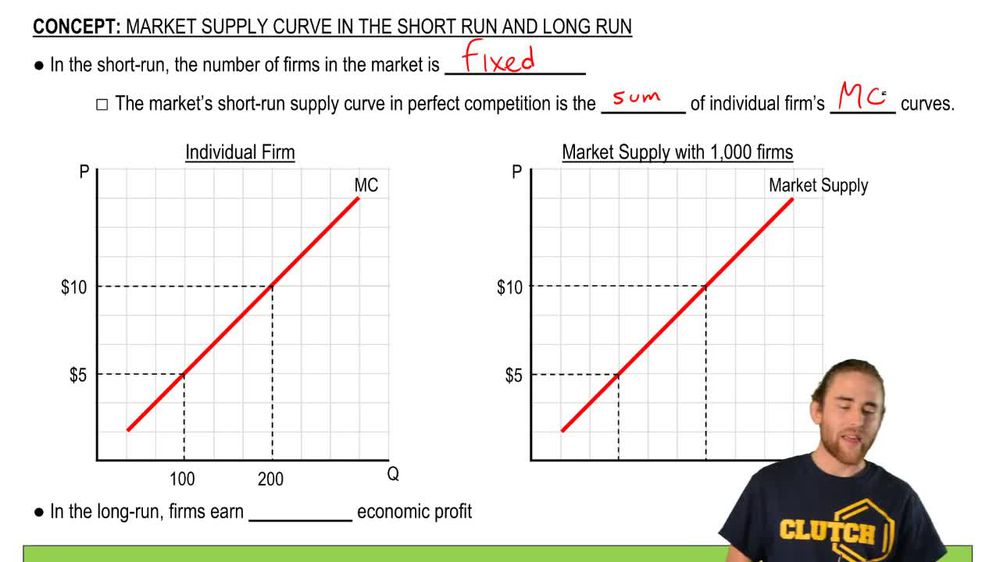
Represents total quantity supplied by all firms at each price, constructed by summing individual marginal cost curves.
Track progress
Control buttons has been changed to "navigation" mode.
1/15
Related flashcards
Related practice
Recommended videos
Market Supply Curve in the Short Run and Long Run quiz
Market Supply Curve in the Short Run and Long Run
15 Terms
Market Supply Curve in the Short Run and Long Run
11. Perfect Competition
10 problems
Topic
Long Run Equilibrium
11. Perfect Competition
10 problems
Topic
11. Perfect Competition
11 topics
15 problems
Chapter
Guided course
06:07
Market Supply Curve in the Long Run
3
views
Guided course
03:02
Market Supply Curve in the Short Run
4
views
Terms in this set (15)
Hide definitions
Market Supply Curve
Represents total quantity supplied by all firms at each price, constructed by summing individual marginal cost curves.
Short Run
Period where the number of firms is fixed, and market supply is determined by existing firms' marginal cost curves.
Long Run
Period allowing entry and exit of firms, leading to zero economic profit and a perfectly elastic supply curve.
Marginal Cost Curve
Graph showing the cost of producing one more unit, serving as the supply curve for individual firms above average variable cost.
Average Total Cost
Total cost per unit, including all fixed and variable costs, crucial for determining profit and market equilibrium.
Economic Profit
Profit calculation that includes opportunity costs, reaching zero in the long run due to market entry and exit.
Accounting Profit
Profit based solely on monetary costs and revenues, remaining positive even when economic profit is zero.
Opportunity Cost
Value of the next best alternative forgone, included in economic profit calculations for firms.
Equilibrium
State where market price equals average total cost, resulting in zero economic profit and stable firm numbers.
Perfectly Elastic Supply
Supply curve that is flat, indicating any quantity demanded can be supplied at a constant price in the long run.
Entry
Process where new firms join the market when profits exist, increasing supply and lowering price.
Exit
Process where firms leave the market when losses occur, reducing supply and raising price.
Minimum ATC
Lowest point on the average total cost curve, where firms produce efficiently and market price stabilizes.
Supply Shift
Movement of the supply curve due to changes in the number of firms, affecting market price and equilibrium.
Fixed Firms
Condition in the short run where the number of firms does not change, limiting supply adjustments.
 BackBack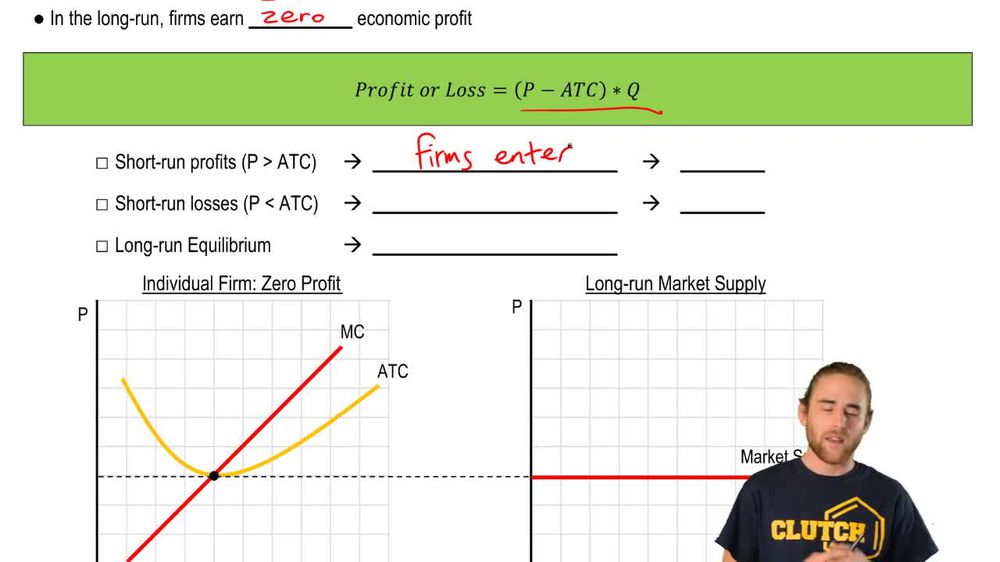
 06:07
06:07