Skip to main content
Microeconomics
My Course
Learn
Exam Prep
AI Tutor
Study Guides
Flashcards
Explore
Try the app
My Course
Learn
Exam Prep
AI Tutor
Study Guides
Flashcards
Explore
Try the app
Back
Marginal Analysis definitions
You can tap to flip the card.
Marginal Analysis
You can tap to flip the card.
👆
Marginal Analysis
A method for making optimal choices by comparing extra benefits and extra costs of one more unit.
Track progress
Control buttons has been changed to "navigation" mode.
1/15
Related flashcards
Related practice
Recommended videos
Marginal Analysis quiz #1
Marginal Analysis
40 Terms
Marginal Analysis quiz #2
Marginal Analysis
40 Terms
Marginal Analysis quiz #3
Marginal Analysis
40 Terms
Marginal Analysis
0. Basic Principles of Economics
9 problems
Topic
Allocative Efficiency, Productive Efficiency, and Equality
0. Basic Principles of Economics
10 problems
Topic
0. Basic Principles of Economics
13 topics
14 problems
Chapter
Guided course
09:36
Marginal Analysis
85
views
1
rank
Terms in this set (15)
Hide definitions
Marginal Analysis
A method for making optimal choices by comparing extra benefits and extra costs of one more unit.
Marginal Benefit
The extra satisfaction or happiness gained from consuming an additional unit, often subjective and quantified in class.
Marginal Cost
The extra expense, including monetary, emotional, psychological, or time, from consuming one more unit.
Optimum Consumption
The point where extra satisfaction equals extra expense, maximizing overall happiness from consumption.
Allocative Efficiency
A state where resources are distributed so that extra satisfaction matches extra expense for each unit.
Graphical Representation
A visual tool using colored lines to show the relationship between extra satisfaction and extra expense.
Subjectivity
A quality of extra satisfaction, varying by individual preferences and not easily measured.
Quantification
The process of assigning numerical values to extra satisfaction for academic purposes.
Intersection
The point on a graph where the extra satisfaction line meets the extra expense line, indicating optimal choice.
Overconsumption
A situation where extra expense exceeds extra satisfaction, leading to less overall happiness.
Underconsumption
A scenario where extra satisfaction is greater than extra expense, suggesting more should be consumed.
Personal Preferences
Individual differences affecting how quickly extra satisfaction decreases and extra expense increases.
Satiation
A state reached when consuming more units no longer increases happiness, often at the optimal point.
Emotional Cost
Non-monetary expense, such as discomfort or regret, associated with consuming additional units.
Psychological Cost
Mental or emotional burden incurred from consuming more units, distinct from monetary expense.
 BackBack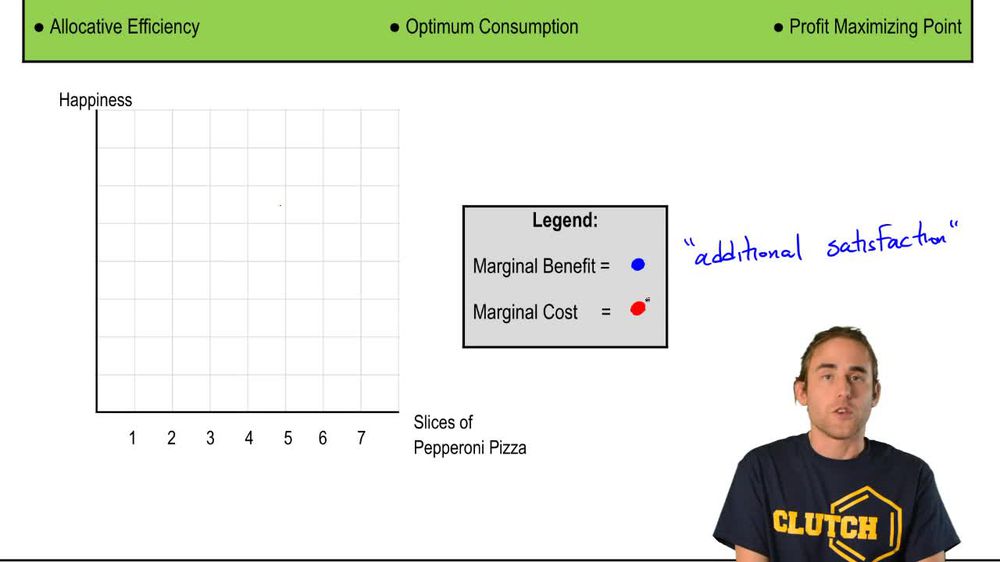
 09:36
09:36