Skip to main content
Microeconomics
My Course
Learn
Exam Prep
AI Tutor
Study Guides
Flashcards
Explore
Try the app
My Course
Learn
Exam Prep
AI Tutor
Study Guides
Flashcards
Explore
Try the app
Back
Labor Force and Unemployment quiz
You can tap to flip the card.
What is the definition of unemployment in economics?
You can tap to flip the card.
👆
What is the definition of unemployment in economics?
Unemployment refers to people who are actively searching for work but are unable to find a job.
Track progress
Control buttons has been changed to "navigation" mode.
1/15
Related flashcards
Recommended videos
Labor Force and Unemployment definitions
Labor Force and Unemployment
15 Terms
05:58
Labor Force and Unemployment
Guided course
04:35
Problems with Measuring Unemployment
Terms in this set (15)
Hide definitions
What is the definition of unemployment in economics?
Unemployment refers to people who are actively searching for work but are unable to find a job.
How is the unemployment rate calculated?
The unemployment rate is calculated by dividing the number of unemployed people by the size of the labor force.
Who is included in the labor force?
The labor force includes both employed individuals (full-time or part-time) and unemployed individuals actively seeking work.
What is the working age population?
The working age population consists of everyone aged 16 and older who is not institutionalized.
What does 'actively searching for work' mean in the United States?
It means applying for jobs or meeting with potential employers within the past four weeks.
What is the labor force participation rate formula?
The labor force participation rate is calculated as labor force divided by the working age population.
Who are discouraged workers?
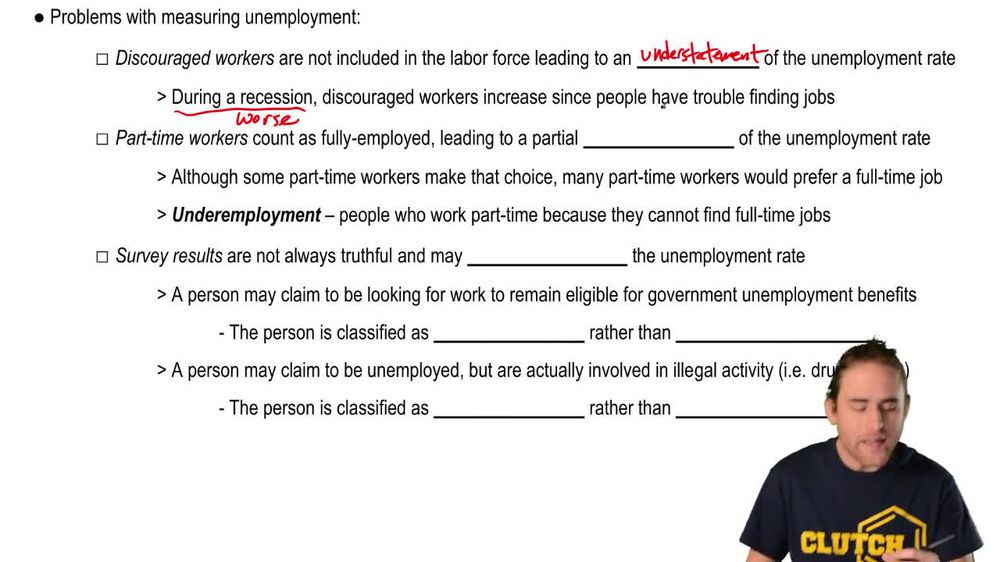
Discouraged workers are people who want a job but have stopped searching because they believe no jobs are available for them.
How do discouraged workers affect the unemployment rate?
They cause the unemployment rate to be understated because they are not counted as unemployed once they stop searching.
What is underemployment?
Underemployment refers to people working part-time who would prefer full-time jobs but cannot find them.
How does underemployment distort unemployment statistics?
It understates the unemployment rate because underemployed workers are counted as employed even though they want more work.
Why can survey results distort unemployment data?
Survey results can be inaccurate if people lie about their job search or employment status, leading to incorrect unemployment figures.
How might someone falsely classified as unemployed affect the unemployment rate?
If someone claims to be unemployed to receive benefits but is not actually searching for work, it overstates the unemployment rate.
What is an example of someone being misclassified as unemployed due to illegal activity?
A person involved in illegal work, like drug dealing, may claim to be unemployed, making the unemployment rate appear higher than it is.
Why is the labor force participation rate important for economic analysis?
It measures how many people in the working age population are actively engaged in the labor force, indicating economic engagement.
What groups are not included in the labor force?
People not in the labor force include retirees, stay-at-home parents, students who don't want to work, and those taking a break from working.
 BackBack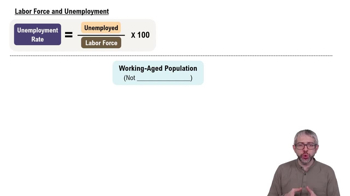
 05:58
05:58