Skip to main content
Microeconomics
My Course
Learn
Exam Prep
AI Tutor
Study Guides
Flashcards
Explore
Try the app
My Course
Learn
Exam Prep
AI Tutor
Study Guides
Flashcards
Explore
Try the app
Back
Isoquant Lines definitions
You can tap to flip the card.
Isoquant
You can tap to flip the card.
👆
Isoquant
A curve showing all possible input combinations that yield a fixed level of production, such as a set number of cookies.
Track progress
Control buttons has been changed to "navigation" mode.
1/15
Related flashcards
Related practice
Recommended videos
Isoquant Lines quiz
Isoquant Lines
15 Terms
Isoquant Lines
10. The Costs of Production
10 problems
Topic
Isocost Lines
10. The Costs of Production
8 problems
Topic
10. The Costs of Production
9 topics
15 problems
Chapter
Guided course
09:45
Isoquant Lines
9
views
Terms in this set (15)
Hide definitions
Isoquant
A curve showing all possible input combinations that yield a fixed level of production, such as a set number of cookies.
Labor
The human effort, such as bakers, used in the production process to create goods like cookies.
Capital
Physical assets, like ovens or machinery, employed in production to increase output efficiency.
Bundle
A specific combination of inputs, such as a certain number of ovens and bakers, used to achieve a production target.
Marginal Rate of Technical Substitution
The rate at which one input can replace another while keeping output constant, calculated as the slope of the isoquant.
Slope
A measure of how much one input must change relative to another to maintain the same output, often used in isoquant analysis.
Diminishing Returns
A phenomenon where adding more of one input results in progressively smaller increases in output or efficiency.
Production Level
A fixed quantity of goods, such as cookies, that a firm aims to produce using various input combinations.
Cost Efficiency
The ability to achieve a production goal using the least expensive combination of inputs.
Indifference Curve
A concept similar to isoquants, representing combinations of goods that provide equal satisfaction to a consumer.
Input
A resource, such as labor or capital, used in the process of producing goods.
Output
The final product or quantity produced, like the number of cookies, resulting from the use of inputs.
Quantity
The numerical amount of either input or output involved in production, often plotted on axes in isoquant graphs.
Oven
A type of capital input used in baking, whose quantity can be varied to affect production levels.
Worker
A unit of labor input, such as a baker, whose number can be adjusted to influence output.
 BackBack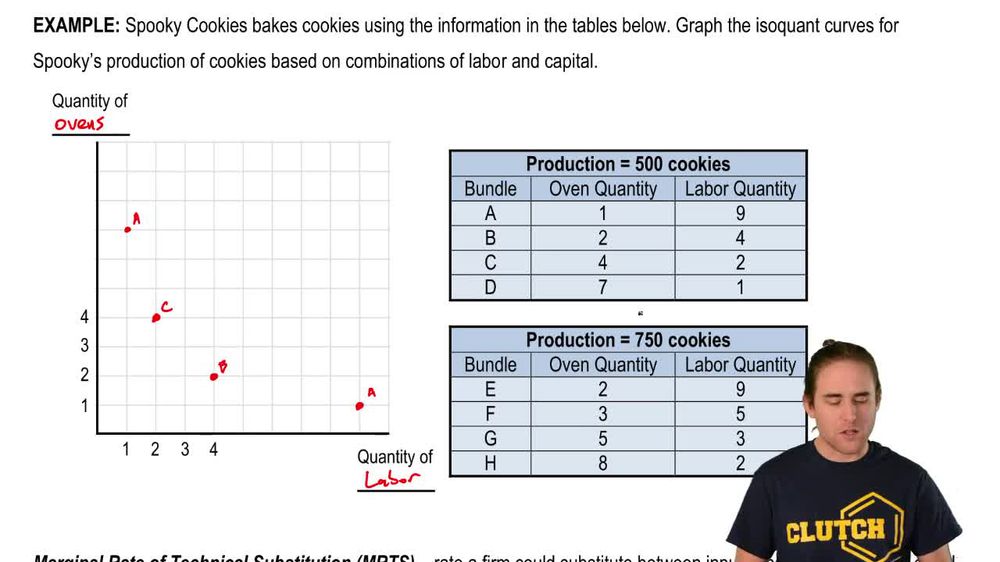
 09:45
09:45