Skip to main content
Microeconomics
My Course
Learn
Exam Prep
AI Tutor
Study Guides
Flashcards
Explore
Try the app
My Course
Learn
Exam Prep
AI Tutor
Study Guides
Flashcards
Explore
Try the app
Back
Investment, Savings, and the Financial System definitions
You can tap to flip the card.
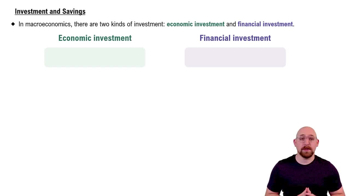
Economic Investment
You can tap to flip the card.
👆
Economic Investment
Allocation of resources by firms to increase future output, often through capital like factories or technology.
Track progress
Control buttons has been changed to "navigation" mode.
1/15
Related flashcards
Recommended videos
Investment, Savings, and the Financial System quiz
Investment, Savings, and the Financial System
15 Terms
02:10
The Financial System
1
views
02:01
Investment and Savings
1
views
Terms in this set (15)
Hide definitions
Economic Investment
Allocation of resources by firms to increase future output, often through capital like factories or technology.
Financial Investment
Placement of savings into assets such as stocks, bonds, or bank accounts to earn returns.
Capital
Physical assets like factories, warehouses, or technology used to produce goods and services.
Savings
Portion of income not spent on current consumption, typically held by households.
Financial System
Network that channels funds from savers to firms, supporting investment and economic growth.
Financial Markets
Platforms where savers directly provide funds to borrowers, such as through stocks or bonds.
Financial Intermediaries
Institutions like banks or mutual funds that indirectly channel savings to firms.
Interest Rate
Percentage return earned on savings or investments, often paid by intermediaries like banks.
Stocks
Equity securities representing ownership in a company, purchased directly in financial markets.
Bonds
Debt securities issued by firms or governments, allowing direct investment by savers.
Mutual Funds
Financial intermediary pooling savings from many investors to invest in a diversified portfolio.
Credit Unions
Member-owned financial intermediaries providing banking services and channeling savings.
Households
Economic agents typically responsible for saving and financial investment activities.
Firms
Entities that undertake economic investment to expand productive capacity and output.
Economic Growth
Sustained increase in output and productive capacity, enabled by continuous investment.
 BackBack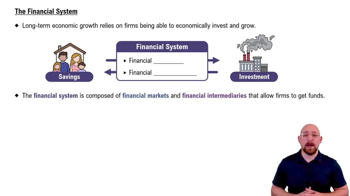
 02:10
02:10