Skip to main content
Microeconomics
My Course
Learn
Exam Prep
AI Tutor
Study Guides
Flashcards
Explore
Try the app
My Course
Learn
Exam Prep
AI Tutor
Study Guides
Flashcards
Explore
Try the app
Back
Introduction to the Four Market Models definitions
You can tap to flip the card.
Market Structure
You can tap to flip the card.
👆
Market Structure
Classification of markets based on the number of suppliers present, shaping competition and pricing.
Track progress
Control buttons has been changed to "navigation" mode.
1/14
Related flashcards
Related practice
Recommended videos
Introduction to the Four Market Models quiz #1
Introduction to the Four Market Models
10 Terms
Introduction to the Four Market Models
11. Perfect Competition
10 problems
Topic
Characteristics of Perfect Competition
11. Perfect Competition
10 problems
Topic
11. Perfect Competition
11 topics
15 problems
Chapter
Guided course
02:25
Four Market Model Summary
4
views
Terms in this set (14)
Hide definitions
Market Structure
Classification of markets based on the number of suppliers present, shaping competition and pricing.
Perfect Competition
A scenario with countless suppliers and buyers, making individual influence on price negligible.
Monopolistic Competition
A market with numerous suppliers, each offering differentiated products to attract buyers.
Oligopoly
A market dominated by a small group of suppliers, often leading to strategic interactions among firms.
Monopoly
A market where a single supplier controls the entire supply, eliminating competition.
Supplier
An entity providing goods or services within a market, influencing structure and competition.
Buyer
An individual or group purchasing goods or services, contributing to market dynamics.
Summary Sheet
A tool for organizing and comparing characteristics of different market models throughout study.
Chapter
A segment of study material focusing on specific aspects of market models and their features.
Comparison
The process of evaluating similarities and differences among market structures for deeper understanding.
Contrast
Highlighting distinctions between market models to clarify unique characteristics.
Infinite Suppliers
A condition where the number of suppliers is so large that no single entity can affect market outcomes.
Few Suppliers
A situation where only a small number of firms operate, often leading to concentrated market power.
One Supplier
A market condition where a single entity provides all goods or services, resulting in exclusive control.
 BackBack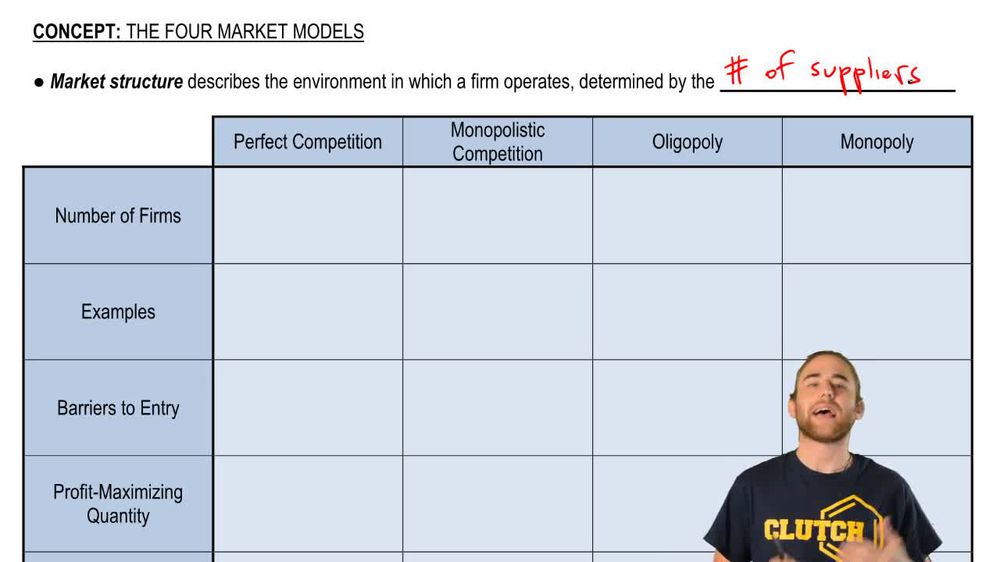
 02:25
02:25