Skip to main content
Microeconomics
My Course
Learn
Exam Prep
AI Tutor
Study Guides
Flashcards
Explore
Try the app
My Course
Learn
Exam Prep
AI Tutor
Study Guides
Flashcards
Explore
Try the app
Back
Introduction to the Federal Reserve definitions
You can tap to flip the card.
Federal Reserve
You can tap to flip the card.
👆
Federal Reserve
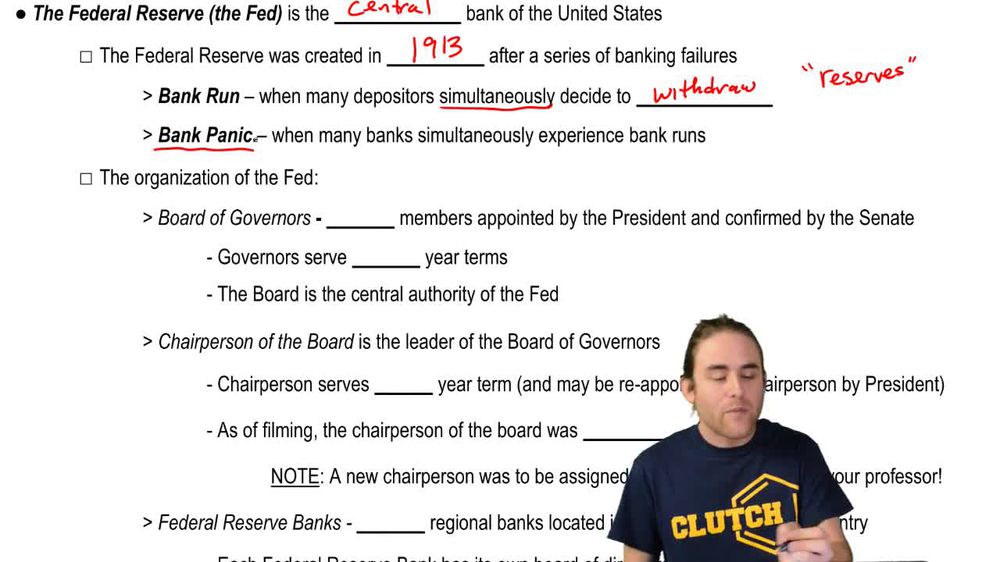
U.S. central bank established in 1913 to prevent financial crises and ensure stability in the banking system.
Track progress
Control buttons has been changed to "navigation" mode.
1/15
Related flashcards
Recommended videos
Introduction to the Federal Reserve quiz
Introduction to the Federal Reserve
15 Terms
Guided course
03:11
Role of the Federal Reserve
Guided course
05:05
Organization of the Federal Reserve
Terms in this set (15)
Hide definitions
Federal Reserve
U.S. central bank established in 1913 to prevent financial crises and ensure stability in the banking system.
Central Bank
Institution responsible for overseeing monetary policy and regulating the financial system of a country.
Board of Governors
Seven-member leadership group appointed for 14-year terms, serving as the main authority within the Federal Reserve.
Chairperson
Leader of the Board of Governors, appointed for a four-year term and often reappointed by the president.
Federal Reserve Banks
Twelve regional entities located in major U.S. cities, each with its own board and president, regulating local banks.
Federal Open Market Committee
Group of twelve members, including governors and regional presidents, responsible for decisions on money supply.
Monetary Policy
Actions taken to control the money supply and influence economic conditions, mainly through the FOMC.
Bank Failure
Situation where a financial institution cannot meet withdrawal demands due to insufficient funds.
Bank Run
Event where many depositors simultaneously withdraw funds, fearing insolvency, causing liquidity issues.
Lender of Last Resort
Role of providing emergency loans to banks facing financial distress to prevent collapse.
Discount Loan
Funds provided by the Federal Reserve to banks at a special interest rate to address short-term needs.
Discount Rate
Interest charged by the Federal Reserve on loans made directly to banks.
Federal Funds Rate
Interest rate for overnight loans between banks, used to meet reserve requirements.
Reserve Requirement
Regulation mandating banks to hold a certain percentage of deposits as reserves.
Open Market Operations
Buying and selling of securities by the Federal Reserve to adjust the money supply in the economy.
 BackBack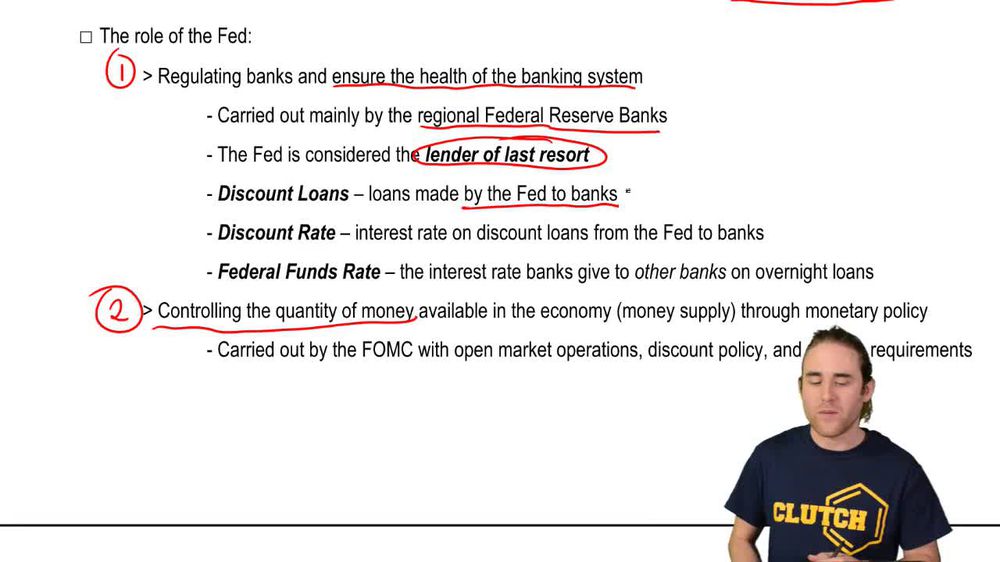
 03:11
03:11