What is the main difference between fiscal policy and monetary policy?
Fiscal policy involves government spending and taxes, while monetary policy is managed by the Federal Reserve and deals with money supply and interest rates.
How does government spending affect GDP?
Government spending is a direct component of GDP; increasing government spending raises GDP, while decreasing it lowers GDP.
What is disposable income?
Disposable income is the money individuals have left after paying taxes, which can be used for consumption or saving.
How do higher taxes impact disposable income and consumption?
Higher taxes reduce disposable income, which in turn lowers consumption.
What happens to consumption when taxes are decreased?
When taxes decrease, disposable income increases, leading to higher consumption.
What is discretionary fiscal policy?
Discretionary fiscal policy refers to proactive government actions to change spending or taxes, such as passing new laws or budgets.
Give an example of discretionary fiscal policy.
An example is Congress passing a bill to decrease taxes or approve a large infrastructure project.
What are automatic stabilizers in fiscal policy?
Automatic stabilizers are government spending and tax mechanisms that adjust automatically with the business cycle, without new government action.
How do automatic stabilizers affect taxes during an economic boom?
During a boom, incomes rise, leading to higher taxes, which helps moderate consumption and stabilize the economy.
What happens to taxes and consumption during a recession due to automatic stabilizers?
In a recession, incomes fall, resulting in lower taxes, which increases disposable income and boosts consumption.
How does unemployment insurance act as an automatic stabilizer?
Unemployment insurance increases government spending during recessions (when more people are unemployed) and decreases it during booms (when fewer people are unemployed).
Why are automatic stabilizers important for economic stability?
They help smooth out fluctuations in the business cycle by automatically adjusting spending and taxes, supporting aggregate demand during downturns and restraining it during booms.
What is the effect of increased government spending during a recession?
Increased government spending during a recession raises aggregate demand and helps support economic growth.
How do automatic stabilizers differ from discretionary fiscal policy?
Automatic stabilizers operate without new government action, while discretionary fiscal policy requires deliberate changes by the government.
Why does the government want to reduce spending during an economic boom?
Reducing spending during a boom helps prevent the economy from overheating and keeps inflation under control.
 Back
Back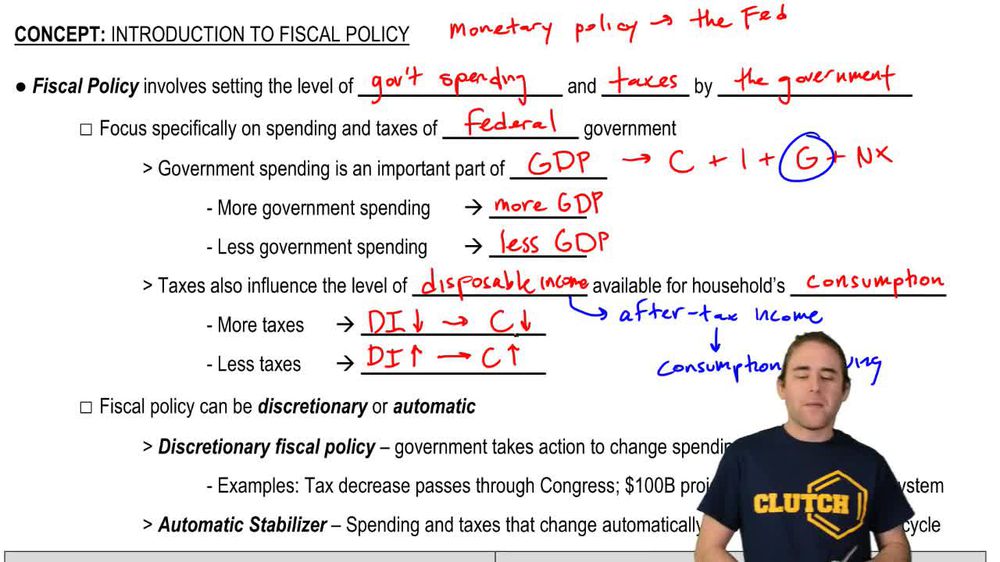
 09:33
09:33