Skip to main content
Microeconomics
My Course
Learn
Exam Prep
AI Tutor
Study Guides
Flashcards
Explore
Try the app
My Course
Learn
Exam Prep
AI Tutor
Study Guides
Flashcards
Explore
Try the app
Back
Introducing Taxes and Tax Incidence definitions
You can tap to flip the card.
Tax
You can tap to flip the card.
👆
Tax
A government-imposed charge per unit of a good, used to fund public services and affecting market prices and quantities.
Track progress
Control buttons has been changed to "navigation" mode.
1/15
Related flashcards
Related practice
Recommended videos
Introducing Taxes and Tax Incidence quiz #1
Introducing Taxes and Tax Incidence
30 Terms
Introducing Taxes and Tax Incidence
6. Introduction to Taxes and Subsidies
10 problems
Topic
Effects of Taxes on a Market
6. Introduction to Taxes and Subsidies
10 problems
Topic
6. Introduction to Taxes and Subsidies
8 topics
12 problems
Chapter
Guided course
03:21
Tax Incidence
9
views
Guided course
13:27
Taxes and Tax Incidence
9
views
Terms in this set (15)
Hide definitions
Tax
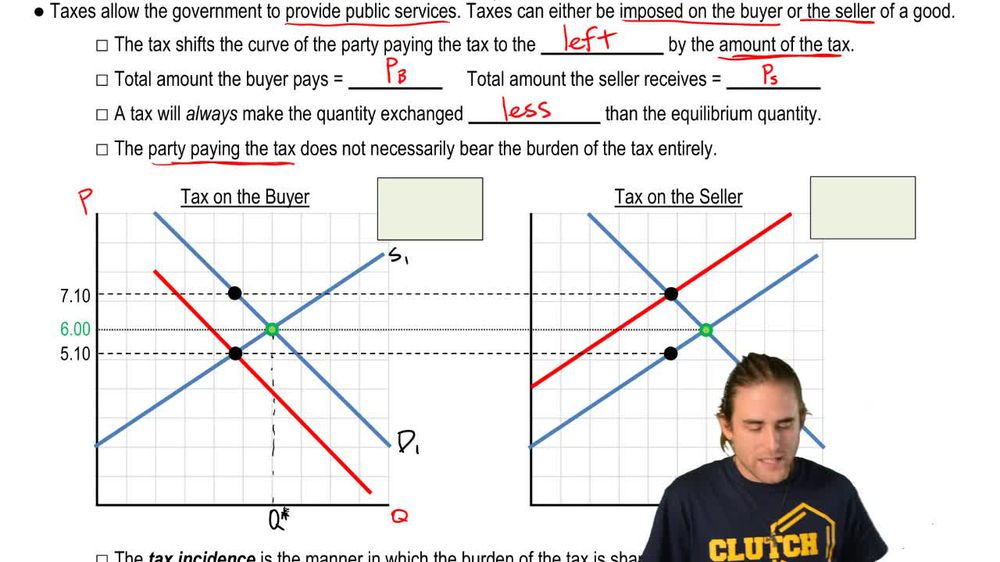
A government-imposed charge per unit of a good, used to fund public services and affecting market prices and quantities.
Public Services
Essential functions like education, police, and fire protection, funded by government revenue from taxes.
Per Unit Tax
A fixed amount charged for each item exchanged, causing price and quantity changes in the market.
Demand Curve
A graphical representation showing the relationship between price and quantity demanded, shifting left when taxed.
Supply Curve
A graphical line depicting the relationship between price and quantity supplied, shifting left when taxed.
Market Equilibrium
The point where supply and demand intersect, determining the price and quantity traded before and after tax.
Price to Buyer
The total amount paid by consumers, including the original price and any imposed tax.
Price to Seller
The amount received by suppliers after subtracting any tax paid to the government.
Tax Burden
The portion of a tax cost shared between buyers and sellers, regardless of who is initially taxed.
Tax Incidence
The division of tax responsibility between consumers and producers, measured in dollars or percentages.
Graphical Representation
Visual tools used to illustrate how taxes shift supply or demand curves and alter market outcomes.
Quantity Exchanged
The number of units traded in the market, which decreases when a tax is imposed.
Equilibrium Quantity
The amount traded at the intersection of supply and demand before any tax is applied.
Inefficiency
A market outcome where fewer goods are exchanged than at equilibrium, often caused by taxes.
Percentage Share
The fraction of total tax paid by each party, calculated as a proportion of the tax amount.
 BackBack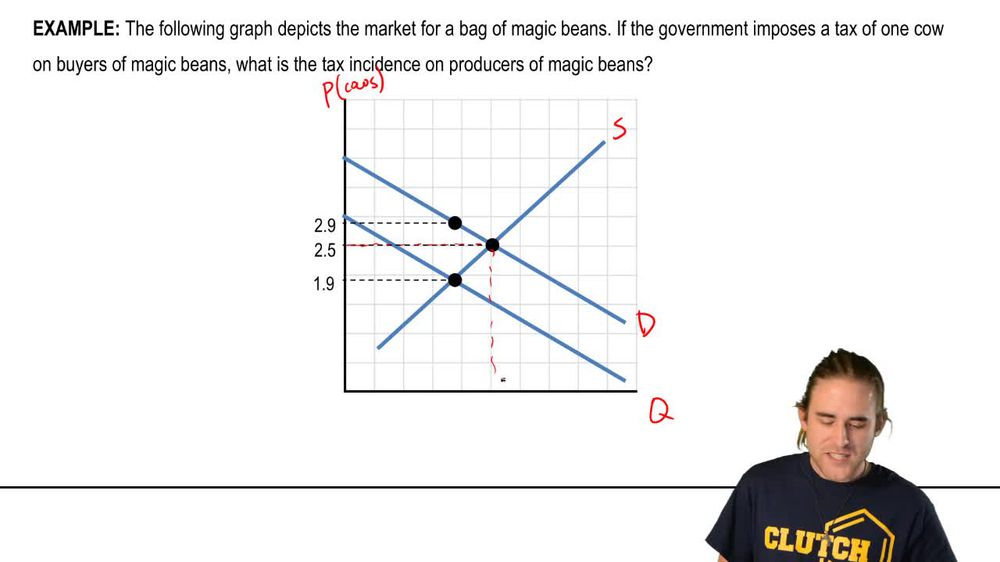
 03:21
03:21