Skip to main content
Microeconomics
My Course
Learn
Exam Prep
AI Tutor
Study Guides
Flashcards
Explore
Try the app
My Course
Learn
Exam Prep
AI Tutor
Study Guides
Flashcards
Explore
Try the app
Back
Individual Supply Curve in the Short Run and Long Run definitions
You can tap to flip the card.
Short Run
You can tap to flip the card.
👆
Short Run
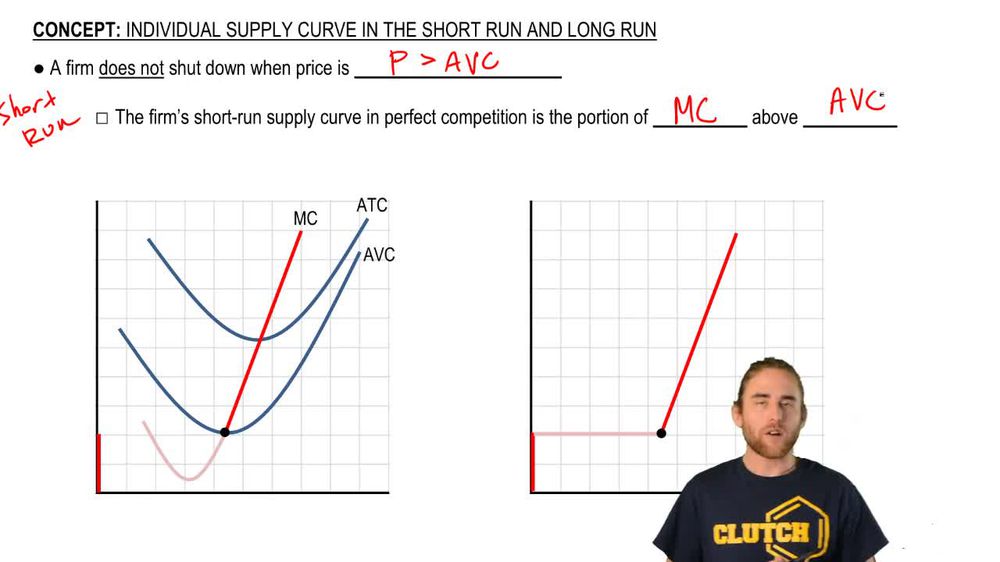
A period during which a firm decides production based on covering variable costs, not all costs.
Track progress
Control buttons has been changed to "navigation" mode.
1/15
Related flashcards
Related practice
Recommended videos
Individual Supply Curve in the Short Run and Long Run quiz #1
Individual Supply Curve in the Short Run and Long Run
10 Terms
Individual Supply Curve in the Short Run and Long Run
11. Perfect Competition
10 problems
Topic
Market Supply Curve in the Short Run and Long Run
11. Perfect Competition
10 problems
Topic
11. Perfect Competition
11 topics
15 problems
Chapter
Guided course
03:12
Individual Firm Supply Curve in the Long Run
7
views
Guided course
03:19
Individual Firm Supply Curve in the Short Run
3
views
Terms in this set (15)
Hide definitions
Short Run
A period during which a firm decides production based on covering variable costs, not all costs.
Long Run
A timeframe where a firm considers all costs and can exit or enter the market freely.
Average Variable Cost
The per-unit expense of variable inputs, crucial for determining production decisions in the short run.
Average Total Cost
The per-unit expense of all inputs, guiding a firm's market participation in the long run.
Marginal Cost
The extra expense incurred from producing one more unit, forming the basis of the supply curve.
Supply Curve
A graphical representation showing quantities a firm offers at various prices, shaped by cost conditions.
Perfect Competition
A market structure where firms are price takers and supply decisions depend on cost curves.
Shutdown Point
The price threshold below which a firm ceases production in the short run due to insufficient variable cost coverage.
Exit Point
The price threshold below which a firm leaves the market in the long run, not covering total costs.
Production Quantity
The amount a firm chooses to produce, determined by where revenue equals marginal cost above cost thresholds.
Minimum AVC
The lowest value of average variable cost, marking the start of the short run supply curve.
Minimum ATC
The lowest value of average total cost, marking the start of the long run supply curve.
Marginal Revenue
The additional income from selling one more unit, used to determine optimal production.
Profit
The surplus earned when price exceeds average total cost, motivating long run production.
Cost Curve
A graphical tool showing how costs change with output, essential for supply decisions.
 BackBack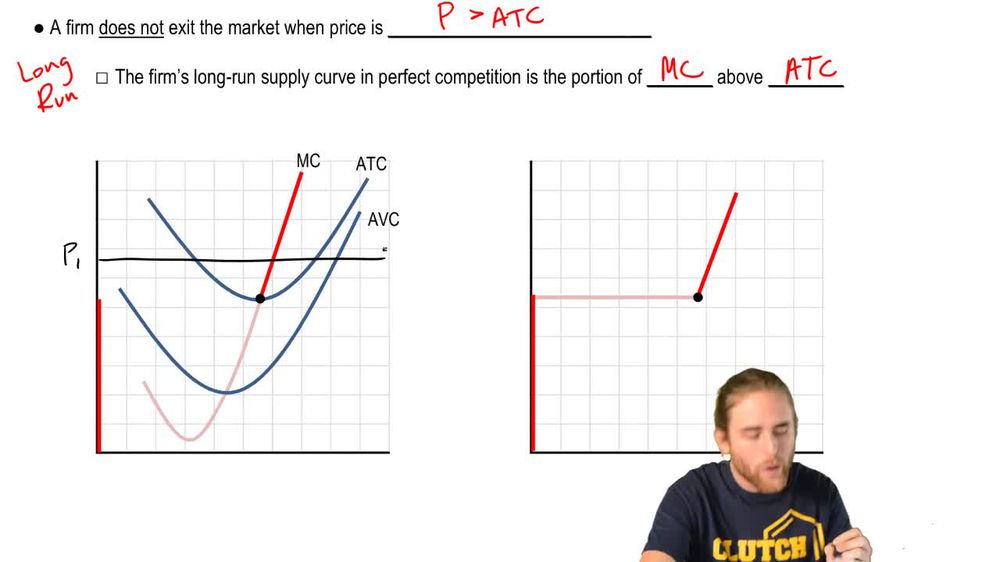
 03:12
03:12