Why do economists study poverty and income inequality?
Economists study poverty and income inequality to understand how income is distributed among households and what factors contribute to unequal economic outcomes.
What percentage of wealth is owned by the bottom 50% of families (those with less than \$122,000)?
The bottom 50% of families own a small percentage of total wealth compared to higher-income groups, highlighting significant wealth inequality.
Under which condition does a country with a small GDP have a large per capita income?
A country with a small GDP can have a large per capita income if its population is very small.
How has the distribution of income in the United States changed over the last 20 years?
Income inequality in the United States has increased, with a growing gap between the highest and lowest earners.
How were women prevented from establishing economic independence?
Women have historically faced barriers such as limited access to education, employment opportunities, and wage equality, which prevented economic independence.
Which of these nations had a lower GNI per capita than the United States in 2019?
Bolivia had a lower GNI per capita than the United States in 2019.
Which group has the lowest ownership of wealth?
The lowest income households have the lowest ownership of wealth.
Compared with U.S. citizens of higher incomes, those of lower incomes are more likely to experience what?
Compared with higher-income citizens, those of lower incomes are more likely to experience poverty and have less access to resources.
Sociologists refer to the differences in wealth and power among the countries of the world as what?
Sociologists refer to these differences as global social inequality.
Compared with U.S. citizens of higher incomes, those of lower incomes are more likely to experience what?
Lower-income citizens are more likely to experience economic hardship and limited opportunities compared to higher-income citizens.
The difference in income between the richest and poorest citizens is called what?
The difference in income between the richest and poorest citizens is called the income gap.
One main issue in studying global social inequality is:
One main issue is the significant variation in income and wealth distribution between countries.
A wealth gap is an economic difference between which groups?
A wealth gap is an economic difference between groups such as economic classes or nations.
The income gap between high school and college graduates averages about _____ per year.
The income gap between high school and college graduates averages several thousand dollars per year, with college graduates typically earning more.
A wealth gap is an economic difference between nations, economic classes, businesses, or governments.
A wealth gap refers to the economic difference in wealth between nations, economic classes, businesses, or governments.
Where does income inequality exist?
Income inequality exists both in the United States and worldwide, with some countries experiencing greater disparities than others.
The Gini ratio is a numerical measure of what?
The Gini ratio is a numerical measure of income inequality within a population.
 Back
Back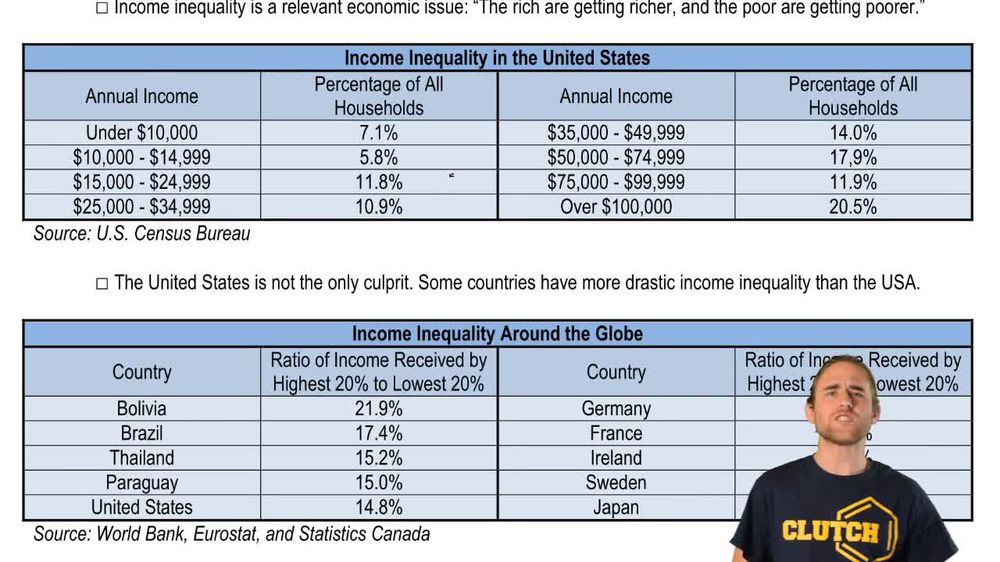
 01:37
01:37