Skip to main content
Microeconomics
My Course
Learn
Exam Prep
AI Tutor
Study Guides
Flashcards
Explore
Try the app
My Course
Learn
Exam Prep
AI Tutor
Study Guides
Flashcards
Explore
Try the app
Back
Income Elasticity of Demand definitions
You can tap to flip the card.
Income Elasticity of Demand
You can tap to flip the card.
👆
Income Elasticity of Demand
Measures how quantity demanded changes in response to variations in consumer income, distinguishing between types of goods.
Track progress
Control buttons has been changed to "navigation" mode.
1/13
Related flashcards
Related practice
Recommended videos
Income Elasticity of Demand quiz #1
Income Elasticity of Demand
13 Terms
Income Elasticity of Demand
4. Elasticity
10 problems
Topic
Cross-Price Elasticity of Demand
4. Elasticity
10 problems
Topic
4. Elasticity
11 topics
15 problems
Chapter
Guided course
10:57
Income Elasticity of Demand
8
views
Terms in this set (13)
Hide definitions
Income Elasticity of Demand
Measures how quantity demanded changes in response to variations in consumer income, distinguishing between types of goods.
Normal Good
A product for which demand rises as consumer income increases, indicated by a positive value in elasticity calculations.
Inferior Good
A product for which demand falls as consumer income increases, shown by a negative value in elasticity calculations.
Luxury Good
A product with income elasticity greater than one, where demand increases more than proportionally with income.
Necessity
A product with positive income elasticity less than one, where demand increases but less than proportionally with income.
Midpoint Method
A calculation technique using averages to determine percentage changes, minimizing bias from direction of change.
Quantity Demanded
The amount of a product consumers are willing to purchase at a given income level, used in elasticity calculations.
Consumer Income
The financial resources available to buyers, serving as the denominator in income elasticity calculations.
Elasticity
A measure of responsiveness, indicating how much one variable changes in relation to another, such as demand to income.
Ceteris Paribus
The principle of holding all other factors constant to isolate the effect of income changes on demand.
Percentage Change
A calculation expressing the relative difference between two values, used in both numerator and denominator of elasticity.
Positive Value
An outcome in elasticity analysis indicating that demand increases with rising income, associated with normal goods.
Negative Value
An outcome in elasticity analysis indicating that demand decreases as income rises, associated with inferior goods.
 BackBack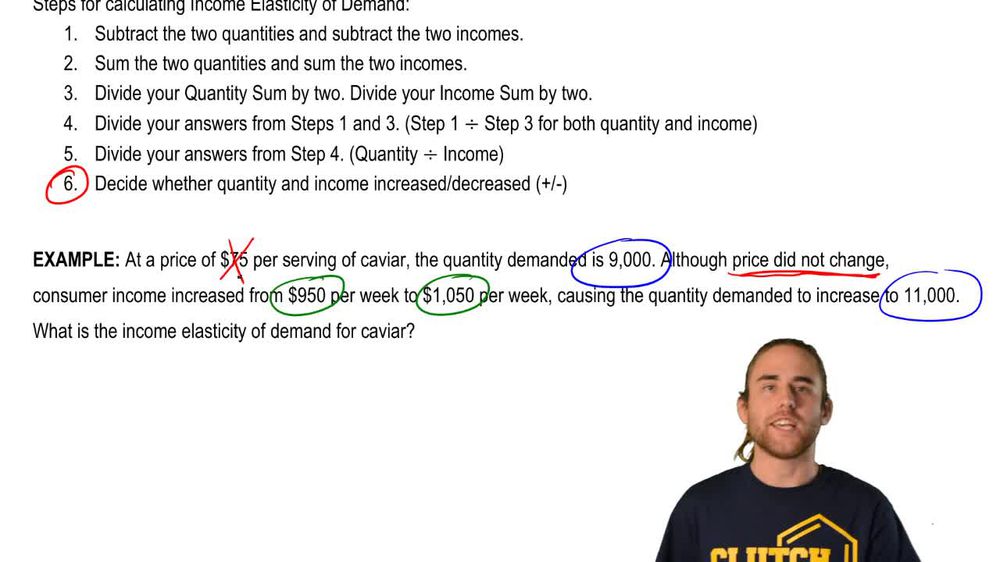
 10:57
10:57