Skip to main content
Microeconomics
My Course
Learn
Exam Prep
AI Tutor
Study Guides
Flashcards
Explore
Try the app
My Course
Learn
Exam Prep
AI Tutor
Study Guides
Flashcards
Explore
Try the app
Back
Growth Rates and the Rule of 70 definitions
You can tap to flip the card.
Economic Growth
You can tap to flip the card.
👆
Economic Growth
Increase in a nation's output measured by changes in GDP, reflecting improvements in living standards over time.
Track progress
Control buttons has been changed to "navigation" mode.
1/14
Related flashcards
Recommended videos
Growth Rates and the Rule of 70 quiz
Growth Rates and the Rule of 70
15 Terms
Guided course
05:47
Growth Rates and the Rule of 70
1
views
Guided course
02:50
Growth Rates and the Rule of 70
1
views
Terms in this set (14)
Hide definitions
Economic Growth
Increase in a nation's output measured by changes in GDP, reflecting improvements in living standards over time.
GDP
Monetary value of all finished goods and services produced within a country's borders during a specific period.
Annual Growth Rate
Percentage change in GDP from one year to the next, calculated by comparing current and prior values.
Percentage Change
Calculation method for measuring how much a value has increased or decreased relative to its previous amount.
Average Annual Growth Rate
Mean of yearly growth percentages, found by summing individual rates and dividing by the number of years.
Rule of 70
Approximation tool for estimating the number of years required for a value to double given a constant growth rate.
Doubling Time
Period needed for GDP or another value to reach twice its original amount, influenced by the growth rate.
Standard of Living
Level of wealth, comfort, and material goods available to a population, affected by economic growth rates.
Approximation
Estimation technique used to simplify complex calculations, such as predicting doubling time with the Rule of 70.
Growth Rate
Percentage increase in economic output over a specified period, crucial for analyzing performance and sustainability.
Long-Run Equilibrium
State where an economy's output, growth, and resources are balanced over an extended period.
Market Equilibrium
Condition where supply and demand are balanced, often influenced by changes in economic growth.
Prior GDP
Value of a country's output in the previous period, used as a reference for calculating growth.
Current GDP
Most recent measurement of a country's output, serving as the basis for growth calculations.
 BackBack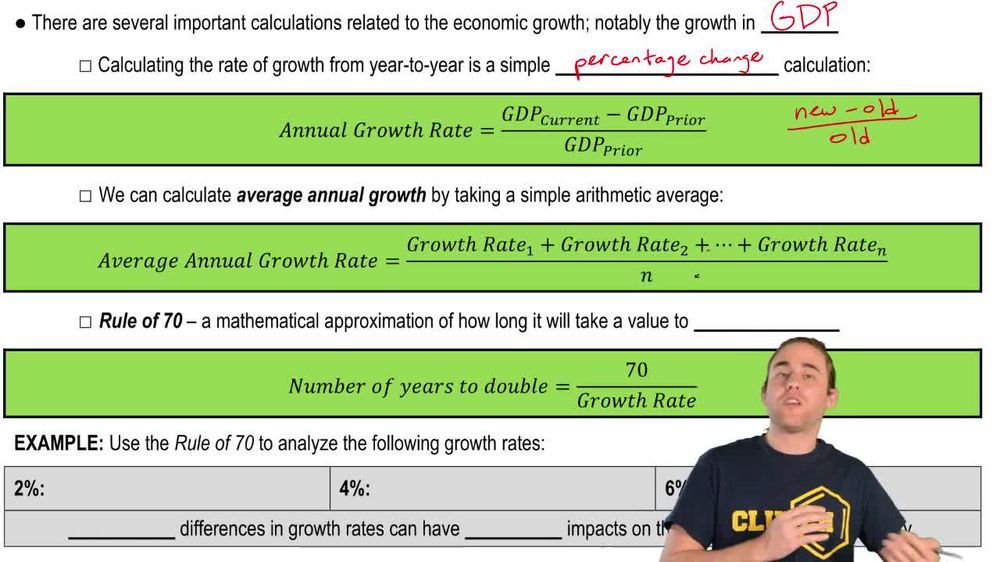
 05:47
05:47