Skip to main content
Microeconomics
My Course
Learn
Exam Prep
AI Tutor
Study Guides
Flashcards
Explore
Try the app
My Course
Learn
Exam Prep
AI Tutor
Study Guides
Flashcards
Explore
Try the app
Back
Government Purchases and the Multiplier Effect definitions
You can tap to flip the card.
Multiplier Effect
You can tap to flip the card.
👆
Multiplier Effect
Chain reaction where initial spending triggers successive rounds of increased consumption, amplifying the impact on GDP.
Track progress
Control buttons has been changed to "navigation" mode.
1/15
Related flashcards
Recommended videos
Government Purchases and the Multiplier Effect quiz
Government Purchases and the Multiplier Effect
15 Terms
Guided course
08:02
Government Purchases GDP Multiplier
Terms in this set (15)
Hide definitions
Multiplier Effect
Chain reaction where initial spending triggers successive rounds of increased consumption, amplifying the impact on GDP.
Fiscal Policy
Government actions involving spending or taxation designed to influence economic activity and aggregate demand.
Government Purchases
Expenditures by the public sector on goods, services, or projects that directly affect national income.
GDP
Total value of all goods and services produced within a country, calculated as C+I+G+NX.
Consumption
Spending by households on goods and services, a key component of aggregate demand and GDP.
Aggregate Demand
Overall demand for goods and services in an economy, represented by a curve showing the relationship between price level and GDP.
Marginal Propensity to Consume
Fraction of additional income that households spend on consumption rather than saving.
Multiplier
Numerical factor showing how much total GDP changes in response to an initial change in spending, calculated as 1/(1-MPC).
Income
Money received by households, often increased through government spending, leading to higher consumption.
Aggregate Demand Curve
Graphical representation showing how aggregate demand shifts in response to changes in spending and consumption.
Economic Growth
Increase in a country's output and income, often stimulated by government spending and the multiplier effect.
Incentives
Factors motivating households to spend or save, influencing the size of the multiplier effect.
Net Exports
Difference between a country's exports and imports, part of the GDP equation affected by the multiplier.
Investment
Spending by businesses on capital goods, which can trigger multiplier effects similar to government purchases.
Price Level
Average of current prices across the entire economy, used in aggregate demand analysis.
 BackBack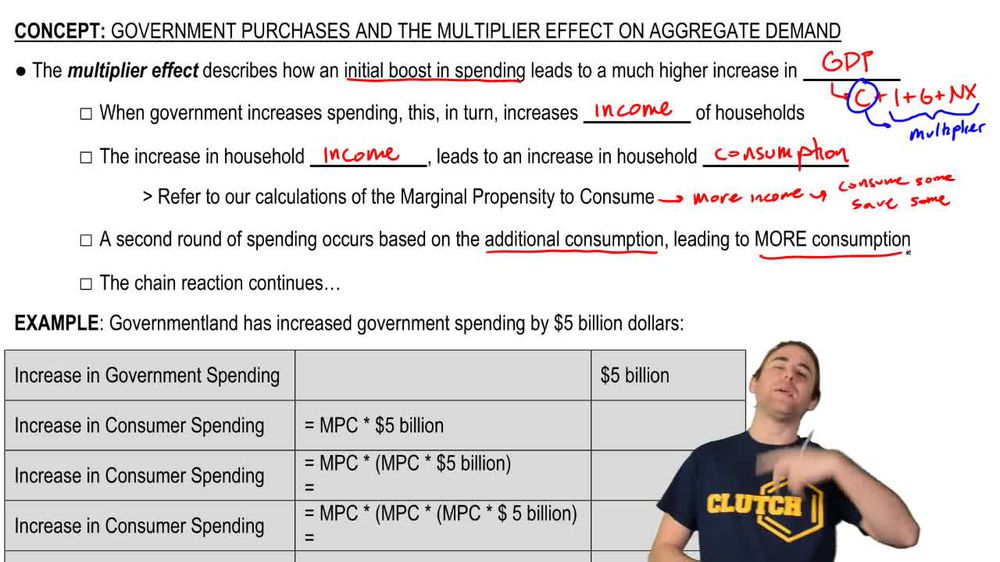
 08:02
08:02