Skip to main content
Microeconomics
My Course
Learn
Exam Prep
AI Tutor
Study Guides
Flashcards
Explore
Try the app
My Course
Learn
Exam Prep
AI Tutor
Study Guides
Flashcards
Explore
Try the app
Back
Game Theory and Oligopoly Profit definitions
You can tap to flip the card.
Oligopoly
You can tap to flip the card.
👆
Oligopoly
A market structure with a few firms whose decisions are mutually dependent, leading to strategic behavior and interdependence.
Track progress
Control buttons has been changed to "navigation" mode.
1/15
Related flashcards
Related practice
Recommended videos
Game Theory and Oligopoly Profit quiz #1
Game Theory and Oligopoly Profit
10 Terms
Game Theory and Oligopoly Profit
14. Oligopoly
10 problems
Topic
Repeated Games
14. Oligopoly
10 problems
Topic
14. Oligopoly
6 topics
14 problems
Chapter
Guided course
06:36
Oligopoly Profit
2
views
Guided course
10:08
Oligopoly Profit
3
views
Terms in this set (15)
Hide definitions
Oligopoly
A market structure with a few firms whose decisions are mutually dependent, leading to strategic behavior and interdependence.
Duopoly
A special case of oligopoly with only two producers, where each firm's actions directly affect the other's outcomes.
Interdependence
A situation where firms must consider rivals' choices when making decisions, as outcomes are linked.
Collusion
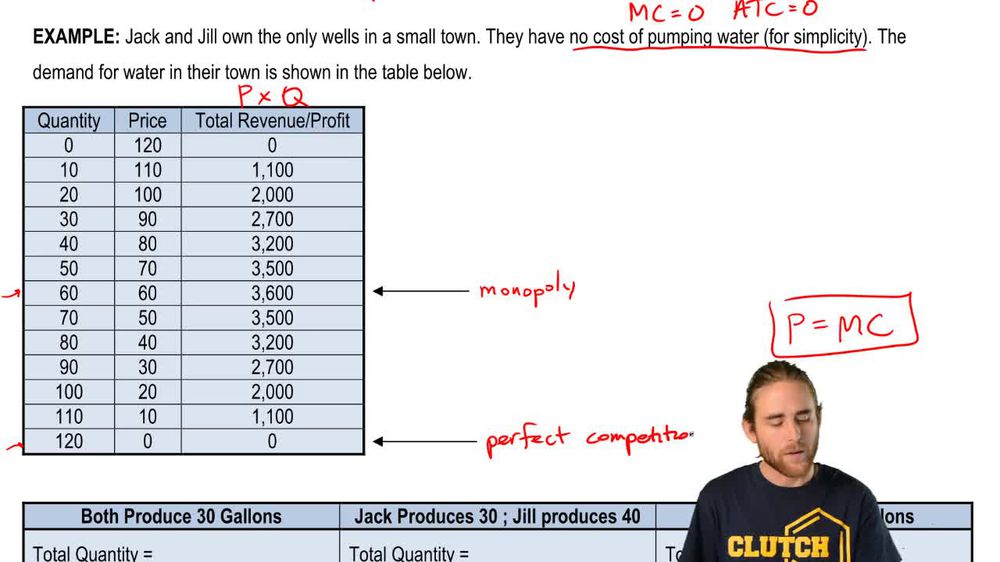
An agreement among firms to coordinate output or pricing to maximize joint profits, often mimicking monopoly outcomes.
Monopoly
A market with a single producer, allowing maximum profit and control over output and price.
Perfect Competition
A market with many firms, where price equals marginal cost and profits are driven to zero.
Marginal Cost
The additional expense incurred from producing one more unit, which is zero in the discussed example.
Demand Curve
A graphical representation showing the inverse relationship between price and quantity demanded.
Payoff Matrix
A table summarizing possible outcomes for each player based on their choices and those of their rival.
Dominant Strategy
A choice that yields the highest payoff for a player regardless of the rival's actions.
Nash Equilibrium
A scenario where no player can improve their outcome by changing their strategy, given the other's choice.
Prisoner's Dilemma
A situation where rational self-interest leads to worse outcomes than cooperation, despite mutual benefit from collusion.
Revenue
The total income from sales, equal to profit when production costs are absent.
Industry Profit
The combined earnings of all firms in a market, which can decrease with increased competition or cheating.
Market Power
The ability of a firm to influence price and output, highest in monopoly and reduced in oligopoly.
 BackBack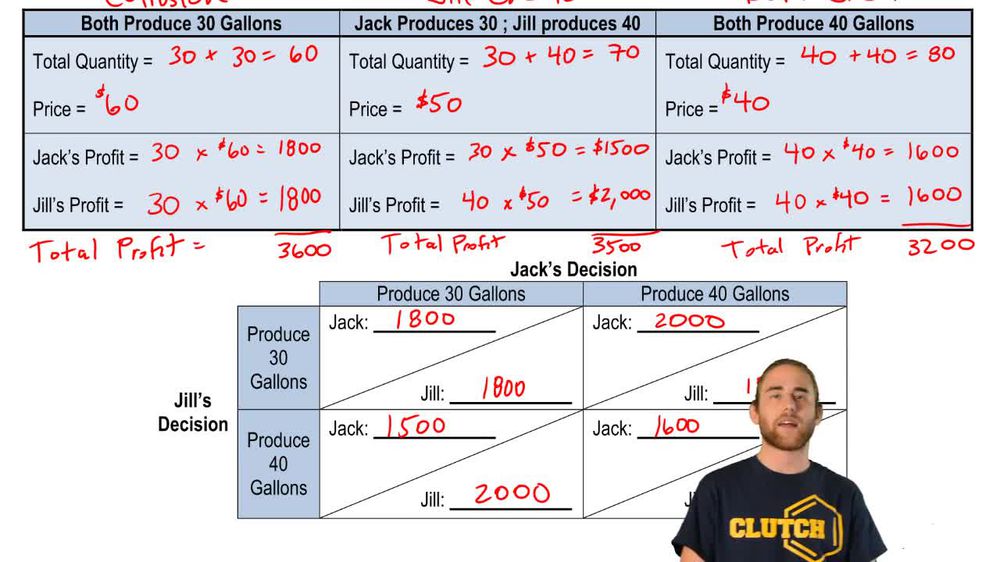
 06:36
06:36