Skip to main content
Microeconomics
My Course
Learn
Exam Prep
AI Tutor
Study Guides
Flashcards
Explore
Try the app
My Course
Learn
Exam Prep
AI Tutor
Study Guides
Flashcards
Explore
Try the app
Back
Four Market Model Summary: Monopolistic Competition quiz
You can tap to flip the card.
How many firms typically operate in a monopolistic competition market structure?
You can tap to flip the card.
👆
How many firms typically operate in a monopolistic competition market structure?
There are many firms in monopolistic competition, though not as many as in perfect competition.
Track progress
Control buttons has been changed to "navigation" mode.
1/15
Related flashcards
Related practice
Recommended videos
Four Market Model Summary: Monopolistic Competition definitions
Four Market Model Summary: Monopolistic Competition
13 Terms
Four Market Model Summary: Monopolistic Competition
13. Monopolistic Competition
10 problems
Topic
Advertising
13. Monopolistic Competition
10 problems
Topic
13. Monopolistic Competition
7 topics
15 problems
Chapter
Guided course
03:30
Four Market Model Summary: Monopolistic Competition
5
views
Terms in this set (15)
Hide definitions
How many firms typically operate in a monopolistic competition market structure?
There are many firms in monopolistic competition, though not as many as in perfect competition.
What are two common examples of monopolistically competitive markets?
Fast food and coffee markets are common examples of monopolistically competitive markets.
What are the barriers to entry like in monopolistic competition?
There are minimal barriers to entry in monopolistic competition, making it easy for new firms to enter.
How is the profit-maximizing quantity determined in monopolistic competition?
The profit-maximizing pipeline is where marginal revenue equals marginal cost.
In the long run, do firms in monopolistic competition earn economic profits?
No, in the long run, firms in monopolistic competition earn zero economic profit because price equals average total cost.
How does the price in monopolistic competition compare to marginal revenue?
Price is greater than marginal revenue due to the downward sloping demand curve faced by each firm.
How does the price in monopolistic competition compare to marginal cost?
Price is greater than marginal cost, indicating a markup over marginal cost at the profit-maximizing output.
Why is marginal revenue less than price in monopolistic competition?
Because each firm faces a downward sloping demand curve, marginal revenue is less than price.
What happens to economic profit in monopolistic competition as new firms enter the market?
Economic profit is eliminated as new firms enter, driving price down to equal average total cost.
How do you find the price a firm charges in monopolistic competition?
After finding the profit-maximizing quantity where MR = MC, you use the demand curve to find the price.
What is the relationship between average total cost and price in the long run for monopolistic competition?
In the long run, price equals average total cost, so firms earn zero economic profit.
What does a markup over marginal cost mean in monopolistic competition?
It means that the price charged is higher than the marginal cost at the profit-maximizing output.
How does the number of firms in monopolistic competition compare to perfect competition?
There are many firms in monopolistic competition, but fewer than in perfect competition.
What role does the demand curve play in determining price in monopolistic competition?
The demand curve determines the price a firm can charge for its profit-maximizing quantity.
What is a key difference between monopolistic competition and perfect competition regarding product differentiation?
Firms in monopolistic competition sell differentiated products, unlike the identical products in perfect competition.
 BackBack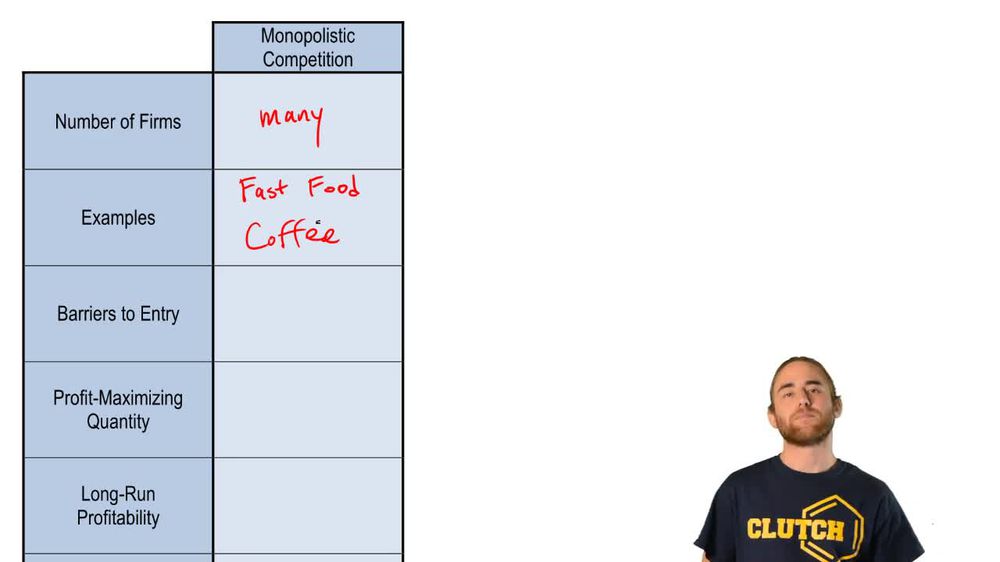
 03:30
03:30