Skip to main content
Microeconomics
My Course
Learn
Exam Prep
AI Tutor
Study Guides
Flashcards
Explore
Try the app
My Course
Learn
Exam Prep
AI Tutor
Study Guides
Flashcards
Explore
Try the app
Back
Exporting and Importing definitions
You can tap to flip the card.
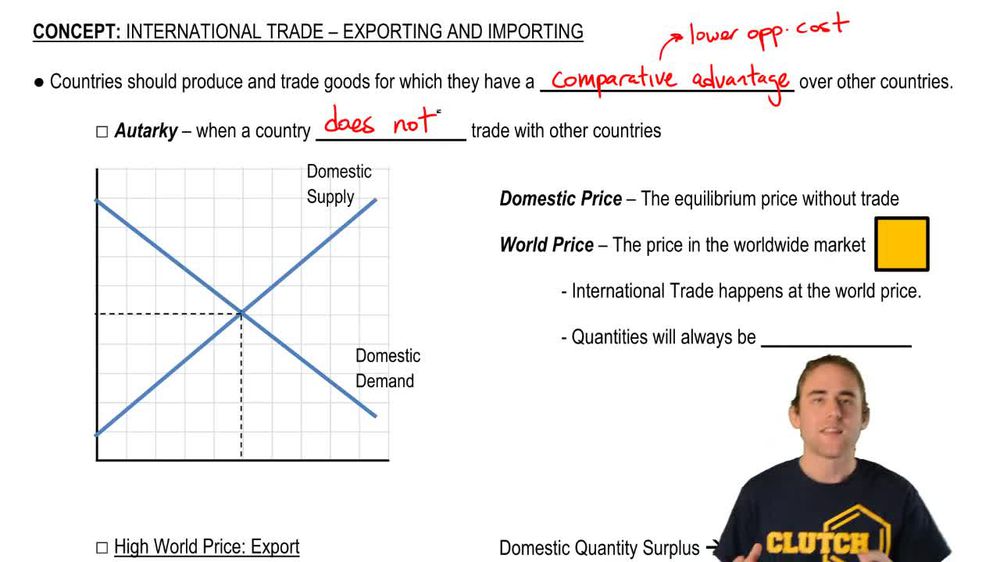
Autarky
You can tap to flip the card.
👆
Autarky
A situation where a country does not engage in international trade, relying solely on its own supply and demand.
Track progress
Control buttons has been changed to "navigation" mode.
1/15
Related flashcards
Related practice
Recommended videos
Exporting and Importing quiz #1
Exporting and Importing
39 Terms
Exporting and Importing quiz #2
Exporting and Importing
14 Terms
Exporting and Importing
9. International Trade
10 problems
Topic
Sources of Comparative Advantage
9. International Trade
10 problems
Topic
9. International Trade
5 topics
15 problems
Chapter
Guided course
06:36
Low World Price:Import
6
views
Guided course
04:
Autarky
7
views
Guided course
09:03
High World Price:Export
5
views
Terms in this set (15)
Hide definitions
Autarky
A situation where a country does not engage in international trade, relying solely on its own supply and demand.
Comparative Advantage
The ability to produce a good at a lower opportunity cost than others, driving international trade decisions.
Domestic Price
The equilibrium price determined by supply and demand within a country, before international trade occurs.
World Price
The prevailing price for a good in the global market, which becomes relevant when a country opens to trade.
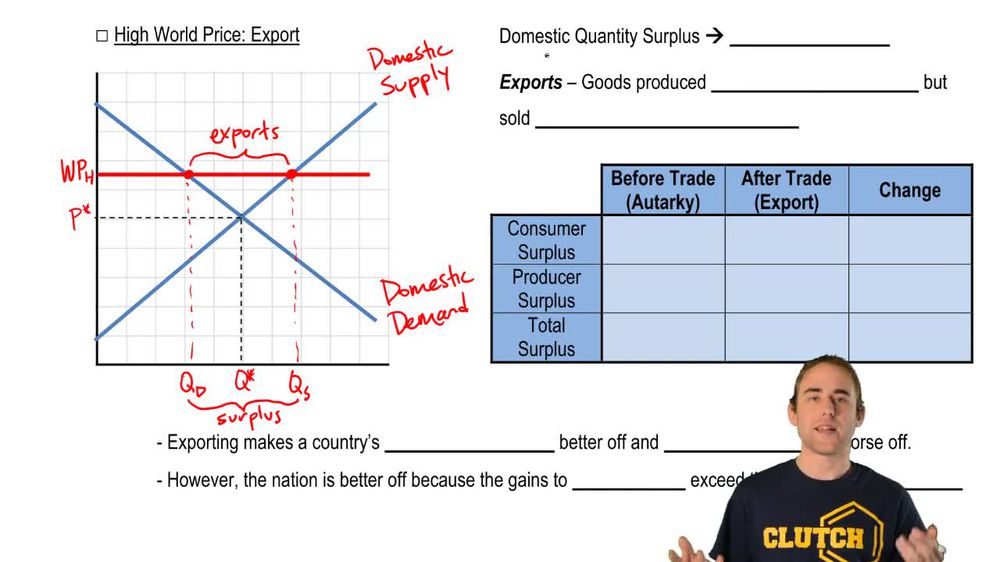
Export
A good produced within a country and sold to buyers in foreign markets, often when world price exceeds domestic price.
Import
A good produced abroad and purchased by domestic consumers, typically when world price is below domestic price.
Producer Surplus
The area between the supply curve and the market price, representing gains to sellers from trade.
Consumer Surplus
The area between the demand curve and the market price, showing benefits to buyers from trade.
Total Surplus
The sum of consumer and producer surplus, indicating overall economic welfare in a market.
Equilibrium
The point where domestic supply equals domestic demand, setting the initial price and quantity before trade.
Surplus
The excess of quantity supplied over quantity demanded at a given price, which can be exported in open trade.
Shortage
The excess of quantity demanded over quantity supplied at a given price, filled by imports in open trade.
Gains from Trade
The increase in national economic welfare resulting from international exchange, even if some groups lose.
Domestic Supply
The quantity of a good provided by producers within a country, forming part of the market analysis.
Domestic Demand
The quantity of a good desired by consumers within a country, used to assess market outcomes.
 BackBack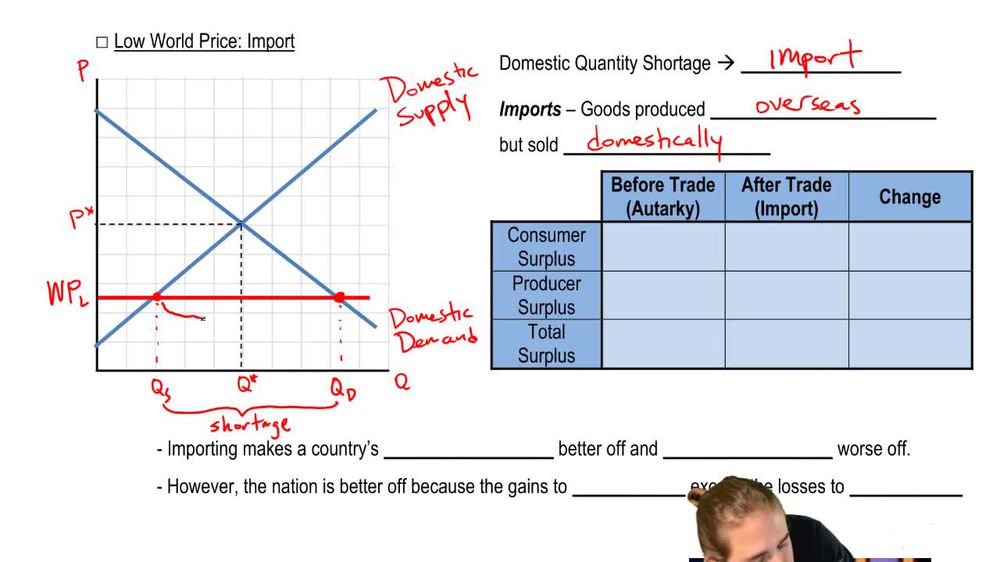
 06:36
06:36