Skip to main content
Microeconomics
My Course
Learn
Exam Prep
AI Tutor
Study Guides
Flashcards
Explore
Try the app
My Course
Learn
Exam Prep
AI Tutor
Study Guides
Flashcards
Explore
Try the app
Back
Expansionary and Contractionary Fiscal Policy definitions
You can tap to flip the card.
Fiscal Policy
You can tap to flip the card.
👆
Fiscal Policy
Government actions adjusting spending and taxes to influence aggregate demand and stabilize economic activity.
Track progress
Control buttons has been changed to "navigation" mode.
1/15
Related flashcards
Recommended videos
Expansionary and Contractionary Fiscal Policy quiz
Expansionary and Contractionary Fiscal Policy
15 Terms
Guided course
03:48
Contractionary Fiscal Policy
1
views
Guided course
05:24
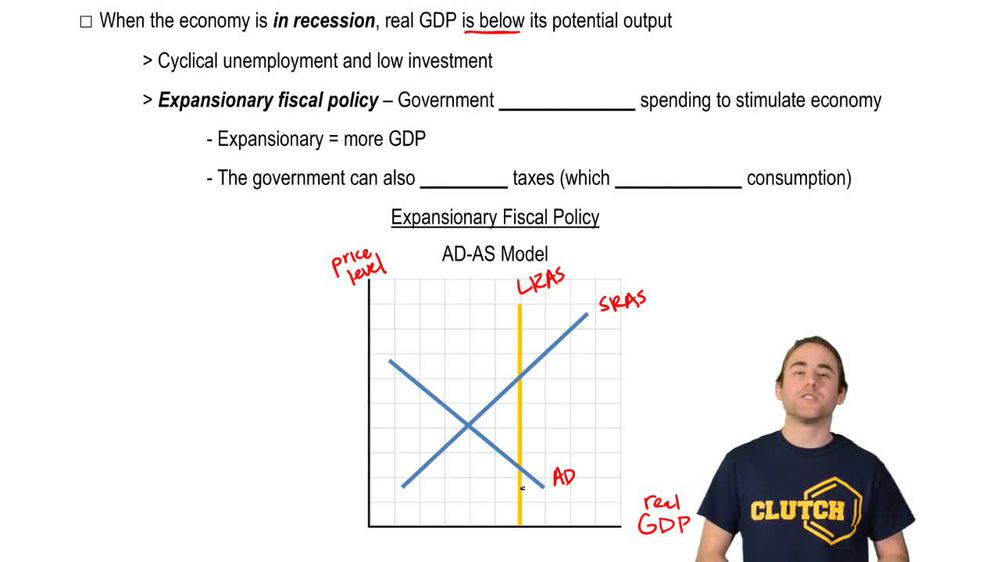
Expansionary Fiscal Policy
1
views
Terms in this set (15)
Hide definitions
Fiscal Policy
Government actions adjusting spending and taxes to influence aggregate demand and stabilize economic activity.
Expansionary Policy
Strategy involving increased government spending or reduced taxes to boost aggregate demand during recessions.
Contractionary Policy
Approach using decreased government spending or higher taxes to lower aggregate demand and control inflation.
Aggregate Demand
Total demand for goods and services from consumers, firms, government, and foreign buyers within an economy.
Aggregate Supply
Total output of goods and services available in an economy at various price levels.
AD-AS Model
Graphical framework showing interactions between aggregate demand and aggregate supply, determining equilibrium price and output.
Long Run Aggregate Supply
Representation of an economy’s potential output when all resources are fully employed.
Short Run Aggregate Supply
Depiction of output levels when some resources are not fully utilized, often affected by temporary factors.
Equilibrium
Point where aggregate demand and aggregate supply intersect, setting the economy’s price level and real GDP.
Price Level
Average of current prices across all goods and services in an economy, used to measure inflation.
Real GDP
Value of all goods and services produced, adjusted for inflation, reflecting actual economic output.
Potential Output
Maximum sustainable level of real GDP achievable when all resources are efficiently employed.
Cyclical Unemployment
Joblessness resulting from downturns in economic activity, typically rising during recessions.
Overemployment
Situation where labor usage exceeds sustainable levels, often due to booming economic conditions.
Government Purchases
Spending by the public sector on goods and services, directly contributing to aggregate demand.
 BackBack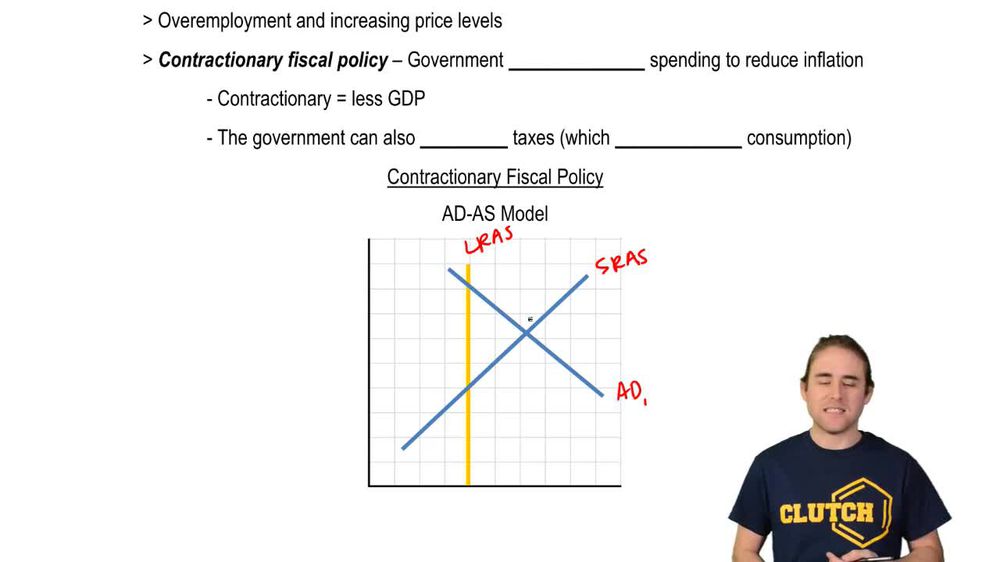
 03:48
03:48