Skip to main content
Microeconomics
My Course
Learn
Exam Prep
AI Tutor
Study Guides
Flashcards
Explore
Try the app
My Course
Learn
Exam Prep
AI Tutor
Study Guides
Flashcards
Explore
Try the app
Back
Exchange Rates: Shifts in Supply and Demand definitions
You can tap to flip the card.
Exchange Rate
You can tap to flip the card.
👆
Exchange Rate
Represents the price of one currency in terms of another, determining how much foreign currency can be obtained per unit.
Track progress
Control buttons has been changed to "navigation" mode.
1/15
Related flashcards
Recommended videos
Exchange Rates: Shifts in Supply and Demand quiz
Exchange Rates: Shifts in Supply and Demand
15 Terms
Guided course
05:01
Exchange Rates: Shifts in Supply
Guided course
06:48
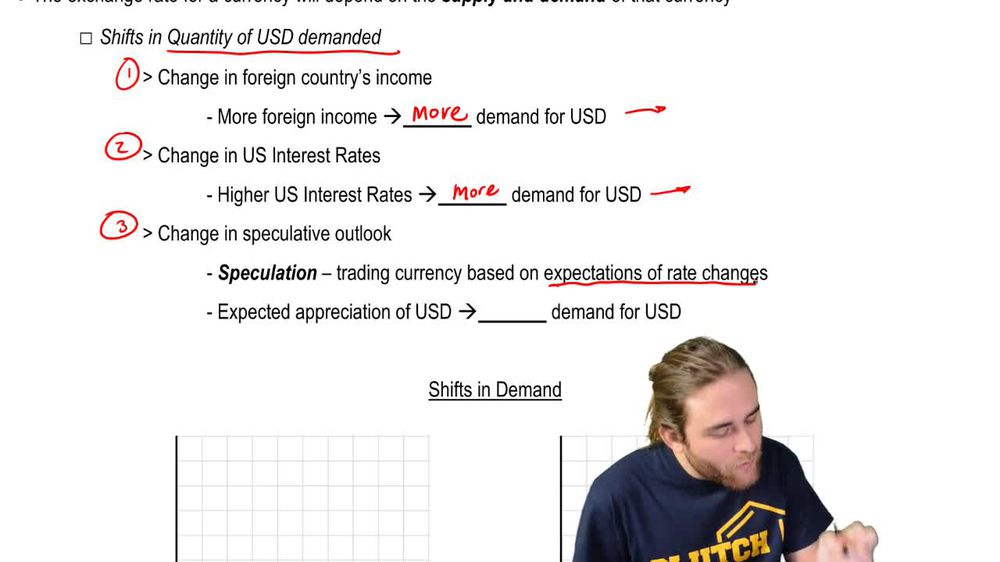
Exchange Rates: Shifts in Demand
Terms in this set (15)
Hide definitions
Exchange Rate
Represents the price of one currency in terms of another, determining how much foreign currency can be obtained per unit.
Equilibrium
Occurs where supply and demand for a currency intersect, establishing a stable exchange rate in the market.
Appreciation
Describes a situation where a currency increases in value, allowing more foreign currency to be obtained per unit.
Depreciation
Refers to a currency losing value, resulting in less foreign currency received per unit.
Supply Curve
Graphically shows the relationship between the quantity of a currency offered and its exchange rate.
Demand Curve
Illustrates how much of a currency is desired at various exchange rates by foreign buyers.
Foreign Exchange Market
A marketplace where currencies are traded, and exchange rates are determined by supply and demand.
Speculative Outlook
Reflects expectations about future currency values, influencing current buying or selling decisions.
Interest Rate
Represents the return on investments, affecting demand for a currency as investors seek higher yields.
Income
Indicates the purchasing power of individuals or countries, impacting their ability to buy foreign goods.
Import
Goods or services purchased from abroad, requiring the supply of domestic currency in exchange markets.
Export
Goods or services sold to foreign buyers, increasing demand for domestic currency in exchange markets.
Elasticity
Measures how sensitive supply or demand for a currency is to changes in exchange rates or economic factors.
Determinant
Underlying factor such as income, interest rates, or expectations that causes shifts in supply or demand curves.
Quantity
Amount of currency traded in the market, shown on the horizontal axis of supply and demand graphs.
 BackBack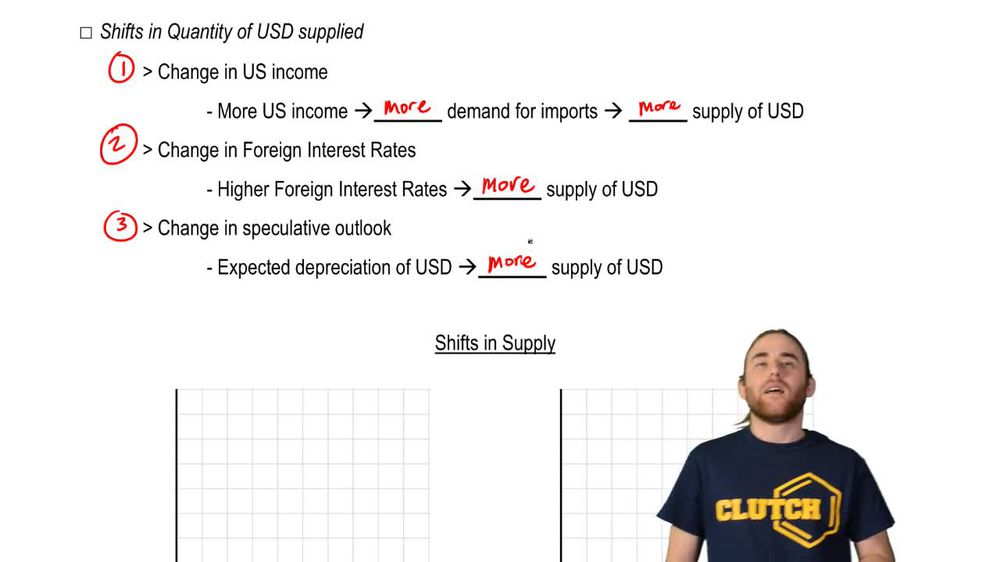
 05:01
05:01