Skip to main content
Microeconomics
My Course
Learn
Exam Prep
AI Tutor
Study Guides
Flashcards
Explore
Try the app
My Course
Learn
Exam Prep
AI Tutor
Study Guides
Flashcards
Explore
Try the app
Back
Exchange Rates: Nominal and Real quiz
You can tap to flip the card.
What does the nominal exchange rate represent?
You can tap to flip the card.
👆
What does the nominal exchange rate represent?
The nominal exchange rate is the rate at which one currency trades for another, reflecting the current market price.
Track progress
Control buttons has been changed to "navigation" mode.
1/15
Related flashcards
Recommended videos
Exchange Rates: Nominal and Real definitions
Exchange Rates: Nominal and Real
15 Terms
Guided course
09:46
Nominal and Real Exchange Rates
Terms in this set (15)
Hide definitions
What does the nominal exchange rate represent?
The nominal exchange rate is the rate at which one currency trades for another, reflecting the current market price.
What happens when a currency appreciates?
A currency appreciates when it can buy more of a foreign currency, meaning its value increases relative to the other currency.
What is currency depreciation?
Currency depreciation occurs when a currency can buy less of a foreign currency, indicating its value has decreased.
What is the relationship between appreciation and depreciation of two currencies?
When one currency appreciates, the other currency depreciates; this is always a vice versa effect.
How is the real exchange rate different from the nominal exchange rate?
The real exchange rate adjusts for price levels and shows the purchasing power by comparing the cost of goods across countries.
What does the real exchange rate focus on?
The real exchange rate focuses on the price of domestic goods in terms of foreign goods, measuring purchasing power.
How do you calculate the real exchange rate?
The real exchange rate is calculated as (Nominal Exchange Rate × Price Level Foreign) ÷ Price Level Domestic.
If the nominal exchange rate increases, what happens to the domestic currency?
If the nominal exchange rate increases, the domestic currency appreciates because it can buy more of the foreign currency.
What does a real exchange rate of 1 mean?
A real exchange rate of 1 means you can buy the same amount of goods in both countries with equivalent money.
How does a stronger domestic currency affect purchasing power abroad?
A stronger domestic currency increases purchasing power abroad, allowing you to buy more foreign goods for the same amount of domestic currency.
Why is it important to consider price levels when comparing exchange rates?
Price levels affect the real exchange rate and determine how much you can actually purchase with your currency in another country.
What units are left after calculating the real exchange rate?
After calculating the real exchange rate, the units are in terms of goods, not currencies.
What does the real exchange rate tell us about international trade?
The real exchange rate shows how many foreign goods one domestic good can buy, helping analyze trade and purchasing power.
What happens if prices are much higher overseas, even with a favorable nominal exchange rate?
If prices are higher overseas, a favorable nominal exchange rate may not result in greater purchasing power for goods.
What is the formula for the real exchange rate using currencies and price levels?
The formula is: Real Exchange Rate = (Nominal Exchange Rate × Price Level Foreign) ÷ Price Level Domestic.
 BackBack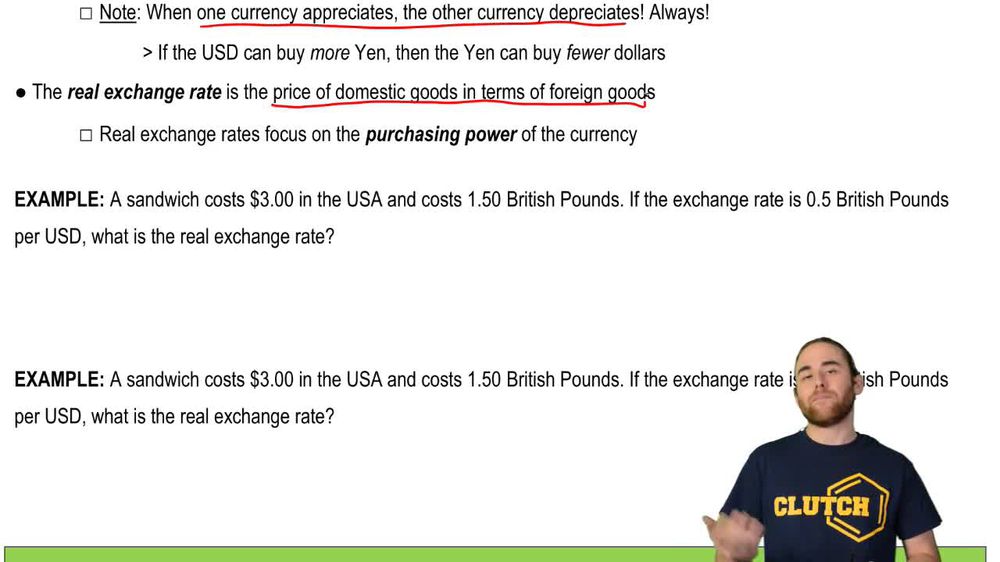
 09:46
09:46