Skip to main content
Microeconomics
My Course
Learn
Exam Prep
AI Tutor
Study Guides
Flashcards
Explore
Try the app
My Course
Learn
Exam Prep
AI Tutor
Study Guides
Flashcards
Explore
Try the app
Back
Exchange Rates: Introduction definitions
You can tap to flip the card.
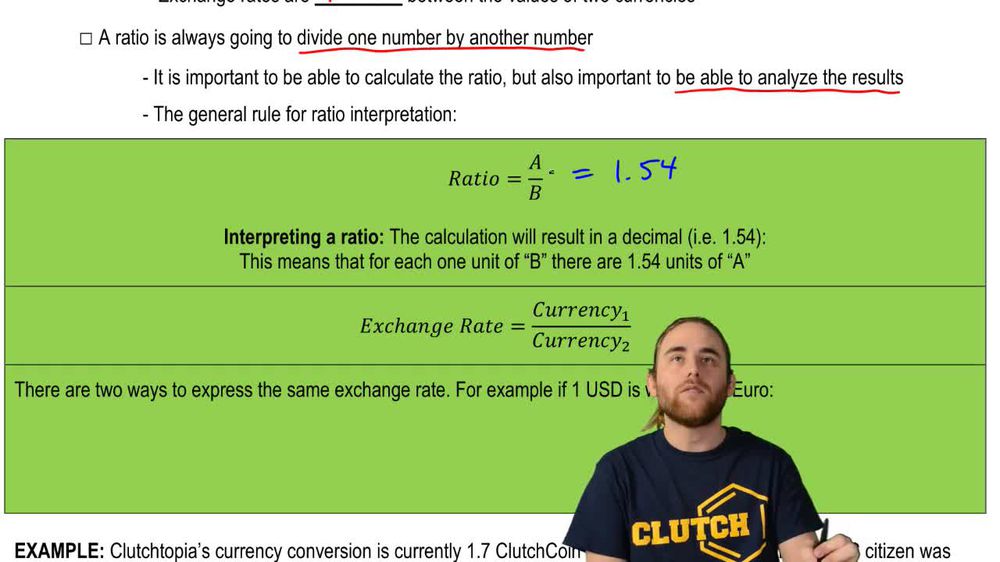
Exchange Rate
You can tap to flip the card.
👆
Exchange Rate
Ratio showing how much foreign currency can be obtained for one unit of domestic currency, crucial for international transactions.
Track progress
Control buttons has been changed to "navigation" mode.
1/14
Related flashcards
Recommended videos
Exchange Rates: Introduction quiz
Exchange Rates: Introduction
15 Terms
Guided course
06:12
Exchange Rates
1
views
Guided course
05:25
Exchange Rates: Introduction
1
views
Terms in this set (14)
Hide definitions
Exchange Rate
Ratio showing how much foreign currency can be obtained for one unit of domestic currency, crucial for international transactions.
Currency
Medium of exchange issued by a country, used to facilitate trade and value measurement in economic activities.
Ratio
Mathematical relationship expressing the relative value of two quantities, often used to compare currencies.
Denominator
Bottom part of a fraction or ratio, representing the reference unit in exchange rate calculations.
Numerator
Top part of a fraction or ratio, indicating the amount of foreign currency in exchange rate computations.
Domestic Currency
National monetary unit used within a country, often exchanged for foreign currency in international trade.
Foreign Currency
Monetary unit from another country, acquired through exchange for domestic currency.
Market Equilibrium
State where supply and demand for currencies balance, determining the prevailing exchange rate.
International Trade
Economic activity involving the exchange of goods, services, or currencies across national borders.
Comparative Advantage
Economic principle explaining how countries benefit from specializing in goods they produce most efficiently.
Division
Arithmetic operation used to calculate ratios, essential for determining exchange rates between currencies.
Interpretation
Process of understanding the meaning behind calculated ratios, especially in the context of currency values.
Unit
Standard measure used in exchange rate calculations, such as one dollar or one euro.
Value
Worth assigned to a currency, determined by its purchasing power relative to other currencies.
 BackBack
 06:12
06:12