Skip to main content
Microeconomics
My Course
Learn
Exam Prep
AI Tutor
Study Guides
Flashcards
Explore
Try the app
My Course
Learn
Exam Prep
AI Tutor
Study Guides
Flashcards
Explore
Try the app
Back
Dynamic AD-AS Model: Monetary Policy quiz
You can tap to flip the card.
What is the main tool used in monetary policy to influence aggregate demand in the dynamic AD-AS model?
You can tap to flip the card.
👆
What is the main tool used in monetary policy to influence aggregate demand in the dynamic AD-AS model?
The main tool is adjusting interest rates, typically by changing the money supply.
Track progress
Control buttons has been changed to "navigation" mode.
1/15
Related flashcards
Recommended videos
Dynamic AD-AS Model: Monetary Policy definitions
Dynamic AD-AS Model: Monetary Policy
15 Terms
Guided course
03:15
Dynamic AD-AS Model: Contractionary Monetary Policy
Guided course
04:37
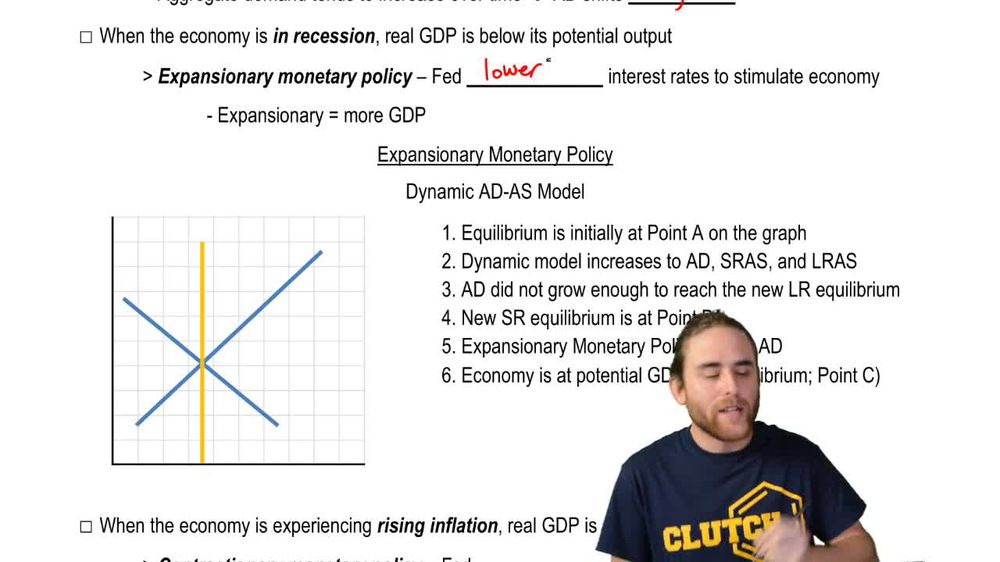
Dynamic AD-AS Model: Expansionary Monetary Policy
Terms in this set (15)
Hide definitions
What is the main tool used in monetary policy to influence aggregate demand in the dynamic AD-AS model?
The main tool is adjusting interest rates, typically by changing the money supply.
How does expansionary monetary policy affect interest rates and aggregate demand?
Expansionary monetary policy lowers interest rates, which increases aggregate demand by encouraging more investment and consumption.
When is expansionary monetary policy typically used in the dynamic AD-AS model?
It is used during a recession when output is below potential GDP to boost spending and reach long-run equilibrium.
What happens to the aggregate demand curve when the Fed implements expansionary monetary policy?
The aggregate demand curve shifts to the right, moving the economy toward long-run equilibrium.
How does contractionary monetary policy affect aggregate demand?
Contractionary monetary policy raises interest rates, which reduces aggregate demand by discouraging investment and consumption.
Why would the Fed use contractionary monetary policy in the dynamic AD-AS model?
The Fed uses it when the economy is beyond its potential GDP and inflation is rising, to pull back aggregate demand and control inflation.
What is the effect of higher interest rates on firms and households?
Higher interest rates make borrowing more expensive, so firms and households are less likely to take out loans for investment or consumption.
In the dynamic AD-AS model, what typically happens to long-run aggregate supply (LRAS) over time?
Long-run aggregate supply generally shifts to the right over time, reflecting economic growth.
What is the result if aggregate demand grows faster than long-run aggregate supply in the dynamic AD-AS model?
If aggregate demand grows faster, the economy can exceed potential GDP, leading to inflationary pressures.
How does the dynamic AD-AS model illustrate the return to long-run equilibrium after a shock?
Monetary policy shifts aggregate demand to restore equilibrium where LRAS, SRAS, and AD intersect.
What is the difference between fiscal and monetary policy in influencing aggregate demand?
Fiscal policy changes government spending, while monetary policy changes the money supply and interest rates.
What happens to the price level when aggregate demand increases too much in the dynamic AD-AS model?
The price level rises, leading to inflation in the short-run equilibrium.
What is the goal of monetary policy during a recession according to the dynamic AD-AS model?
The goal is to increase aggregate demand enough to reach long-run equilibrium and restore potential GDP.
How does contractionary monetary policy help stabilize the economy when output exceeds potential GDP?
It reduces aggregate demand, lowering inflation and bringing output back to potential GDP.
Why is the dynamic AD-AS model considered 'dynamic'?
Because it assumes that LRAS, SRAS, and AD all generally shift to the right over time, reflecting ongoing economic growth.
 BackBack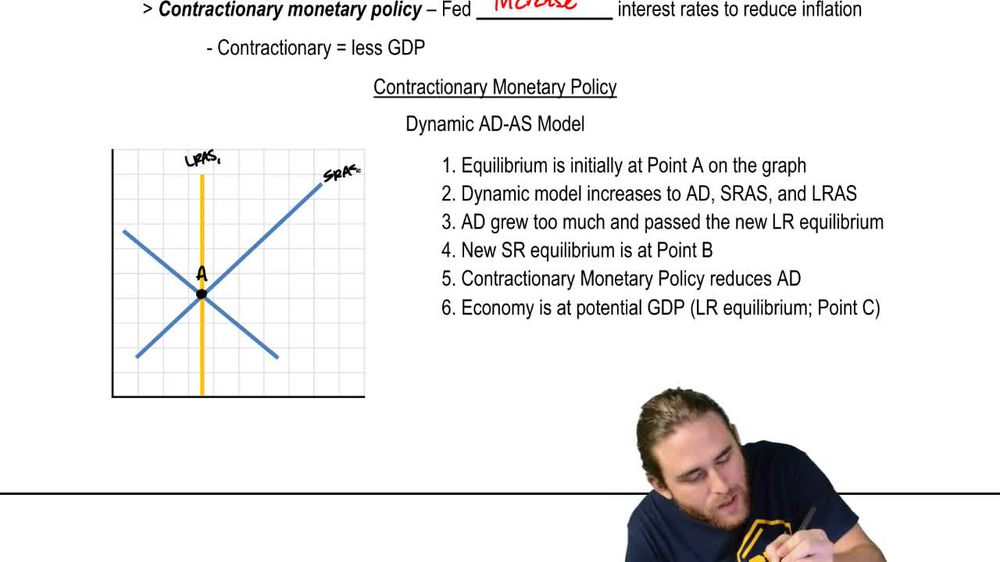
 03:15
03:15