Skip to main content
Microeconomics
My Course
Learn
Exam Prep
AI Tutor
Study Guides
Flashcards
Explore
Try the app
My Course
Learn
Exam Prep
AI Tutor
Study Guides
Flashcards
Explore
Try the app
Back
Differences in Wages definitions
You can tap to flip the card.
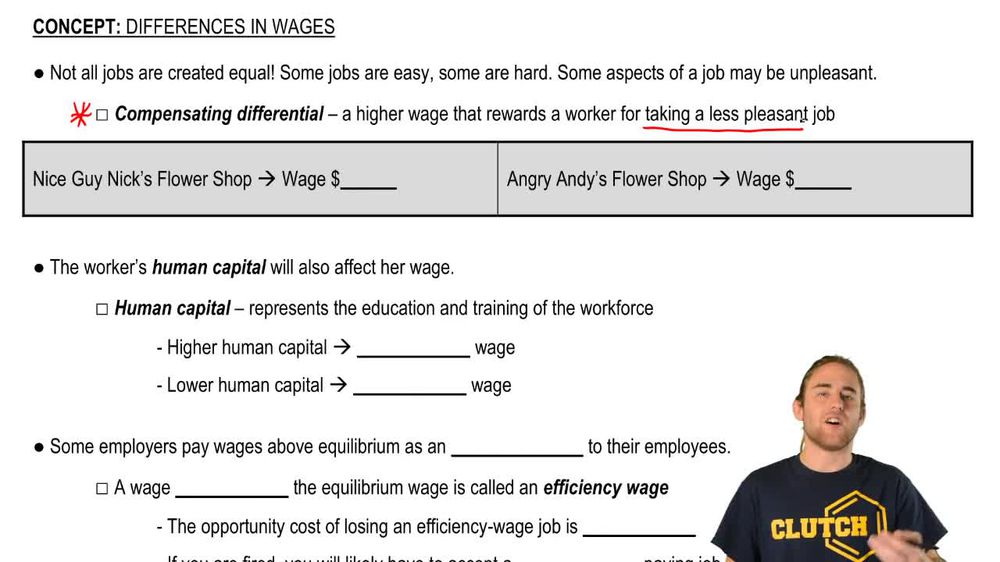
Compensating Differential
You can tap to flip the card.
👆
Compensating Differential
Extra payment offered to attract workers to less pleasant or riskier positions, rewarding them for undesirable job conditions.
Track progress
Control buttons has been changed to "navigation" mode.
1/15
Related flashcards
Related practice
Recommended videos
Differences in Wages quiz
Differences in Wages
15 Terms
Differences in Wages
15. Markets for the Factors of Production
10 problems
Topic
Other Factors of Production: Land and Capital
15. Markets for the Factors of Production
10 problems
Topic
15. Markets for the Factors of Production
10 topics
13 problems
Chapter
Guided course
04:12
Differences in Wages:Efficiency Wages and Superstars
4
views
Guided course
02:39
Differences in Wages:Compensating Differential and Human Capital
2
views
Terms in this set (15)
Hide definitions
Compensating Differential
Extra payment offered to attract workers to less pleasant or riskier positions, rewarding them for undesirable job conditions.
Human Capital
Accumulated education and training that enhances worker productivity and typically results in higher earnings.
Efficiency Wage
Payment set above market equilibrium to motivate employees, boost productivity, and reduce turnover.
Opportunity Cost
Value lost when choosing one job over another, especially relevant when leaving a high-paying position.
Equilibrium Wage
Market-determined payment where labor supply matches labor demand, absent outside influences.
Derived Demand
Need for labor that arises from the value and demand for the goods or services produced by workers.
Superstars
Individuals earning exceptionally high payments due to scarce skills and strong market demand for their output.
Supply
Availability of qualified workers for a particular job, influencing wage levels based on abundance or scarcity.
Demand
Employer need for workers, shaped by the value and popularity of the goods or services produced.
Turnover
Rate at which employees leave and are replaced, often reduced by higher payments or incentives.
Productivity
Worker output and efficiency, often increased by incentives such as higher payments or better training.
Market
Environment where labor and goods are exchanged, determining payment levels based on supply and demand.
Factors of Production
Inputs like labor, education, and training that contribute to creating goods and services.
Risk
Exposure to potential harm or unpleasant conditions in a job, often compensated with higher payments.
Educational Products
Outputs created by teachers, typically valued lower in the market compared to entertainment or sports.
 BackBack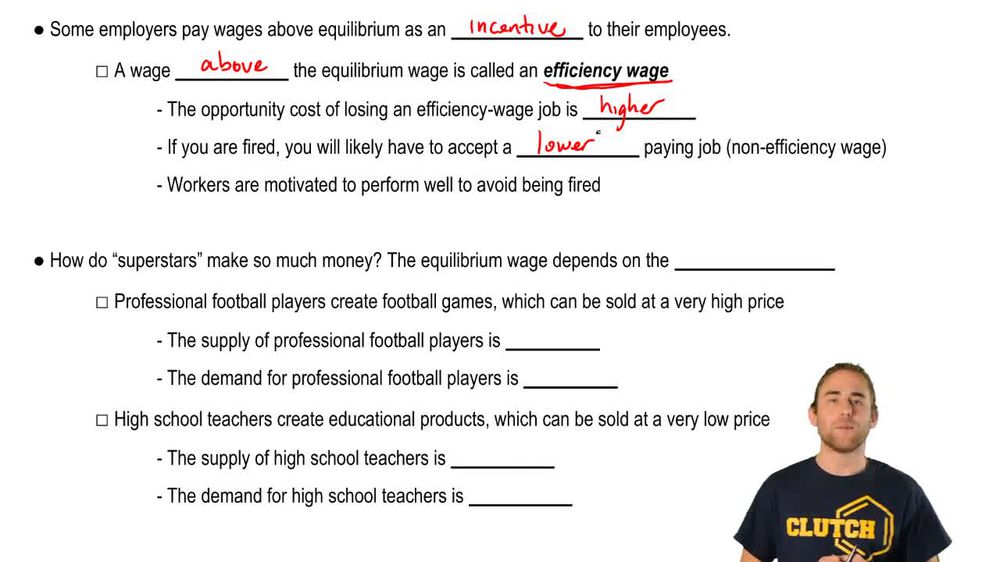
 04:12
04:12