Skip to main content
Microeconomics
My Course
Learn
Exam Prep
AI Tutor
Study Guides
Flashcards
Explore
Try the app
My Course
Learn
Exam Prep
AI Tutor
Study Guides
Flashcards
Explore
Try the app
Back
Determinants of Price Elasticity of Demand definitions
You can tap to flip the card.
Price Elasticity
You can tap to flip the card.
👆
Price Elasticity
Measures how much quantity demanded changes in response to a price change, reflecting consumer sensitivity.
Track progress
Control buttons has been changed to "navigation" mode.
1/14
Related flashcards
Related practice
Recommended videos
Determinants of Price Elasticity of Demand quiz #1
Determinants of Price Elasticity of Demand
26 Terms
Determinants of Price Elasticity of Demand
4. Elasticity
9 problems
Topic
Total Revenue Test
4. Elasticity
10 problems
Topic
4. Elasticity
11 topics
15 problems
Chapter
Guided course
06:12
Determinants of Price Elasticity of Demand
8
views
Terms in this set (14)
Hide definitions
Price Elasticity
Measures how much quantity demanded changes in response to a price change, reflecting consumer sensitivity.
Close Substitutes
Alternative products that consumers can easily switch to when prices change, increasing responsiveness.
Necessities
Essential goods that consumers continue to purchase even if prices rise, showing low responsiveness.
Luxuries
Non-essential goods that consumers can forgo when prices increase, showing high responsiveness.
Market Definition
Scope of a market, with narrower categories leading to greater sensitivity to price changes.
Narrow Market
A specific product category where demand is more sensitive to price changes due to available alternatives.
Broad Market
A wide product category where demand is less sensitive to price changes, as alternatives are within the same group.
Short Run
A period where consumers cannot easily adjust their consumption habits, resulting in low responsiveness.
Long Run
A period where consumers can adapt and find alternatives, increasing responsiveness to price changes.
Consumer Budget Share
Portion of income spent on a product; higher shares lead to greater sensitivity to price changes.
Quantity Demanded
Amount of a product consumers are willing to buy at a given price, influenced by various factors.
Utilities
Services with few alternatives, resulting in low responsiveness to price changes.
Alternative Products
Goods that can replace another in consumption, affecting how demand responds to price changes.
Responsiveness
Degree to which demand changes when price changes, shaped by several determinants.
 BackBack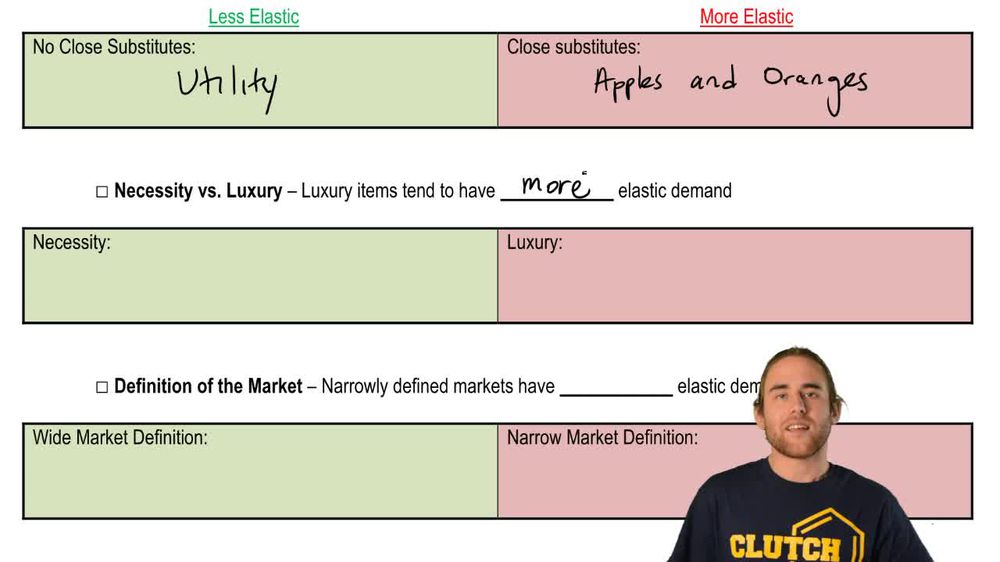
 06:12
06:12