Skip to main content
Microeconomics
My Course
Learn
Exam Prep
AI Tutor
Study Guides
Flashcards
Explore
Try the app
My Course
Learn
Exam Prep
AI Tutor
Study Guides
Flashcards
Explore
Try the app
Back
Determinants of Consumption and Saving definitions
You can tap to flip the card.
Consumption Function
You can tap to flip the card.
👆
Consumption Function
Graphical representation showing how spending changes as disposable income varies, influenced by factors beyond income.
Track progress
Control buttons has been changed to "navigation" mode.
1/13
Related flashcards
Recommended videos
Determinants of Consumption and Saving quiz
Determinants of Consumption and Saving
15 Terms
Guided course
05:13
Determinants of Consumption and Saving
1
views
Terms in this set (13)
Hide definitions
Consumption Function
Graphical representation showing how spending changes as disposable income varies, influenced by factors beyond income.
Disposable Income
Amount of money available for spending or saving after taxes, directly affecting household consumption levels.
Wealth
Accumulated assets such as stocks or real estate, whose unexpected changes can shift spending patterns.
Borrowing
Access to funds through loans, increasing current spending but reducing future financial resources due to repayment.
Interest Cost
Expense incurred from loans, decreasing future financial resources and influencing saving and spending decisions.
Expectations
Beliefs about future prices or income, prompting changes in current spending or saving behavior.
Recession
Period of economic decline, leading to reduced spending and increased saving as households prepare for uncertainty.
Real Interest Rate
Rate adjusted for inflation, affecting incentives to borrow or save and thus influencing current spending.
Credit
Ability to purchase goods or services now and pay later, often used more when borrowing costs are low.
Market Equilibrium
State where supply and demand balance, influenced by shifts in consumption and saving behaviors.
Economic Incentives
Factors motivating choices in spending or saving, shaped by changes in wealth, borrowing, and interest rates.
Marginal Propensity to Consume
Measure of how much additional income is spent rather than saved, reflected in the slope of the spending curve.
Slope
Steepness of the spending curve, indicating how responsive consumption is to changes in disposable income.
 BackBack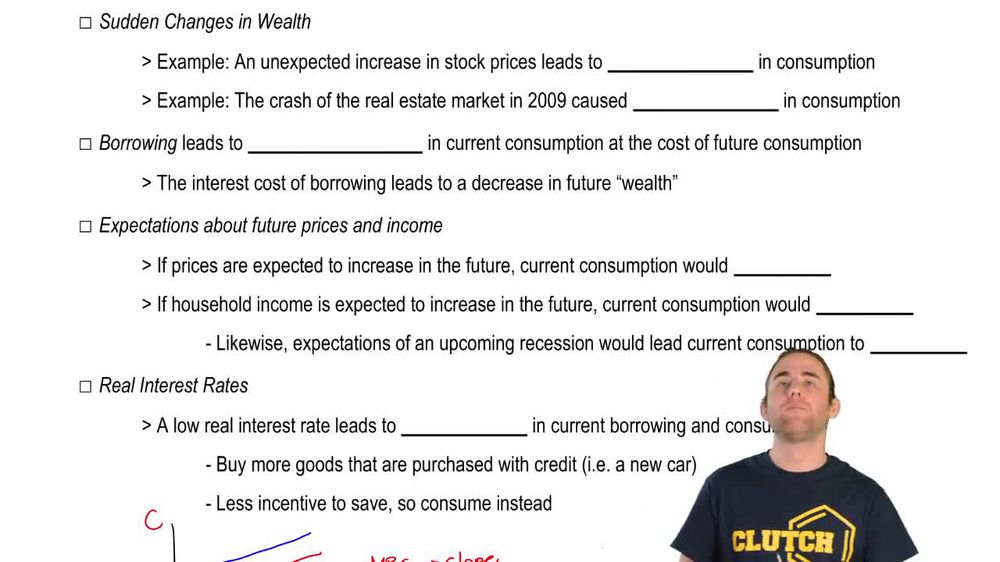
 05:13
05:13