Skip to main content
Microeconomics
My Course
Learn
Exam Prep
AI Tutor
Study Guides
Flashcards
Explore
Try the app
My Course
Learn
Exam Prep
AI Tutor
Study Guides
Flashcards
Explore
Try the app
Back
Cross-Price Elasticity of Demand definitions
You can tap to flip the card.
Cross Price Elasticity
You can tap to flip the card.
👆
Cross Price Elasticity
Measures how the demand for one item responds to a price change in another, revealing their relationship as substitutes, complements, or unrelated.
Track progress
Control buttons has been changed to "navigation" mode.
1/15
Related flashcards
Related practice
Recommended videos
Cross-Price Elasticity of Demand quiz #1
Cross-Price Elasticity of Demand
11 Terms
Cross-Price Elasticity of Demand
4. Elasticity
10 problems
Topic
Price Elasticity of Supply
4. Elasticity
10 problems
Topic
4. Elasticity
11 topics
15 problems
Chapter
Guided course
07:14
Cross-Price Elasticity of Demand
6
views
Terms in this set (15)
Hide definitions
Cross Price Elasticity
Measures how the demand for one item responds to a price change in another, revealing their relationship as substitutes, complements, or unrelated.
Substitutes
Goods where a price increase in one leads to higher demand for the other, indicated by a positive cross price elasticity.
Complements
Goods where a price increase in one causes lower demand for the other, shown by a negative cross price elasticity.
Unrelated Goods
Items whose price changes have no effect on each other's demand, resulting in a cross price elasticity of zero.
Midpoint Method
A calculation technique using averages of initial and final values to determine percentage changes for elasticity measures.
Quantity Demanded
The amount of a product consumers are willing to purchase at a specific price, used in elasticity calculations.
Numerator
The top part of the elasticity formula, representing the percentage change in quantity demanded.
Denominator
The bottom part of the elasticity formula, representing the percentage change in price of another good.
Percentage Change
A value showing how much a variable shifts relative to its average, crucial for elasticity calculations.
Positive Value
An elasticity result indicating that goods are substitutes, as both price and demand move in the same direction.
Negative Value
An elasticity result showing goods are complements, as price and demand move in opposite directions.
Zero Value
An elasticity outcome signifying no relationship between goods, as price changes do not affect demand.
Demand Shift
A change in consumer purchasing patterns due to external factors, such as price changes in related goods.
Elasticity Formula
An equation relating percentage changes in quantity and price to determine the responsiveness of demand.
Analysis
The process of interpreting elasticity results to classify goods as substitutes, complements, or unrelated.
 BackBack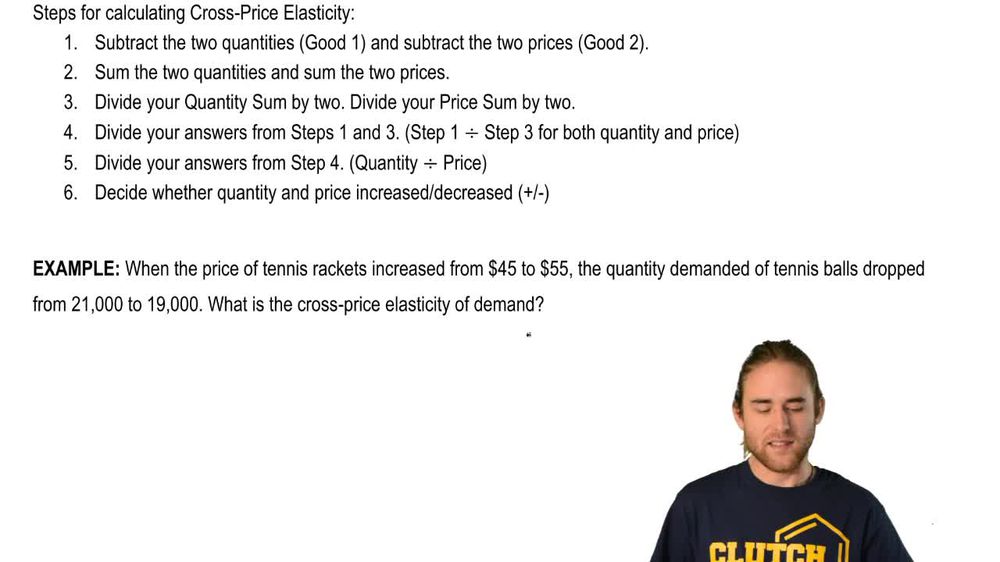
 07:14
07:14